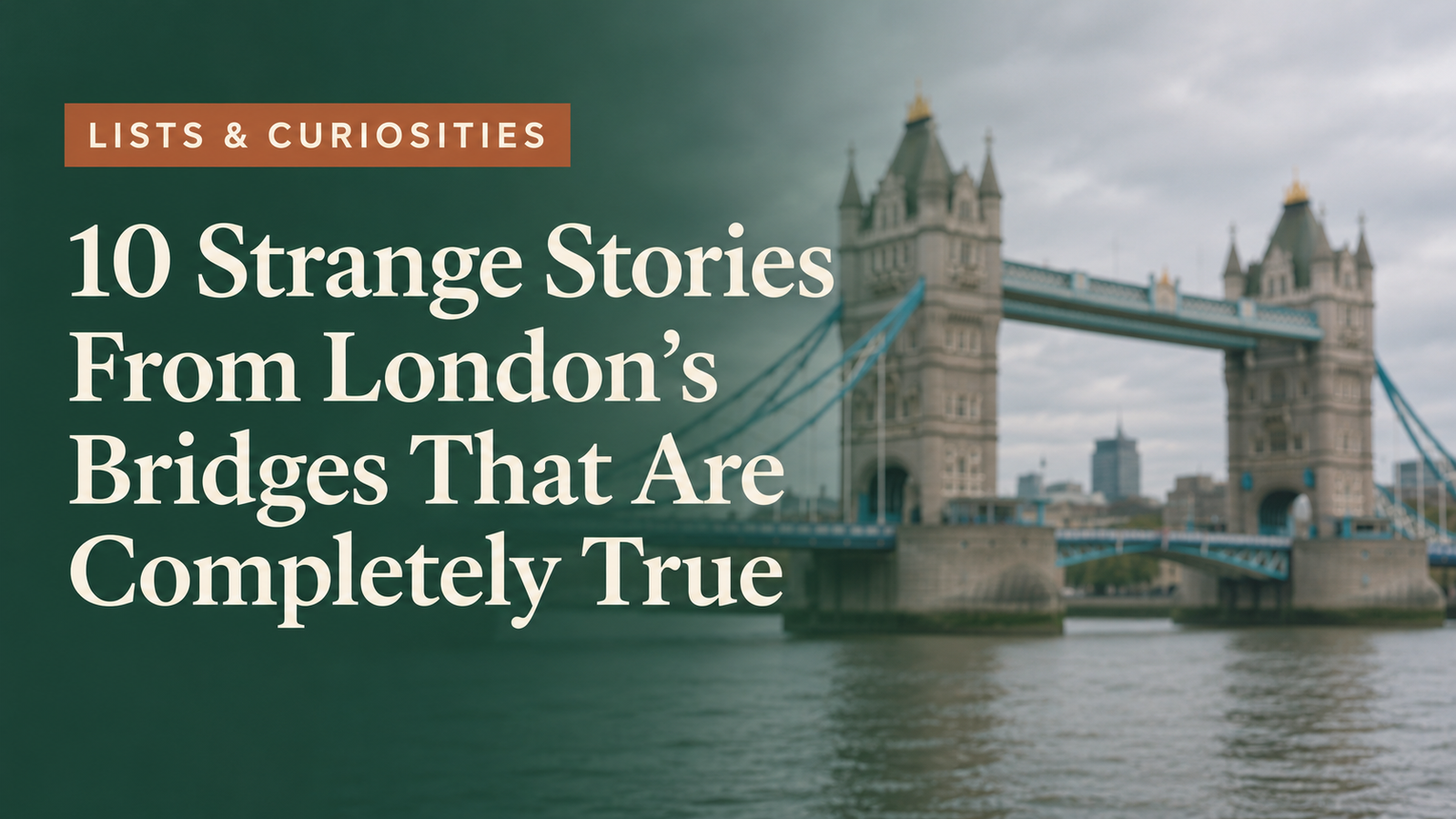
London’s bridges are meant to help people cross the city without incident. Most days, that is precisely what they do.
On less ordinary days, they have been jumped by a double decker bus, flown through by aircraft, crossed by hundreds of bouncing space hoppers and decorated with a bundle of straw. One London bridge was even dismantled, shipped across an ocean and rebuilt in the Arizona desert.
These stories sound like urban legends, but each one is supported by official histories, heritage records or contemporary accounts. Where the popular version has become exaggerated, we have separated the memorable truth from the added mythology.
The short version
London’s bridges have seen some things
A bus driver made a split second jump on Tower Bridge, troops are still ordered to change their step on Albert Bridge, sheep return to the City for an annual crossing and the remains of a vanished railway bridge still stand in the Thames.
01 · Tower Bridge
A double decker bus jumped Tower Bridge
On the evening of December 30, 1952, Albert Gunter was driving a number 78 bus across Tower Bridge when the road beneath him began to rise.
The bridge should have been closed to road traffic before its bascules started moving. On this occasion, the normal warning procedure failed and the bus was already on the northern bascule when it began lifting.
Gunter faced an unpleasant choice. He could stop and risk the bus sliding backward, or he could accelerate toward the other half of the bridge, which had not yet started rising.
He chose the second option.
The bus crossed the widening gap and landed heavily on the southern bascule. Passengers were thrown from their seats and those on board were taken to the hospital, but the bus remained upright and everyone survived.
The official Tower Bridge account of the bus jump records that the vehicle was traveling at only around 12 miles per hour. Gunter received £10 and a day off work for his quick thinking.
Not every detail reported after the incident agrees. Tower Bridge’s own page includes both a later recollection and a contemporary newspaper report that differ over the precise number and nature of the injuries. The essential part is not disputed: the bridge rose beneath a London bus, the driver kept moving and the vehicle reached the other side.
You can explore the bascules, machinery and history behind the incident through Tower Bridge.
02 · Tower Bridge
Pilots and wingsuit flyers have passed through Tower Bridge
The gap between Tower Bridge’s roadway and its high level walkways has attracted several people who viewed a famous landmark and apparently saw an aerial obstacle course.
On August 10, 1912, aviation pioneer Frank McClean flew a Short Farman seaplane along the Thames and passed between the roadway and upper walkways. He continued under other bridges toward Westminster. A side wind caught the aircraft during his return journey and put it into the river, but McClean escaped without injury.
On April 5, 1968, Royal Air Force pilot Alan Pollock flew a Hawker Hunter jet through the same space. The unauthorized flight was partly a protest over defense policy and what Pollock considered inadequate plans for the RAF’s fiftieth anniversary.
The bridge received a new kind of airborne visitor on May 12, 2024. Marco Fürst and Marco Waltenspiel became the first people to fly wingsuits through Tower Bridge. They passed between the towers before opening their parachutes and landing safely.
The official history of daring feats at Tower Bridge includes these attempts and several other incidents. None should be treated as an invitation to plan a repeat performance.
One bridge, several escape routes
Road, river or sky?
Tower Bridge has carried everyday traffic above the Thames, opened for vessels below and, on a handful of remarkable occasions, had aircraft pass through the space between its roadway and walkways.
03 · Millennium Bridge
Six hundred people crossed Millennium Bridge on space hoppers
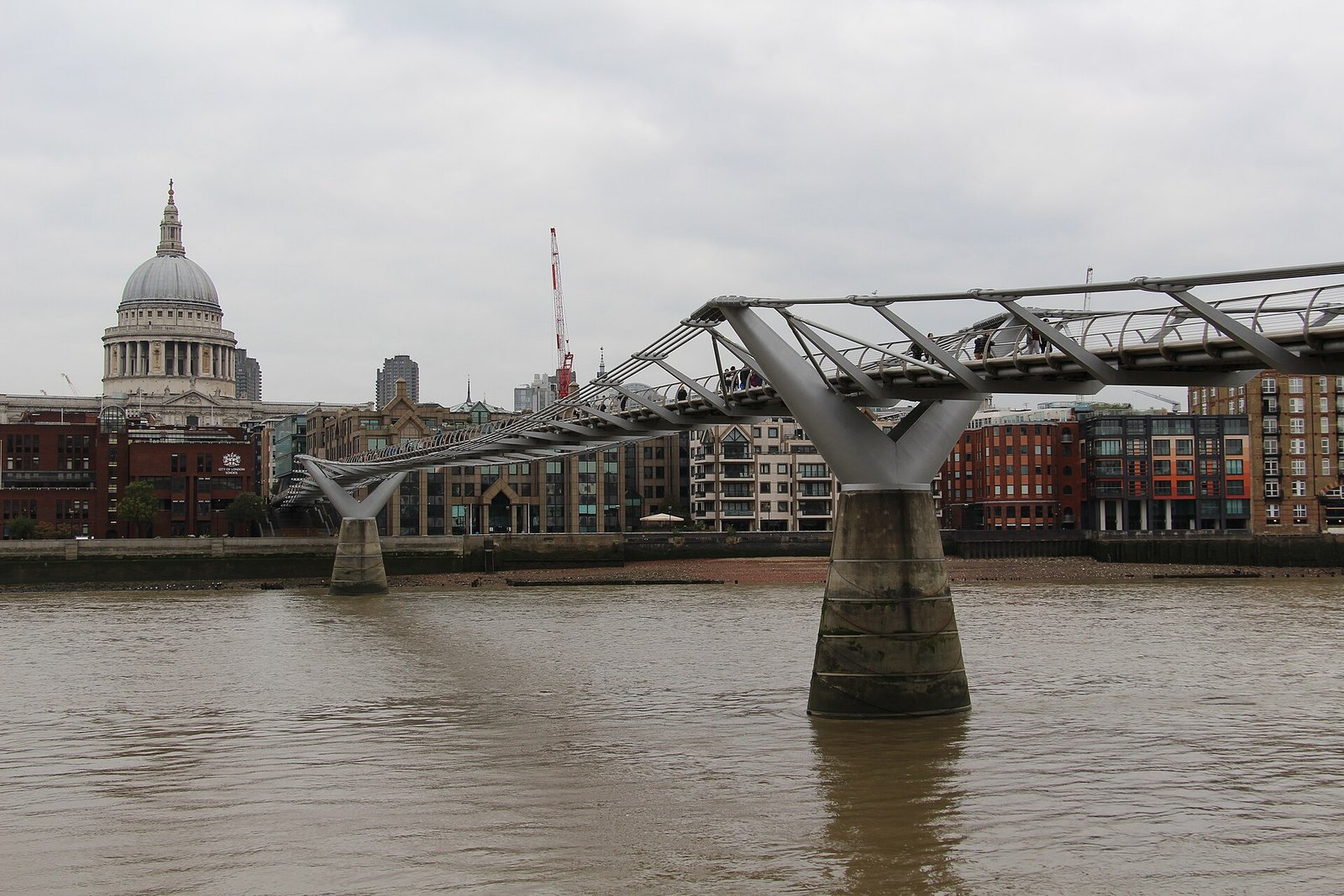
Millennium Bridge is remembered for the unexpected movement that earned it the nickname “the Wobbly Bridge.” In April 2007, however, the bouncing was intentional.
Six hundred people assembled on the bridge with specially made gold space hoppers. They bounced simultaneously for 60 seconds, breaking the world record for the largest space hopper event at the time.
The spectacle was a publicity event for television channel UKTV Gold, but the record attempt was real. Contemporary photographs show the bridge covered with rows of people sitting on matching golden hoppers.
The event appears in the City Bridge Foundation’s official collection of 25 Millennium Bridge facts. A contemporary report from London SE1 records the 2007 world record attempt.
04 · Millennium Bridge
A bundle of straw was hung beneath Millennium Bridge
In October 2023, people walking beside the Thames noticed a large bundle of straw hanging beneath Millennium Bridge.
It was not an art installation, a harvest decoration or an unexplained piece of river folklore. It was a navigational warning.
Maintenance work temporarily reduced the available headroom beneath the bridge. Thames Byelaw 36.1 requires a bridge owner to suspend a bundle of straw during daylight when work affects the space available to vessels. At night, a white light performs the same job.
The rule survives because it communicates a physical danger without requiring a boat operator to read a sign while moving on the river. A conspicuous object hanging at the restricted height shows precisely where the problem begins.
The Port of London Authority guide to bridges on the tidal Thames includes the straw requirement. City Bridge Foundation also confirms that the bundle was displayed during work to replace a protective membrane between Millennium Bridge’s aluminum deck and steel structure.
Not quite an ancient law
An old fashioned warning in a modern rulebook
News reports often described the straw requirement as an ancient law. Its appearance certainly feels medieval, but the important point is that it remains part of the Port of London’s working navigation rules.
05 · Albert Bridge
Albert Bridge tells marching troops to break step
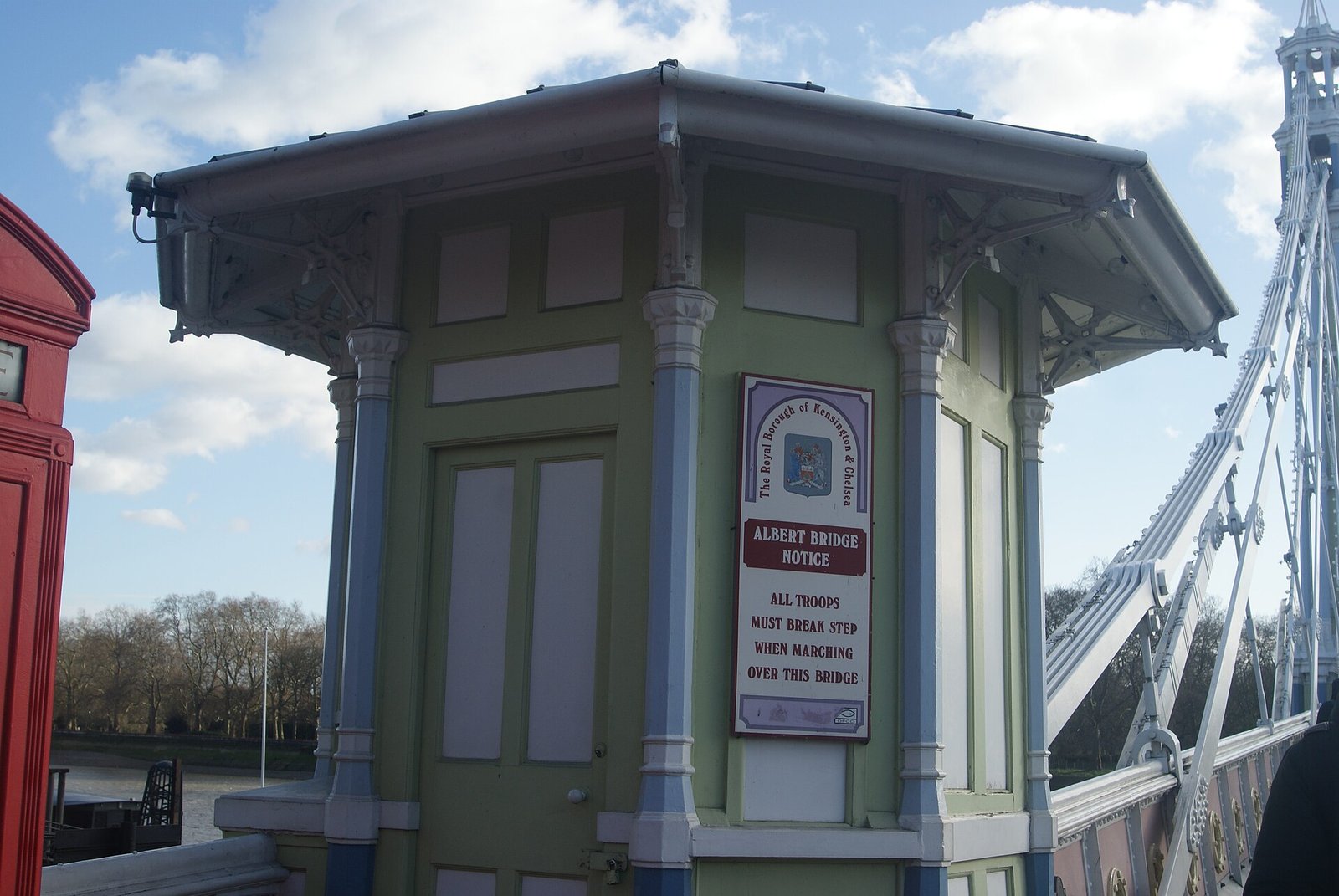
Signs attached to Albert Bridge carry an unusual instruction:
“All troops must break step when marching over this bridge.”
When a group marches in time, every footfall applies force in the same rhythm. If that rhythm matches a bridge’s natural movement, the repeated forces can amplify its vibration. Breaking step removes the shared rhythm.
Albert Bridge became known as the “Trembling Lady” because of its tendency to vibrate when large numbers of people crossed. Its proximity to Chelsea Barracks made marching soldiers a practical concern, so troops were instructed to change their step before crossing.
The warning remains, although the surviving signs are not Victorian originals. Historic England’s Albert Bridge listing describes them as modern signs attached to the bridge’s original tollbooths. The London Museum history of Albert Bridge explains the bridge’s vibration and its enduring nickname.
The crossing combines suspension, cable stayed and beam bridge elements, making its structure almost as unusual as its surviving warning signs.
06 · London Bridge and Southwark Bridge
Sheep still cross bridges into the City of London
In medieval London, livestock farmers brought animals across London Bridge on their way to markets in the City. Freemen of the City were exempt from the bridge toll paid by other traders.
That history has developed into the famous claim that a Freeman can drive sheep across London Bridge whenever the mood takes them. The modern reality is more organized.
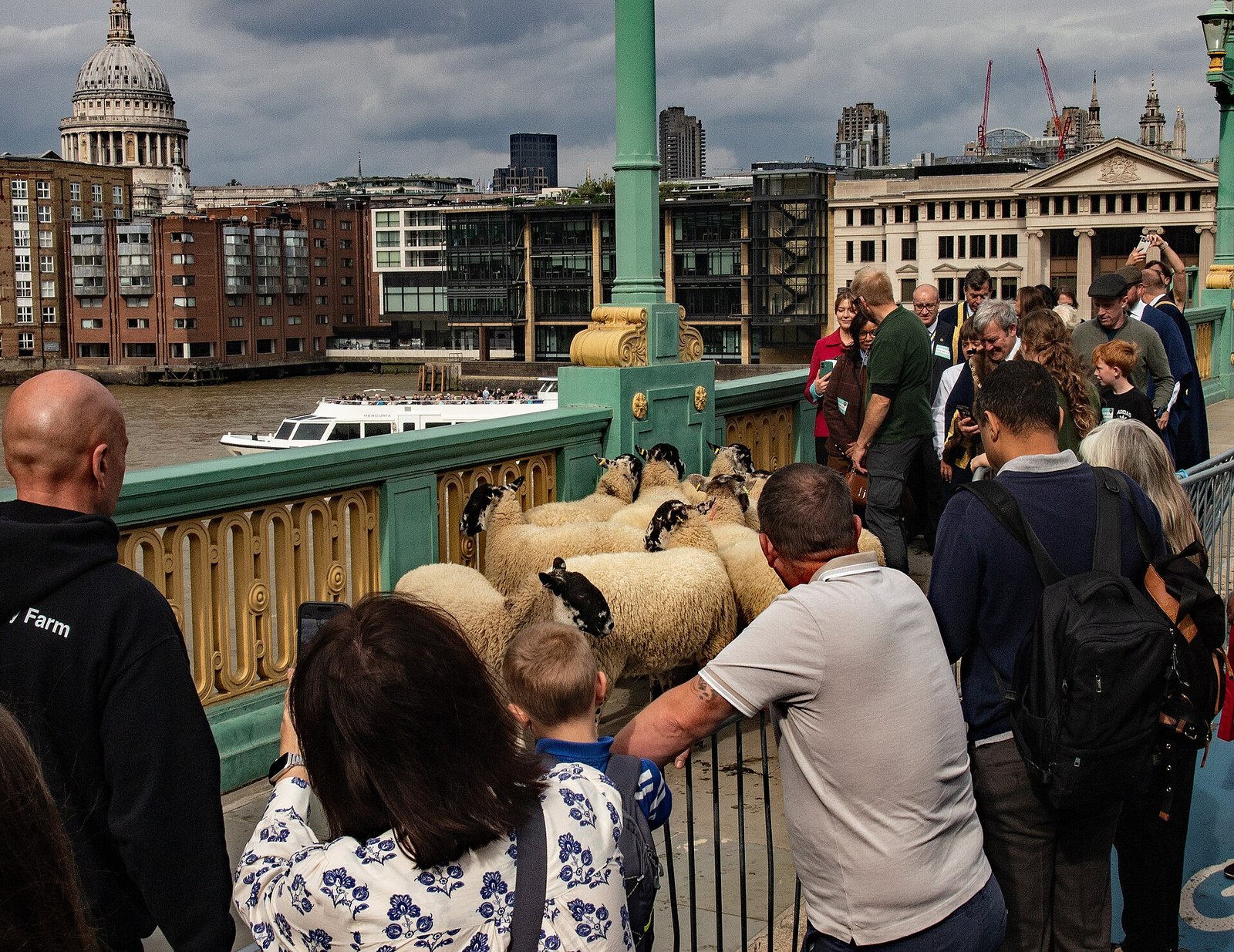
In 2013, the Worshipful Company of Woolmen arranged the first official modern Sheep Drive for Freemen and their guests. The charity event has continued with road restrictions, registered participants, animal welfare arrangements and a carefully managed flock.
The event is associated with London Bridge, but modern editions have also taken place on other City crossings, including Southwark Bridge. It is a planned recreation of a historic trading tradition, not a standing invitation to arrive at a bridge with several sheep.
The Woolmen’s history of the London Sheep Drive carefully distinguishes the historic toll exemption from the organized event held today.
07 · London Bridge, Arizona
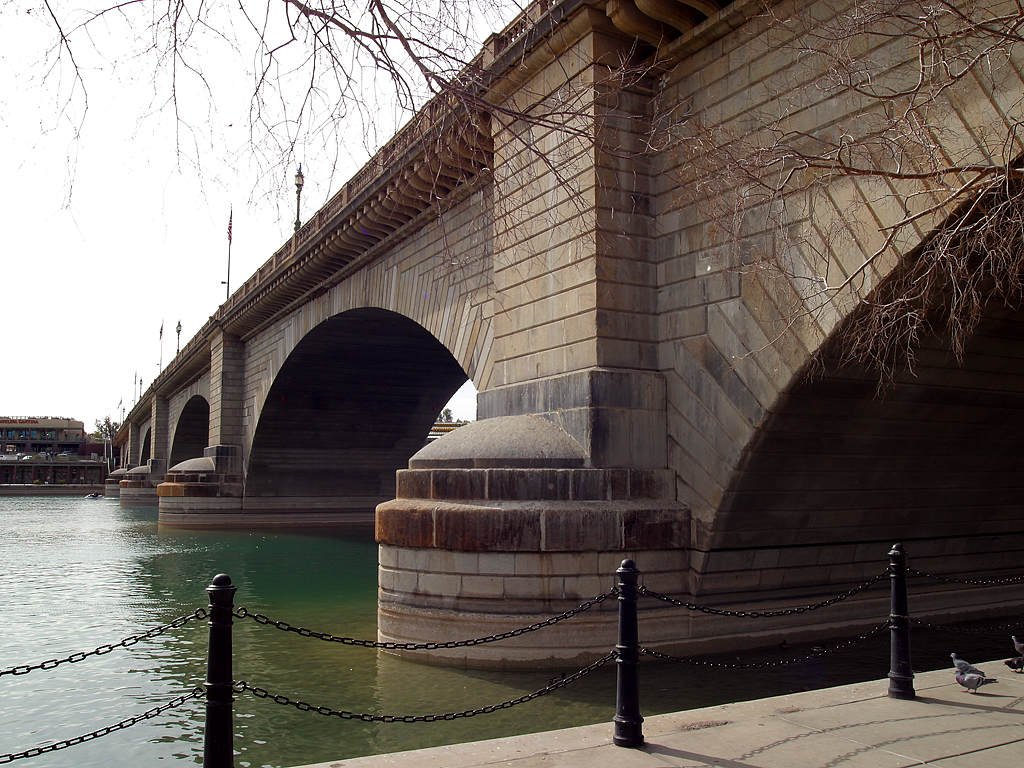
London Bridge was rebuilt in the Arizona desert
The London Bridge completed in 1831 eventually became unsuitable for the volume and weight of modern traffic. When the City of London decided to replace it, the historic structure was offered for sale.
American industrialist Robert P. McCulloch bought it in 1968 for more than $2.4 million. The popular version says the bridge was moved stone by stone and reassembled exactly as it had stood across the Thames. The true engineering story is slightly different and far more interesting.
The historic granite facing stones were marked, shipped to the United States and placed around a new reinforced concrete bridge. The Arizona structure therefore combines material from the London crossing with a modern load bearing core.
It was reconstructed on dry land beside Lake Havasu. Once the bridge was in place, the ground beneath it was dredged to form Bridgewater Channel. Water arrived after the bridge.
The completed crossing was formally dedicated on October 10, 1971. It now links the mainland of Lake Havasu City with an island created by the channel.
The Historic American Engineering Record for London Bridge documents the concrete structure and original granite cladding. Lake Havasu City’s official city history confirms that the bridge was built before the channel beneath it was dredged.
For the complete journey, read our article about how London Bridge ended up in Arizona or visit London Bridge, Arizona.
Myth checked
It is old London Bridge, but it is not only old London Bridge
The granite facing, balustrades and other historic elements came from London. The structure carrying modern traffic in Arizona is reinforced concrete. Describing it as either completely original or completely fake misses the clever part of the story.
08 · Rolling Bridge
Rolling Bridge was inspired by the moving tails in Jurassic Park
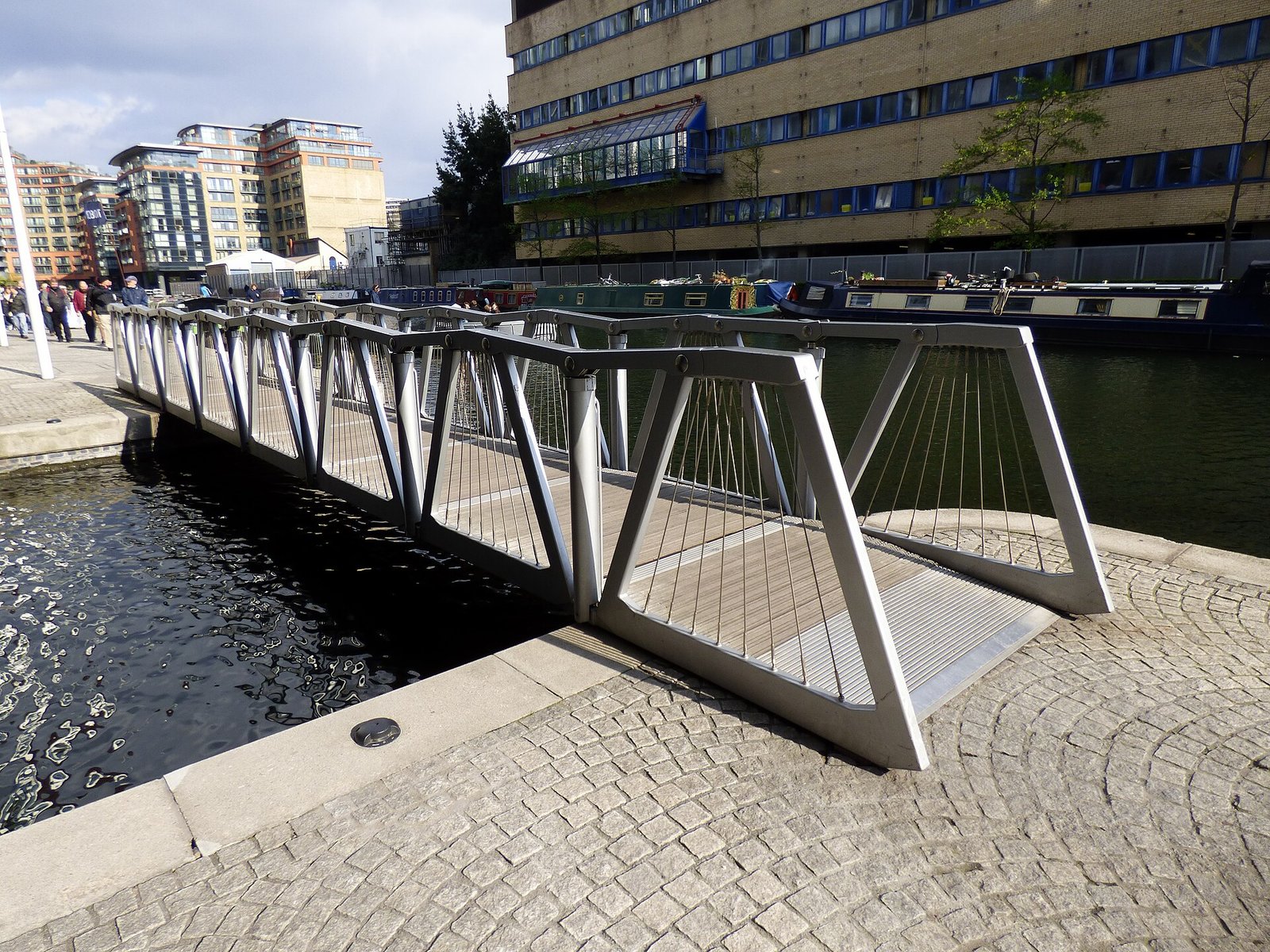
Most opening bridges lift, rotate or divide in the middle. Paddington’s Rolling Bridge curls itself into a compact sculptural shape.
Heatherwick Studio wanted a bridge that would leave the waterway completely clear without appearing to break apart. The designers found an unlikely source of inspiration in the fluid, coiling tails of the animatronic dinosaurs created for the Jurassic Park films.
Hydraulic machinery folds the linked steel sections upward until the ends meet and the walkway forms a raised circular shape. The machinery is concealed within the bridge and operates with surprisingly little noise.
The 12 meter bridge was completed in 2004. Its name can be slightly misleading because it does not roll along the ground. The bridge rolls itself up.
Heatherwick Studio’s Rolling Bridge project history explains both the dinosaur inspiration and the effort to create a softer form of movement.
If you are planning a visit, our guide explains how to see Paddington’s moving bridges.
09 · Vauxhall Bridge
Vauxhall Bridge hides eight enormous bronze figures
Someone can cross Vauxhall Bridge every day without seeing its most important decoration.
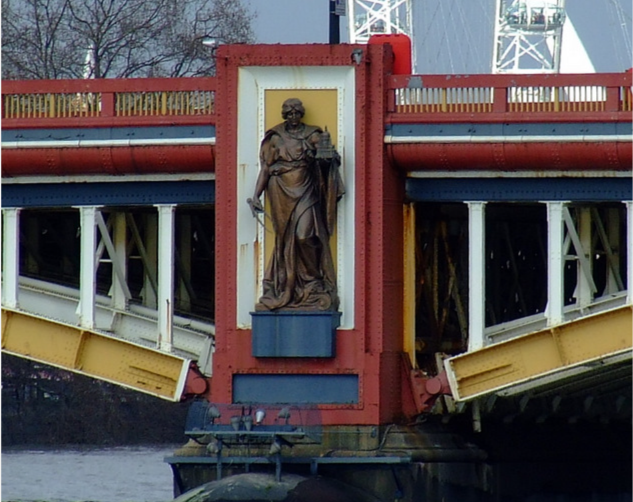
Eight bronze female figures are mounted against the bridge’s river piers, below the level of the roadway. They face the water rather than the people and traffic passing above.
The four upstream figures by Frederick Pomeroy represent Agriculture, Architecture, Engineering and Pottery. Architecture holds a model of St Paul’s Cathedral. Engineering carries a detailed steam engine and a mallet.
Alfred Drury’s four downstream figures represent Government, Education, Fine Art and Science, which is also described in some records as Astronomy.
Their position makes the sculptures difficult to appreciate from the bridge itself. Better views are available from the Thames Path, a boat or another crossing.
Historic England’s listing for Vauxhall Bridge considers the sculptures one of the principal reasons for its Grade II* designation and describes them as unique among British river crossings.
The crossing also appears in our guide to hidden figures and symbols on London’s bridges, alongside nine other details worth finding.
10 · Blackfriars Railway Bridge
The remains of a vanished railway bridge still stand in the Thames
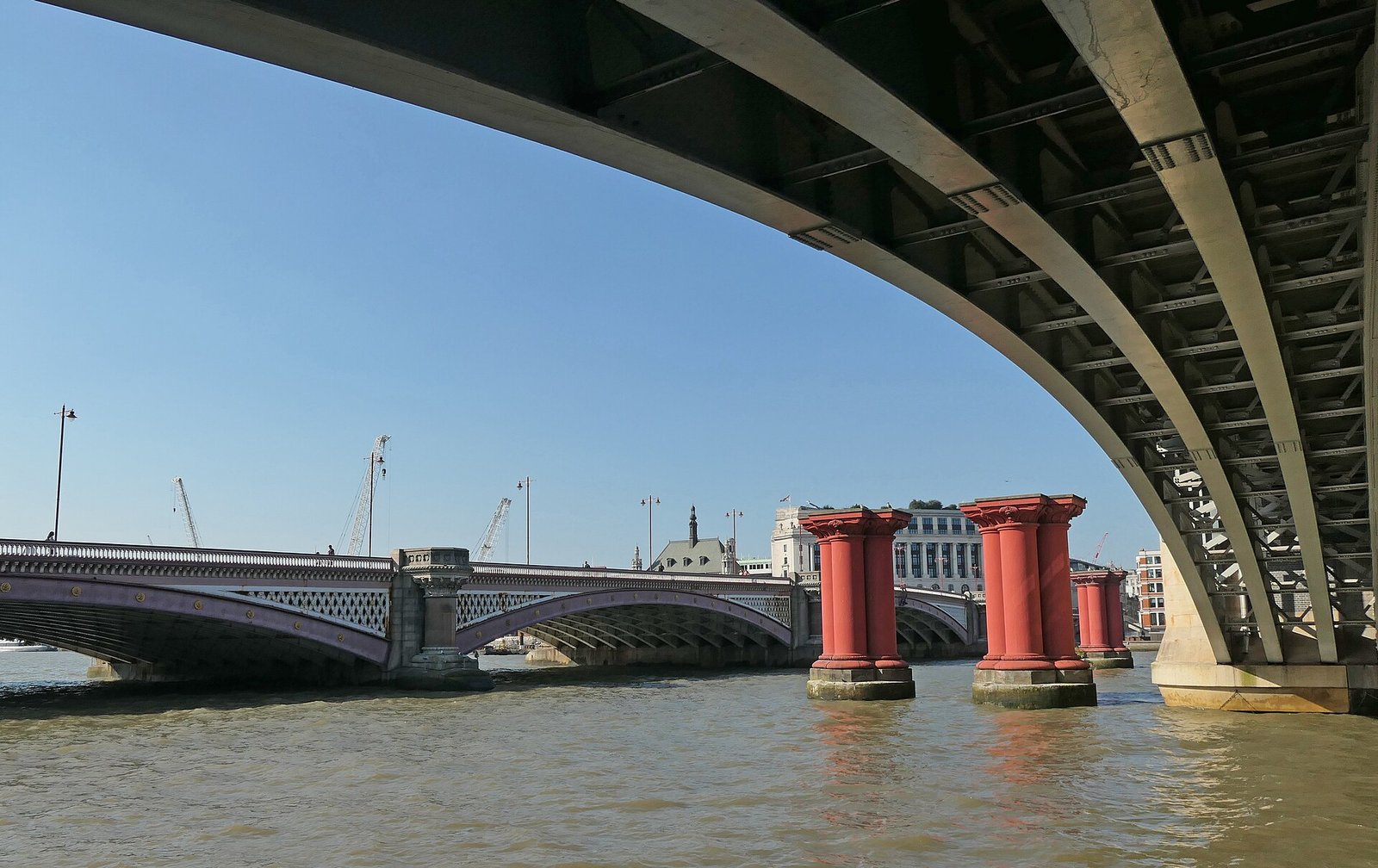
Beside Blackfriars Railway Bridge is a line of red columns that appears to be waiting for a bridge deck that never arrived.
These are the remains of the original Blackfriars Railway Bridge, which opened in December 1864. The wrought iron lattice girder bridge carried trains across the Thames for the London, Chatham and Dover Railway.
A second railway bridge opened beside it in 1886. As trains became heavier, the older crossing was considered too weak for modern traffic. Its main structure was dismantled during the mid 1980s.
The river columns were not removed. They remain in a line beside the working railway bridge, along with surviving abutment details and cast iron shields carrying the insignia of the former railway company.
The result is one of London’s strangest bridge views: the supports of one Victorian railway crossing standing beside the bridge that replaced it.
The National Transport Trust history of Blackfriars Railway Bridge documents the original crossing and its surviving remains. Historic England’s archive also records the piers of the vanished 1864 railway bridge.
The surviving columns make it possible to read the old and current crossings together, even though only one of them still carries trains.
More than a way across
London’s bridges are full of unexpected stories
Bridges are usually described through dates, materials and measurements. Those details matter, but they are only the beginning. The best bridge stories come from what people have attempted, forgotten, misunderstood or left behind.
Browse The Bridge Atlas collection to discover more famous landmarks, overlooked crossings and bridges hiding in plain sight.
Research
Sources and further reading
Explore the official histories, heritage records and specialist sources used to check these strange but true bridge stories.
-
The day a bus jumped Tower Bridge
Tower Bridge -
Daring feats at Tower Bridge
Tower Bridge -
Twenty five facts about Millennium Bridge
City Bridge Foundation -
Mariners’ guide to bridges on the tidal Thames
Port of London Authority -
Albert Bridge and the “Trembling Lady”
London Museum -
Albert Bridge heritage listing
Historic England -
History of the Woolmen Sheep Drive
Woolmen Sheep Drive and Livery Fair -
Historic American Engineering Record for London Bridge
Library of Congress -
Lake Havasu City history
Go Lake Havasu -
Design history of Rolling Bridge
Heatherwick Studio -
Vauxhall Bridge heritage listing
Historic England -
History of Blackfriars Railway Bridge
National Transport Trust
Information checked November 17, 2026.