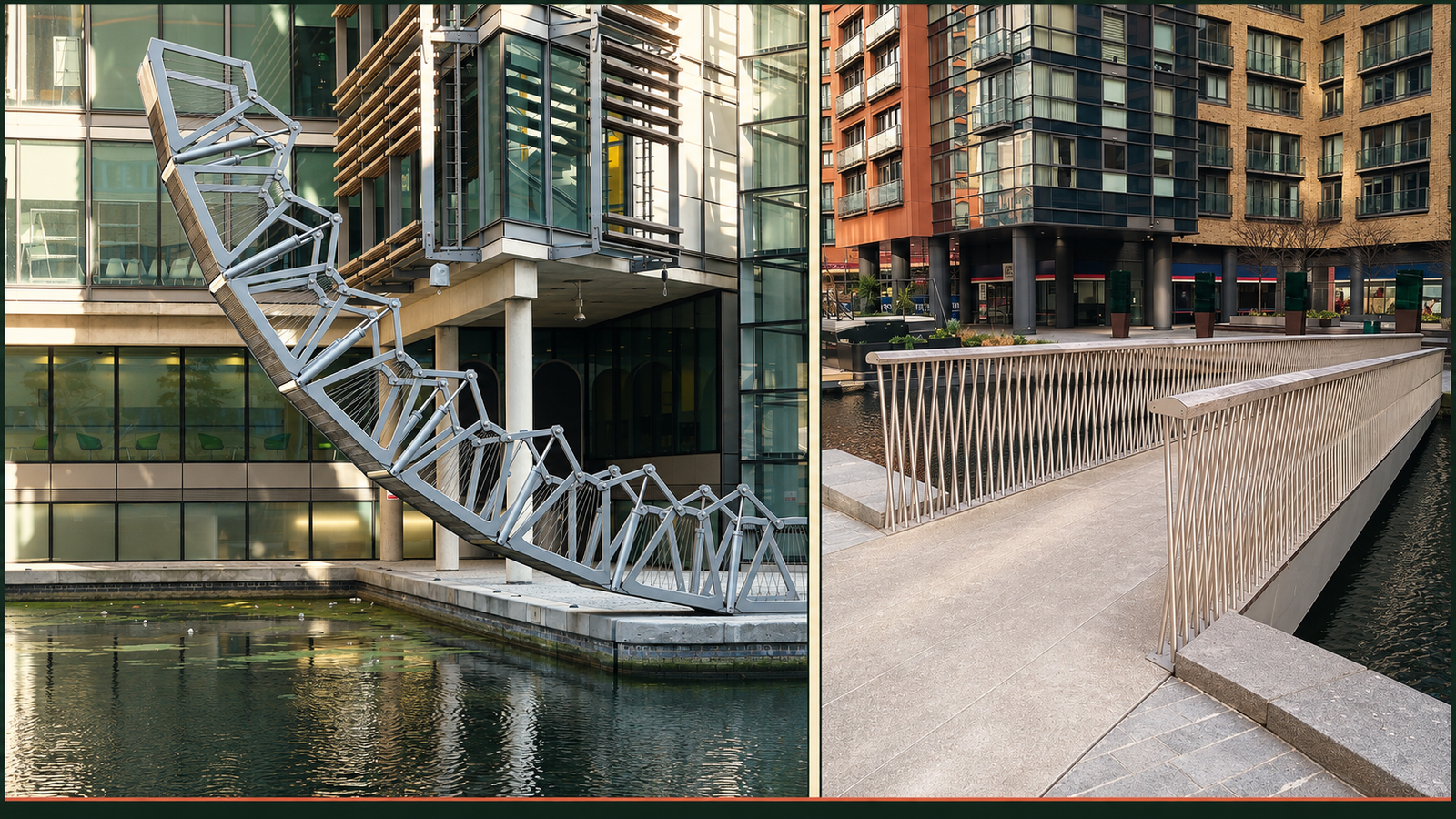
Paddington has two bridges that refuse to behave like ordinary bridges. One opens like a giant hand fan. The other curls into an octagon and appears to pack itself away beside the canal.
Fan Bridge and Rolling Bridge sit only a few minutes apart at Paddington Basin. Both are free to visit, both work as everyday pedestrian crossings, and both become pieces of moving public art when their mechanisms are activated.
This guide explains how to find them, what makes each bridge different and why you should check their operating status before traveling specifically to watch them move.
Plan your visit
Paddington’s moving bridges at a glance
Number of bridges
Two
Time needed
About 30 minutes, or one hour with a basin walk
Cost
Free
Nearest stations
Paddington and Edgware Road
Distance apart
Roughly 200 meters
Best starting point
Fan Bridge at Merchant Square
Current operating information
Check before traveling to see the bridges move
Published information is currently inconsistent. The Paddington Partnership states that Rolling Bridge is out of action, while its Fan Bridge page continues to list scheduled demonstrations.
Both bridges can still be visited and photographed when stationary. Do not make a special journey solely to watch them move without checking the latest information from Merchant Square shortly before leaving.
Where are Paddington’s moving bridges?
Fan Bridge and Rolling Bridge stand beside Paddington Basin, an eastern arm of the Grand Union Canal behind Paddington station.
The bridges are part of the public waterside area around Merchant Square. They are close enough to visit together without needing public transportation between them.
Fan Bridge crosses the main head of the basin near Merchant Square. Rolling Bridge spans a much smaller inlet a short walk farther west. Both can be easy to overlook when lowered because they resemble ordinary modern footbridges from some angles.
The official Paddington area map is useful for finding the basin, its public paths and nearby step free routes.
How do you walk from Fan Bridge to Rolling Bridge?
Starting with Fan Bridge creates the simplest route for visitors approaching along Praed Street and South Wharf Road.
The short walking route
See both bridges in five simple steps
1
Enter Paddington Basin
From Paddington station, head toward Praed Street and South Wharf Road, then follow the signs and public paths toward Merchant Square and the canal.
2
Find Fan Bridge
Fan Bridge crosses the head of the basin beside Merchant Square. When lowered, look for the five gray deck sections and the sculpted counterweights at one end.
3
Cross Fan Bridge
Walk across when the bridge is lowered. If it is being prepared for an opening, follow instructions from the bridge operators and remain behind any barriers.
4
Turn left beside the water
Follow the public waterside route west along Paddington Basin. The walk between the two bridges takes only a few minutes.
5
Look for the small inlet
Rolling Bridge crosses a short side inlet rather than the full canal. Its modest size makes it surprisingly easy to walk past when it is lying flat.
If you approach from Bishop’s Bridge Road or Little Venice, you may reach Rolling Bridge first. The route works equally well in either direction.
What happens when Fan Bridge opens?
Fan Bridge is the larger and more theatrical of the two crossings. Its 20 meter walkway is divided lengthwise into five steel sections.
Hydraulic cylinders lift the sections at different speeds and to different heights. As they separate, the bridge takes on the shape of a traditional Japanese hand fan rising above the canal.
Large counterweights help balance the steel sections and reduce the power needed to move them. The highest section rises steeply while the others stop at progressively lower angles.
When the bridge closes, the five sections meet to create one continuous pedestrian walkway. Read about its design, construction and canal delivery in our complete Fan Bridge, London profile.
What happens when Rolling Bridge moves?
Rolling Bridge performs a completely different trick. Instead of separating into long blades, its walkway is divided into eight short hinged sections.
Hydraulic cylinders hidden within the bridge pull the sections together. The walkway rises from its unsupported end and gradually curls backward until the two ends meet.
The final shape resembles an octagon standing beside the water. The movement leaves the small inlet clear without leaving part of the bridge attached to the opposite bank.
It is often described as a bridge that rolls up, although it does not roll across the ground like a wheel. Explore its unusual mechanism and Jurassic Park inspiration in our Rolling Bridge, London profile.
Side by side
Fan Bridge compared with Rolling Bridge
Fan Bridge
Five sections rise
Opened: September 2014
Designer: Knight Architects
Length: 20 meters
Movement: Five steel blades spread like a fan
Crosses: The head of Paddington Basin
Rolling Bridge
Eight sections curl
Opened: September 2004
Designer: Heatherwick Studio
Length: About 12 meters
Movement: Eight hinged sections curl into an octagon
Crosses: A small canal inlet
When do Paddington’s moving bridges open?
You will find several different timetables online, and they should not all be treated as current.
The Paddington Partnership’s Fan Bridge visitor page lists demonstrations at noon on Wednesdays and Fridays and at 2 p.m. on Saturdays.
However, its separate Rolling Bridge visitor page currently states that Rolling Bridge is out of action.
Visit London continues to mention Wednesday and Friday demonstrations for both bridges. This conflict is precisely why old schedules should be treated as a guide rather than a promise.
Maintenance, wind and operational requirements can prevent a scheduled movement. Check with Merchant Square or the Paddington Partnership shortly before your visit if watching the bridges move is your main reason for going.
Which bridge opens first?
Older accounts disagree about the order in which the bridges are demonstrated. Some describe Fan Bridge opening first, while others remember the operators beginning at Rolling Bridge.
The bridges are close enough for visitors to follow the operators between them, but the order should not be relied upon. Arrive early, look for barriers or staff around either crossing and be prepared to move along the basin.
If a demonstration is advertised for noon, arriving at least 10 minutes early is sensible. The moving sequence itself does not take long, and arriving at the exact advertised time could mean seeing the final few seconds rather than the full performance.
Where is the best place to watch the bridges move?
Fan Bridge
Stand beside the basin
A position facing the side of the bridge makes the fan shape easiest to see. The open space around Merchant Square provides several views without standing close to the moving sections.
Rolling Bridge
Watch from across the inlet
A side view from the opposite edge of the small inlet shows each section rising and the complete octagonal shape forming beside the water.
Always remain outside temporary barriers and leave space for operators and other visitors. The bridges are working structures rather than amusement rides, even when their movements attract an audience.
Can you walk across Fan Bridge and Rolling Bridge?
Yes. Both structures were built as pedestrian crossings and can normally be walked across when they are lowered.
Fan Bridge carries people across the head of Paddington Basin. Rolling Bridge provides a much shorter crossing over a small inlet beside the canal.
Neither bridge can be crossed while it is moving. Operators close the walkway before activating the mechanisms and reopen it after the bridge has returned to its normal position.
How long should you allow for a visit?
Allow about 30 minutes if you only want to find, photograph and cross the two bridges.
An hour provides a more relaxed visit and leaves time to explore Merchant Square, walk around the basin and stop at the Floating Pocket Park.
If you continue west along the canal toward Little Venice, allow at least another 30 minutes. The towpath route is part of the attraction, with narrowboats, waterside buildings and quieter views appearing as the busy streets around Paddington recede.
Did you know?
Both bridges arrived by water
Rolling Bridge was assembled on the Sussex coast and floated to Paddington along the canal. Ten years later, the five steel sections of Fan Bridge also arrived by barge because road access around the construction site was limited.
What else can you see around Paddington Basin?
The bridges can be combined with several nearby stops without turning the visit into a full day out.
Floating Pocket Park
London’s Floating Pocket Park occupies platforms on the canal and includes seating, planted borders and views across the basin. The Paddington Partnership’s guide to the Floating Pocket Park explains how the garden was created on the water.
Merchant Square Water Maze
The Water Maze uses hundreds of ground level jets to create changing walls of water. It sits close to Fan Bridge and is particularly popular during warmer weather.
Little Venice
Continue west to reach Little Venice, where the Grand Union Canal meets the Regent’s Canal among narrowboats, waterside cafes and Rembrandt Gardens. The Canal & River Trust guide to Little Venice includes visitor information and nearby facilities.
Are Paddington’s moving bridges worth visiting when they are not operating?
Yes, provided you are already in Paddington or interested in unusual bridge design.
Fan Bridge’s counterweights, divided deck and stainless steel balustrades remain interesting when the structure is closed. Rolling Bridge is more understated, but standing beside it makes the sequence of hinged sections easier to understand.
The basin itself provides a pleasant short walk away from the traffic around Paddington station. Seeing the bridges move is the highlight, but it is not the only reason to visit.
If your sole aim is to watch the mechanisms operate, wait until their current status has been confirmed. A stationary bridge is an interesting discovery. A long journey made for a canceled demonstration is less charming.
Explore more unusual London bridges
Fan Bridge and Rolling Bridge belong to a much larger family of structures designed to move. Browse more movable bridges, explore our growing collection of Central London bridges, or discover other crossings built above London’s canals.
Research
Paddington moving bridges sources and further reading
Explore the official design accounts, local visitor information and area guides used to research this article.
-
Current visitor notice for Rolling Bridge
The Paddington Partnership -
Fan Bridge visitor information and listed demonstration times
The Paddington Partnership -
Paddington area map and visitor routes
The Paddington Partnership -
Visitor guide to Paddington and its canal attractions
Visit London -
Design story of Merchant Square Footbridge
Knight Architects -
Design story of Rolling Bridge
Heatherwick Studio -
Little Venice visitor information
Canal & River Trust
Information checked October 16, 2026.