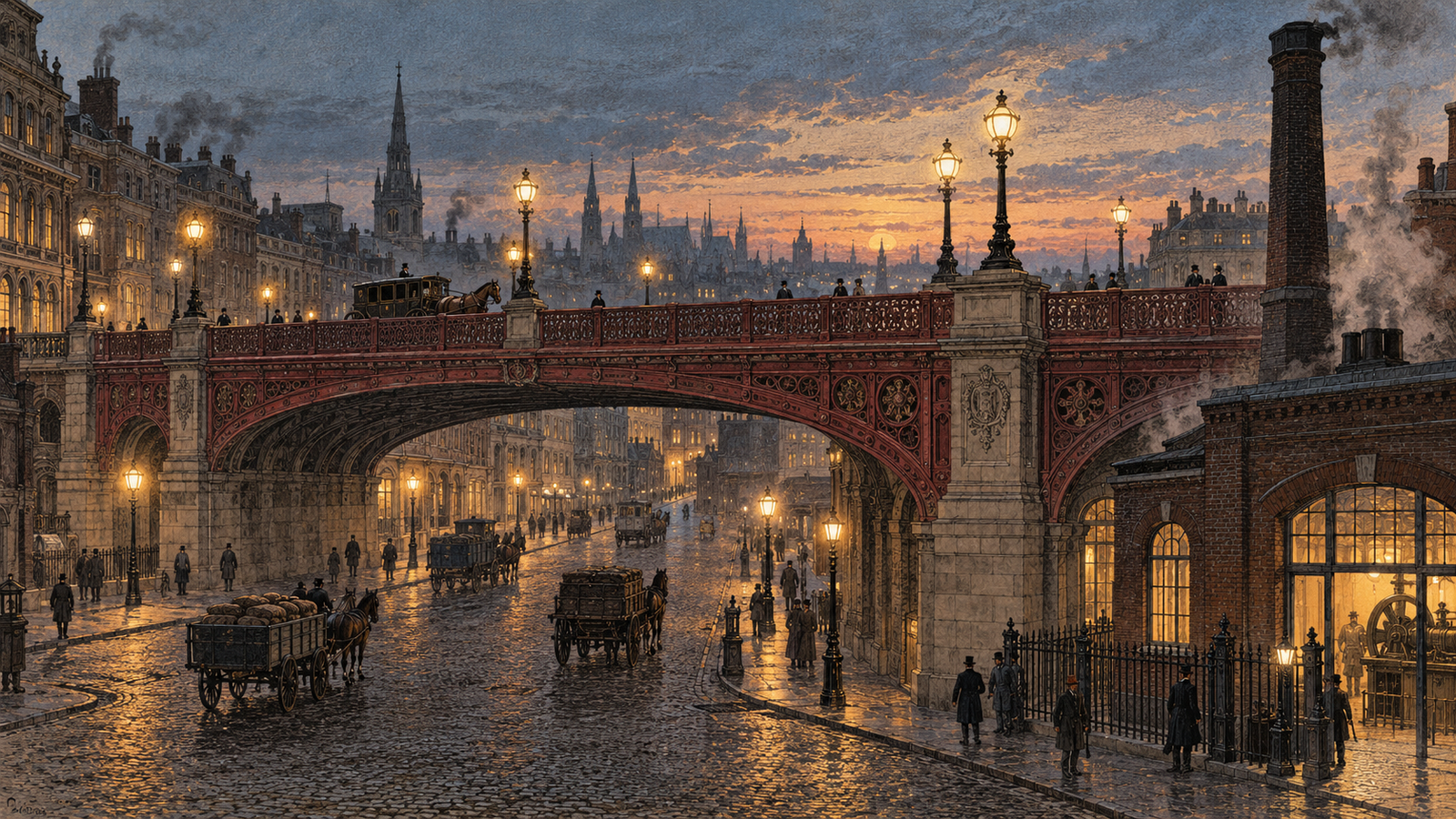
Holborn Viaduct was built to help horses, carts and pedestrians cross one of London’s most troublesome valleys. Just thirteen years after it opened, the Victorian bridge found itself involved in something even more ambitious: the arrival of public electricity.
In 1882, a power station operated by Thomas Edison’s company began generating electricity at 57 Holborn Viaduct. Coal, steam, enormous generators and cables hidden inside the viaduct combined to illuminate streets, businesses and public buildings around the City of London.
It was a small area by modern standards. For Londoners accustomed to gas flames, however, the ability to illuminate an entire district from one central station offered a glimpse of a very different future.
The short version
A bridge became part of an electrical experiment
Thomas Edison’s engineers placed a coal powered generating station beside Holborn Viaduct. The passages beneath the roadway gave them somewhere to carry electrical cables without excavating the surrounding streets.
Why did Edison choose Holborn Viaduct?
London was already brightly illuminated by gas. Gas companies had pipes, customers and legal rights beneath the streets. Edison’s electric lighting system needed to compete with an industry that had spent decades building its network.
Edison planned to generate electricity in a central station and distribute it to nearby customers through underground cables. The idea resembled the existing gas system, but instead of gas flowing through pipes, electrical current would travel through protected conductors.
Digging up London’s streets presented legal and practical difficulties. Gas suppliers were also unlikely to welcome a new competitor occupying the ground around their pipes.
Holborn Viaduct offered a clever solution. The structure contained culverts and passages beneath its roadway. Edison’s representatives proposed using these existing spaces to carry their cables, allowing the experiment to proceed without excavating the main street.
The location also sat close to busy offices, shops, public buildings and the newspaper businesses around Fleet Street. The Smithsonian history of Edison’s central lighting system explains how the viaduct provided both a practical cable route and a highly visible place to demonstrate the new technology.
Who built the Holborn Viaduct power station?
The famous name belonged to Thomas Edison, but the work in London was led on the ground by members of his team.
William Joseph Hammer, a young American electrical engineer, worked with Edison representative Edward Hibberd Johnson to construct and operate the station. Hammer had previously worked at Edison’s laboratory and understood that an electric light was only one part of a much larger system.
A successful public supply required generators, engines, cables, switches, lamps and a method of keeping everything working together. The Holborn experiment tested the complete system rather than a single invention.
The station began operating on January 12, 1882. The William J. Hammer Collection at the Smithsonian preserves notebooks, reports, correspondence and plans connected with the project.
Inside the station
A generator weighing almost 30 tons
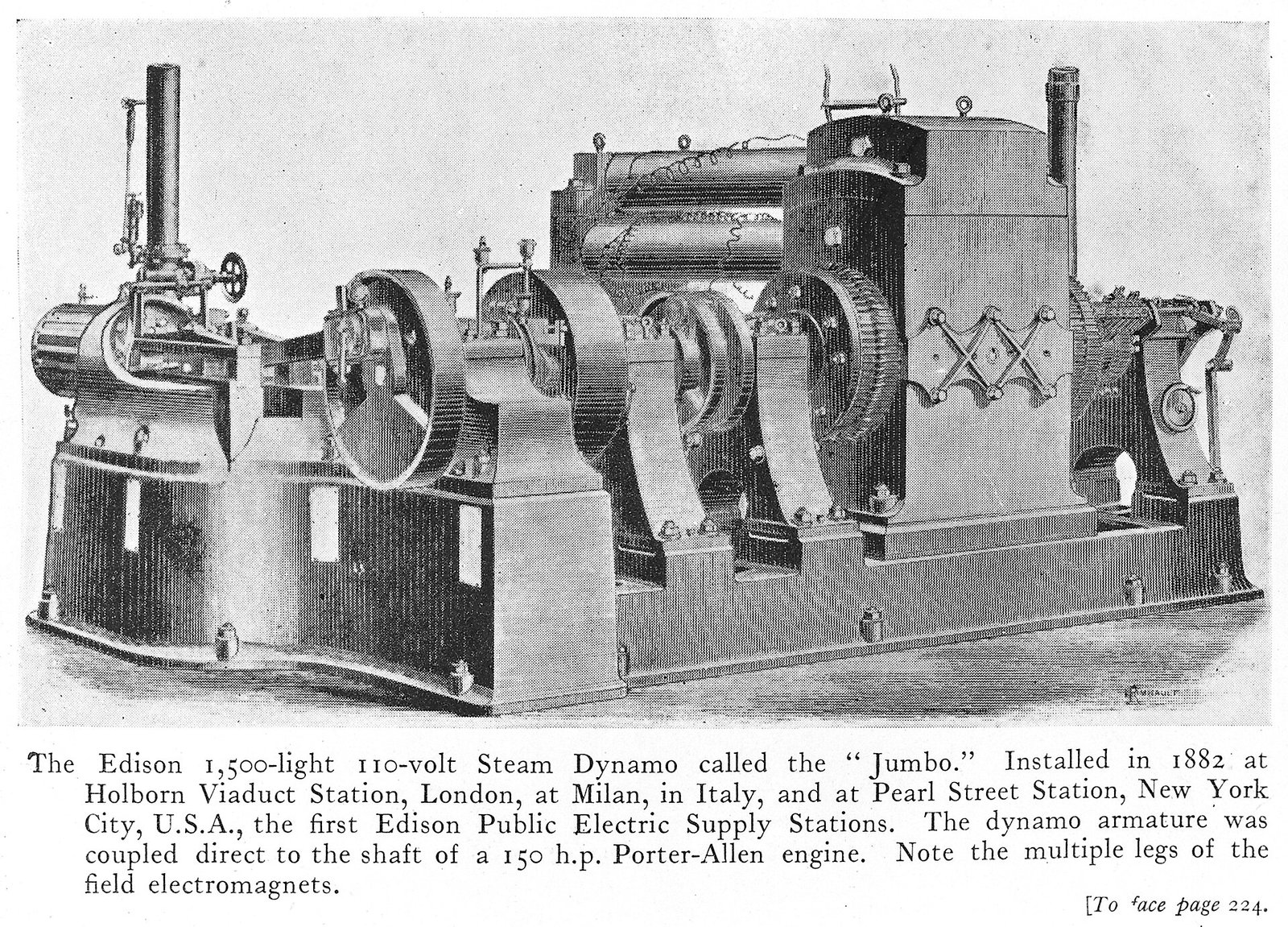
Coal heated water to produce steam. The steam powered an engine, which turned a huge Edison generator known as a Jumbo. Each machine weighed roughly 30 tons and produced direct current at approximately 110 volts.
How did electricity travel beneath Holborn Viaduct?
The cables used at Holborn were very different from the flexible electrical wires found in a modern home.
Edison’s system used solid copper conductors protected inside iron tubes. An insulating mixture surrounded the copper and helped prevent electricity from escaping into the surrounding ground.
The tubes were manufactured in sections measuring 20 feet. That length was not accidental. A section could still be transported around an average street corner on a horse drawn cart.
According to the Science Museum’s history of the Edison tube, the installation at Holborn Viaduct was the first commercial underground electricity supply installation of its kind in the world.
Similar tubes were later used in New York, Milan, Berlin and Brisbane. A cable system tested beneath a London viaduct became part of an international electrical network.
What did the Holborn Viaduct power station illuminate?
The initial system supplied close to 1,000 incandescent lamps. More than 160 illuminated streets between Holborn Circus, the viaduct, Newgate Street and the General Post Office.
Electricity also reached businesses and buildings such as the City Temple. The General Post Office received an overhead cable because it could not be reached through the viaduct’s underground passages.
On April 11, 1882, the electric lighting system was formally demonstrated across the district. A contemporary report published by Nature described 936 incandescent lamps operating in the streets and surrounding premises.
The lamps produced a warm golden light that resembled gas, but observers found it brighter and steadier. They could also be switched on and off without anyone walking from lamp to lamp with a flame.
Did you know?
The system eventually powered around 3,000 lamps
The Holborn installation began with close to 1,000 lamps but later grew to a capacity of approximately 3,000. Three enormous Jumbo generators were installed to help supply them.
Was Holborn really the world’s first power station?
The answer depends on what is meant by first.
Godalming in Surrey introduced a public electricity supply powered by water in 1881. It therefore predates the Holborn station as a public electricity supply.
Holborn Viaduct is more precisely described as the world’s first coal powered station generating electricity for public use. The Smithsonian also identifies it as the first central station constructed specifically for incandescent electric lighting.
This distinction matters. Holborn did not invent electricity, provide the first electric streetlight or supply an entire city. Its achievement was showing that one central generating station could distribute incandescent lighting to multiple streets, buildings and paying customers.
An important distinction
The first of which kind?
Godalming had the earlier public electricity supply. Holborn Viaduct became the first coal powered public generating station and the first central station built for incandescent lighting.
Did Edison light London before New York?
Yes, although only a small part of London received the Holborn supply.
The Holborn station started operating in January 1882. Edison’s better known Pearl Street Station in New York did not begin supplying electricity until September of that year.
Holborn gave Edison’s engineers somewhere to test generators, cables and thousands of lamps together. The Smithsonian describes it as a testing ground for the permanent station being planned in New York.
London was therefore not simply following an American invention. For several important months, it was where Edison’s central lighting system was being tested in public.
Five important dates
The Holborn electricity timeline
1881
Edison develops the protected tubes used to carry underground electrical conductors.
January 1882
The Holborn Viaduct station begins operating at number 57.
April 1882
The district’s incandescent lighting system is publicly demonstrated.
September 1882
Edison’s Pearl Street Station begins supplying customers in New York.
1884
The temporary Holborn demonstration comes to an end after proving that the system could work.
Why did the Holborn power station last such a short time?
The Holborn installation was a public service, but it was also a commercial experiment and technology demonstration. It was never the enormous citywide power network that the word power station might suggest today.
The Smithsonian records that the temporary system continued until 1884. That was long enough to demonstrate that electricity could be generated centrally and distributed through underground conductors to numerous customers.
Its short life should not hide its importance. Electrical technology was developing rapidly, regulations were still being written and gas remained an established competitor. Holborn provided engineers with practical experience that could not be gained from laboratory experiments alone.
Can you still see the Holborn Viaduct power station?
The original generating station no longer survives. Modern development has transformed the site around number 57, and there is little at street level to reveal what happened there.
The viaduct itself remains. Its hidden passages were one reason Edison’s engineers could install their experimental network, making the bridge an important participant rather than a convenient name for the station.
You can explore the bridge’s construction, sculptures, hidden levels and surviving features in our Holborn Viaduct, London profile.
Holborn Viaduct is usually remembered as a Victorian solution to traffic and steep streets. For a brief period in the 1880s, it also became a shortcut into the electrical age.
Research
Holborn Viaduct power station sources and further reading
Explore the contemporary reports, museum collections and electrical histories used to research this story.
-
Edison’s Holborn Viaduct lighting experiment
Smithsonian National Museum of American History -
William J. Hammer papers and Holborn Viaduct project records
Smithsonian Institution Archives -
The underground Edison tubes first used at Holborn Viaduct
Science Museum Group -
Contemporary report on the Holborn electric lighting demonstration
Nature, April 1882 -
Landmarks in the history of electricity generation
Institution of Engineering and Technology -
Thomas Edison chronology for 1882
Thomas A. Edison Papers, Rutgers University -
The history of Holborn Viaduct and its power station
London Museum
Information checked October 18, 2026.
1 thought on “How Thomas Edison’s Holborn Viaduct Power Station Lit London”
Comments are closed.