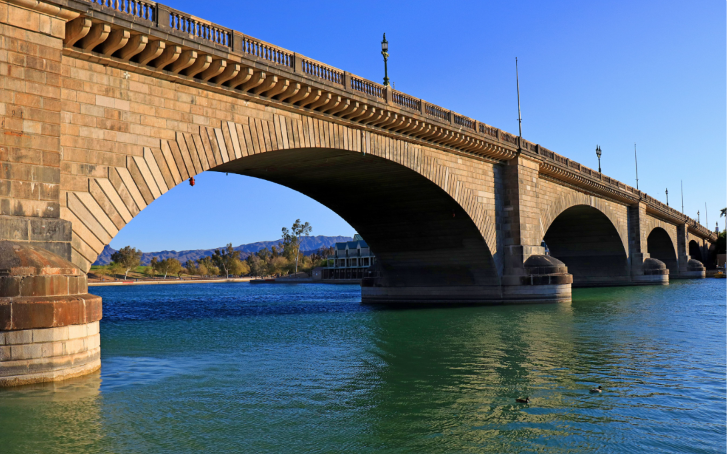
Imagine crossing London Bridge and seeing palm trees, speedboats and desert mountains instead of the River Thames.
That is what happens in Lake Havasu City, Arizona.
Standing over the Bridgewater Channel is a bridge built for nineteenth-century London. Its granite once looked down upon crowds of commuters, horse-drawn traffic and boats passing through the heart of the British capital.
Today, those original stones form five familiar arches in the Arizona desert, more than 5,000 miles away.
The story sounds simple. An American businessman bought London Bridge, took it apart and rebuilt it in the United States.
The truth is far more interesting.
Not every part of the old bridge made the journey. What crossed the Atlantic was its historic granite exterior, carefully numbered and later fitted around a new structure.
So how do you buy a bridge, move it across an ocean and rebuild it somewhere that did not yet have any water for it to cross?
THE JOURNEY AT A GLANCE
OPENED IN LONDON
1831
PURCHASED
1968
PURCHASE PRICE
$2.46m
REDEDICATED IN ARIZONA
1971
A bridge London had outgrown
The bridge began with a design by Scottish engineer John Rennie.
Rennie died in 1821, before Parliament approved his proposal. His son, also named John Rennie, developed the working plans and supervised construction.
King William IV and Queen Adelaide opened the completed bridge in 1831.
Its five granite arches were broad, solid and designed for the London of their time. Pedestrians, carriages and horse drawn traffic travelled across it while boats passed beneath.
London soon changed around it.
The arrival of the railways brought growing numbers of commuters into the city. Motor vehicles added more traffic and more weight.
The bridge was widened in 1902, but the extra space could not solve the problem forever.
By the 1960s, cracks had appeared and parts of the bridge had settled. London needed a wider crossing capable of handling modern traffic.
The City of London decided that the old bridge had to go.
Then somebody asked an unusual question.
What if another city wanted to buy it?
WHO BUYS A USED BRIDGE?
Robert P. McCulloch had made his fortune selling chainsaws and engines. Now he needed something spectacular enough to put his new desert city on the map.
London Bridge was exactly that.
A city looking for an identity
Robert P. McCulloch was an American businessman who had made his name selling chainsaws, engines and other machinery.
His interest in boat motors brought him to Lake Havasu, where the open water provided space for testing.
McCulloch saw potential in the surrounding desert. In 1964, his company purchased 26 square miles of land beside the lake.
Working with planner C. V. Wood, he began developing Lake Havasu City.
The new community had sunshine, space and ambitious plans. What it lacked was a landmark capable of attracting attention from far beyond Arizona.
London Bridge provided the answer.
The City of London offered the ageing bridge for sale, and McCulloch submitted the winning bid on 18 April 1968.
The final price was $2.46 million.
McCulloch reached that figure by doubling the estimated $1.2 million cost of dismantling the bridge and adding $60,000, representing one thousand dollars for each year of his age.
The purchase generated international attention before a single stone had reached Arizona.
McCulloch had his landmark.
He also had 10,276 granite blocks sitting on the other side of the Atlantic.
FROM THE THAMES TO THE DESERT
A journey of more than 5,000 miles
London
The 10,276 exterior granite blocks were numbered as they were removed.
Panama Canal
The stone travelled by ship towards the western coast of the United States.
Long Beach
The cargo was unloaded in California and transferred onto trucks.
Lake Havasu City
The granite arrived in Arizona ready to become the face of a new bridge.
The biggest stone puzzle in the world
Buying London Bridge did not make it portable.
The original structure contained around 130,000 tons of stone. Moving that entire mass across an ocean and rebuilding it as it stood in London would have been enormously difficult and expensive.
The solution was careful, practical and slightly less romantic than the popular version of the story.
Workers removed 10,276 exterior granite blocks from the bridge. Each one was numbered and its position recorded so the visible stonework could later be returned to the correct place.
Around 10,000 tons of historic masonry eventually made the journey to Arizona.
The blocks travelled by ship through the Panama Canal before reaching Long Beach, California. From there, they were loaded onto trucks and carried inland to Lake Havasu City.
What happened next is the detail often missing from shorter versions of the story.
The original stone bridge was not completely rebuilt.
Instead, engineers constructed a new reinforced concrete bridge. The surviving London granite was then attached to the outside, recreating the appearance of Rennie’s five arch design.
The concrete structure carried the weight and made the bridge suitable for modern traffic. The historic stone gave it the face, character and physical connection to London.
Calling it an ordinary replica would be unfair. Thousands of genuine stones from the 1831 bridge still form its exterior.
But calling it an exact reconstruction would also be misleading. Much of the original structure remained in Britain or was discarded, while the working bridge beneath the granite was new.
The London Bridge in Arizona is neither entirely old nor entirely modern.
It is a historic bridge wearing a new skeleton.
OLD STONE, NEW STRUCTURE
Which parts are original?
THE HISTORIC FABRIC
The visible face
The exterior includes 10,276 numbered granite pieces from London. The 1902 stone balustrades and curved supporting brackets were also preserved.
THE MODERN STRUCTURE
The working bridge
Beneath the granite is a reinforced concrete bridge built in Arizona. It carries the weight, supports modern traffic and gives the historic stone a new purpose.
The bridge arrived before the water
Most bridges are built after somebody decides where a road needs to cross a river.
Lake Havasu City did things differently.
When reconstruction began, there was no water beneath London Bridge. It was assembled on dry land beside a former airfield peninsula.
Workers shaped mounds of sand beneath each arch, creating temporary moulds for the new concrete structure.
The numbered granite pieces were then fitted around its exterior.
Only after the bridge was finished did crews dredge the Bridgewater Channel beneath it.
Water from Lake Havasu flowed into the new channel, turning the peninsula into an island and giving the bridge something to cross.
The unusual order made construction easier, but it also produced one of the strangest images in the bridge’s history.
For a time, London Bridge stood in the Arizona desert with cars able to cross it and no water underneath.
AN UNUSUAL ORDER
Bridge first. Water second.
STEP ONE
Build the bridge on dry land
STEP TWO
Dig the channel beneath it
STEP THREE
Allow the lake to flow through
Did he think he was buying Tower Bridge?
One rumour has followed the bridge from London to Arizona.
The story claims that Robert McCulloch believed he was buying Tower Bridge, the famous landmark with two towers and a roadway that opens for passing ships.
According to the tale, he only discovered his mistake after completing the purchase.
There is no convincing evidence that this happened.
McCulloch denied the story. Ivan Luckin, the City of London council member who arranged the sale, rejected it as well.
The City of London had put London Bridge up for sale, and McCulloch submitted the winning bid. This was no accidental purchase.
The confusion is easy to understand. Tower Bridge is one of the most recognisable sights in London, yet visitors frequently call it London Bridge.
Tower Bridge was never for sale. McCulloch bought the bridge offered by the City of London.
The rumour survived because it is funny, simple and far easier to remember than the truth.
MYTH CHECK
Did he buy the wrong bridge?
THE RUMOUR
McCulloch thought he was purchasing Tower Bridge.
THE EVIDENCE
McCulloch and the man who arranged the sale both rejected the story.
Verdict: a memorable rumour unsupported by the historical record.
A second opening day
On 10 October 1971, London Bridge was officially rededicated in Arizona.
It was 140 years since the bridge had first opened across the River Thames.
The celebration included marching bands, fireworks, hot air balloons and skydivers.
Its surroundings could hardly have been more different.
The crowded streets and busy river of London had been replaced by desert mountains, sunshine and the blue water of Lake Havasu.
The bridge now crossed the newly created Bridgewater Channel, connecting the mainland with the island formed during construction.
McCulloch’s unusual purchase gave Lake Havasu City an identity that few new communities could match.
People came to see the improbable sight of London Bridge standing in the Arizona desert. The landmark generated attention for the city and became the centrepiece of its waterfront.
A bridge that London considered outdated had found a completely new purpose.
TWO OPENING DAYS
One bridge. Two cities. 140 years apart.
1831
London
Opened across the River Thames
1971
Lake Havasu City
Rededicated across the Bridgewater Channel
A landmark with two lives
The most remarkable part of this story is not that somebody bought an old bridge.
It is that the bridge remained recognisable after its purpose, structure and surroundings had changed.
The entire 1831 structure did not move to Arizona. Its load bearing interior is modern, and much of the original material never left Britain.
Yet 10,276 pieces of historic granite made the journey.
That makes the result difficult to fit into one simple description. It is more than a replica, but it is not a complete reconstruction.
It is part historic fabric, part modern bridge and part audacious publicity idea.
The bridge once helped define London. When London outgrew it, those same stones helped a young city in Arizona define itself.
London Bridge did not fall down.
It changed careers.
SOURCES AND FURTHER READING
Explore the history in greater detail
These trusted sources provide the historical record behind this article.