Bridge profile
London Bridge
London, England, United Kingdom
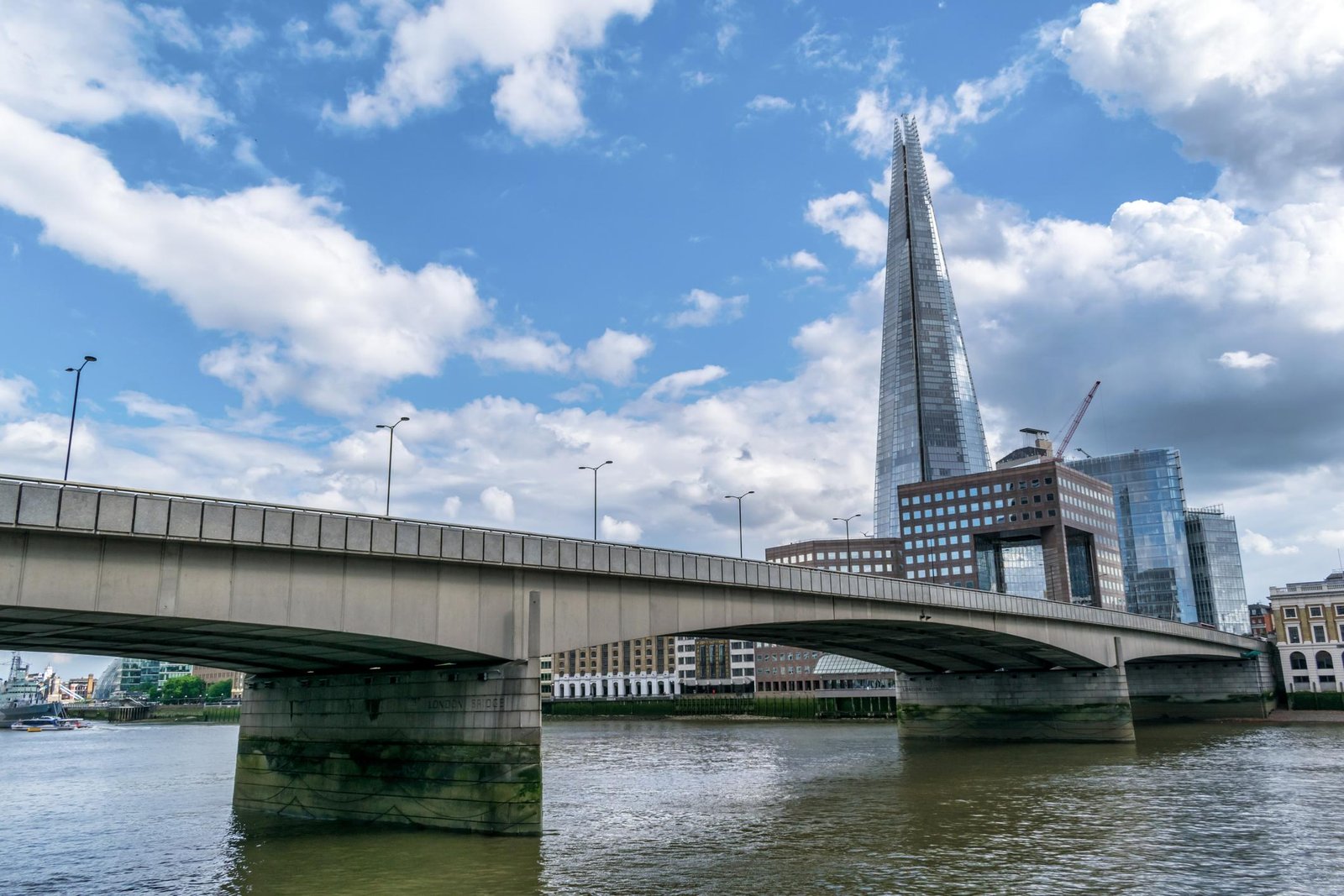
Opened in 1973, the current London Bridge links the City of London with Southwark at a crossing point used for nearly 2,000 years. Its understated concrete design stands on one of the most historic bridge sites in the world.
At a glance
Key facts
Visit and use
Nearest postcode / ZIP code
Bridge use
Status
Open to traffic
People and construction
Architect / designer
Harold Knox King with Mott, Hay & Anderson and William Holford & Partners
Design and dimensions
Main materials
Total length
Approximately 262 meters / 860 feet
Number of spans
3
London Bridge does not need towers, moving roadways or dramatic decoration to be one of the most important bridges in London. Its real story lies beneath the traffic. People have crossed the River Thames at or near this point for almost as long as London has existed.
The bridge standing here today opened in 1973, but it is only the latest in a long line of crossings. Roman timber, medieval stone, crowded houses, traitors’ heads, a famous nursery rhyme and a bridge sold to Arizona all belong to the history of London Bridge.
The short version
One name, many bridges
London Bridge is not one ancient structure that has survived for 2,000 years. It is a succession of bridges built near the same crossing point. The present bridge is a concrete box girder bridge that connects the City of London with Southwark.
Is this the original London Bridge?
No. The current London Bridge is the newest chapter in a story that began during Roman London.
The first known bridge near this location was built by the Romans around AD 50. It linked the settlement of Londinium on the northern bank with routes leading south. Later timber bridges were damaged or destroyed by conflict, storms, fires and ice, then repaired or replaced as London continued to grow.
The London Museum history of London Bridge follows the crossing from its Roman beginnings through its many rebuilds.
What was Old London Bridge like?
Construction of the first stone London Bridge began in 1176 under Peter de Colechurch. It took 33 years to complete and opened in 1209. Its 19 arches stretched about 900 feet across the Thames.
This was more than a route across the river. Houses, shops and inns crowded along the bridge, while a chapel dedicated to Thomas Becket stood among them. Fortified gates and a drawbridge added to the feeling that travelers were entering a street suspended over the water.
The bridge also had a darker role. From the medieval period into the seventeenth century, the heads of executed traitors were displayed on poles near its southern entrance. William Wallace, Thomas More and Thomas Cromwell were among the best known people whose heads were placed there.
Did you know?
An earlier fire helped stop the Great Fire
A fire in 1633 destroyed part of the housing at the northern end of Old London Bridge. The empty section acted as a firebreak in 1666 and helped prevent the Great Fire of London from spreading across the bridge into Southwark.
Why was Old London Bridge replaced?
The medieval bridge survived for more than six centuries, but its many narrow arches restricted the river and made the current faster around its foundations. The crowded roadway was also poorly suited to the growing volume of traffic entering London.
By the eighteenth century, the houses had been removed and the road widened, but the aging bridge remained expensive to maintain. Scottish engineer John Rennie designed a replacement with five broad granite arches. Rennie died before construction began, so his sons John and George carried out the work.
The new stone bridge opened on August 1, 1831. It was wider and allowed river traffic to pass through larger openings, but London eventually outgrew this bridge as well. The Institution of Civil Engineers history of London Bridge explains how each replacement responded to the pressures of a changing city.
How did London Bridge end up in Arizona?
By the 1960s, Rennie’s bridge could no longer comfortably handle modern traffic. The City of London decided to replace it and offered the old structure for sale.
American entrepreneur Robert P. McCulloch bought the bridge in 1968 for £1.02 million, equivalent to about $2.4 million at the time. Its 10,276 exterior granite blocks were numbered before being shipped to the United States. They were then fitted around a new supporting structure in Lake Havasu City, Arizona.
The reconstructed bridge opened on October 10, 1971. McCulloch knew he was buying London Bridge, despite the popular story claiming that he thought he had purchased Tower Bridge. Our London Bridge, Arizona profile explores what was moved, what was rebuilt and how the bridge became a desert landmark.
Four important dates
London Bridge timeline
Around AD 50
The Romans build the first known bridge near this crossing point.
1209
The medieval stone bridge is completed after 33 years of construction.
1831
John Rennie’s granite bridge opens across the Thames.
1973
The current London Bridge opens to traffic.
How was the current London Bridge built?
Construction of the present bridge began in 1967. City engineer Harold Knox King led the project with consulting engineers Mott, Hay & Anderson and architectural advisers William Holford & Partners. John Mowlem & Co carried out the construction.
The bridge uses four large precast concrete box beams. A box beam is hollow inside, giving it strength without the weight of a solid block. The sections were made at Surrey Commercial Docks, carried along the Thames by barge and lifted into position using a temporary gantry across the river.
The finished bridge has three spans and only two piers standing in the tidal river. This created wider channels for boats than the bridge it replaced. Queen Elizabeth II opened the new London Bridge to traffic on March 16, 1973.
Why does the current London Bridge look so plain?
London Bridge can appear understated beside the towers and moving roadway of its famous neighbor. Its restrained appearance reflects the practical reason it was built: London needed a wider, stronger crossing capable of carrying large numbers of people and vehicles.
The structure is made from concrete and steel, with polished granite used on its visible surfaces. It measures about 107 feet across, providing considerably more road and pedestrian space than Rennie’s bridge. The design keeps decoration simple and gives the river more room to pass beneath it.
Is London Bridge falling down?
No. The nursery rhyme is far older than the bridge standing in London today.
The words can be traced back to at least the seventeenth century, but nobody knows which event inspired them. Earlier London Bridges were damaged by fire, storms, frozen river ice and conflict, so the song may preserve a mixture of different stories rather than one particular collapse. The London Museum guide to London Bridge Is Falling Down explores the possibilities.
Is London Bridge the same as Tower Bridge?
No. They are neighboring bridges with very different appearances and histories.
London Bridge is the broad concrete crossing opened in 1973. Tower Bridge is the Victorian bridge with two Gothic towers and a roadway that opens for ships. The two bridges stand just over half a mile apart.
You can compare their designs and histories through our Tower Bridge profile.
Can you walk or cycle across London Bridge?
Yes. London Bridge is a working public crossing rather than a ticketed attraction. Pedestrian paths run along both sides, and changes introduced by Transport for London provide dedicated space for cycling.
The bridge is also a useful part of a central London walk. Tower Bridge can be reached in less than 15 minutes along the riverside, while Borough Market and Southwark Cathedral are close to the southern end. The Monument to the Great Fire of London and the historic City streets are on the northern side.
Transport arrangements and temporary restrictions can change, so check the Transport for London website when planning a journey.
Research
London Bridge sources and further reading
Explore the official histories, engineering records and specialist sources used to research this bridge profile.
-
The 2,000 year history of London Bridge
London Museum -
History of London’s bridges across the River Thames
City of London Corporation -
London Bridge construction and ownership
City Bridge Foundation -
Engineering history of London Bridge
Institution of Civil Engineers -
The difference between Tower Bridge and London Bridge
Tower Bridge -
Historic American Engineering Record for London Bridge in Arizona
Library of Congress -
London Bridge walking and cycling changes
Transport for London
Information checked October 1, 2026.