Bridge profile
Southwark Bridge, London
Southwark and the City of London, London, England
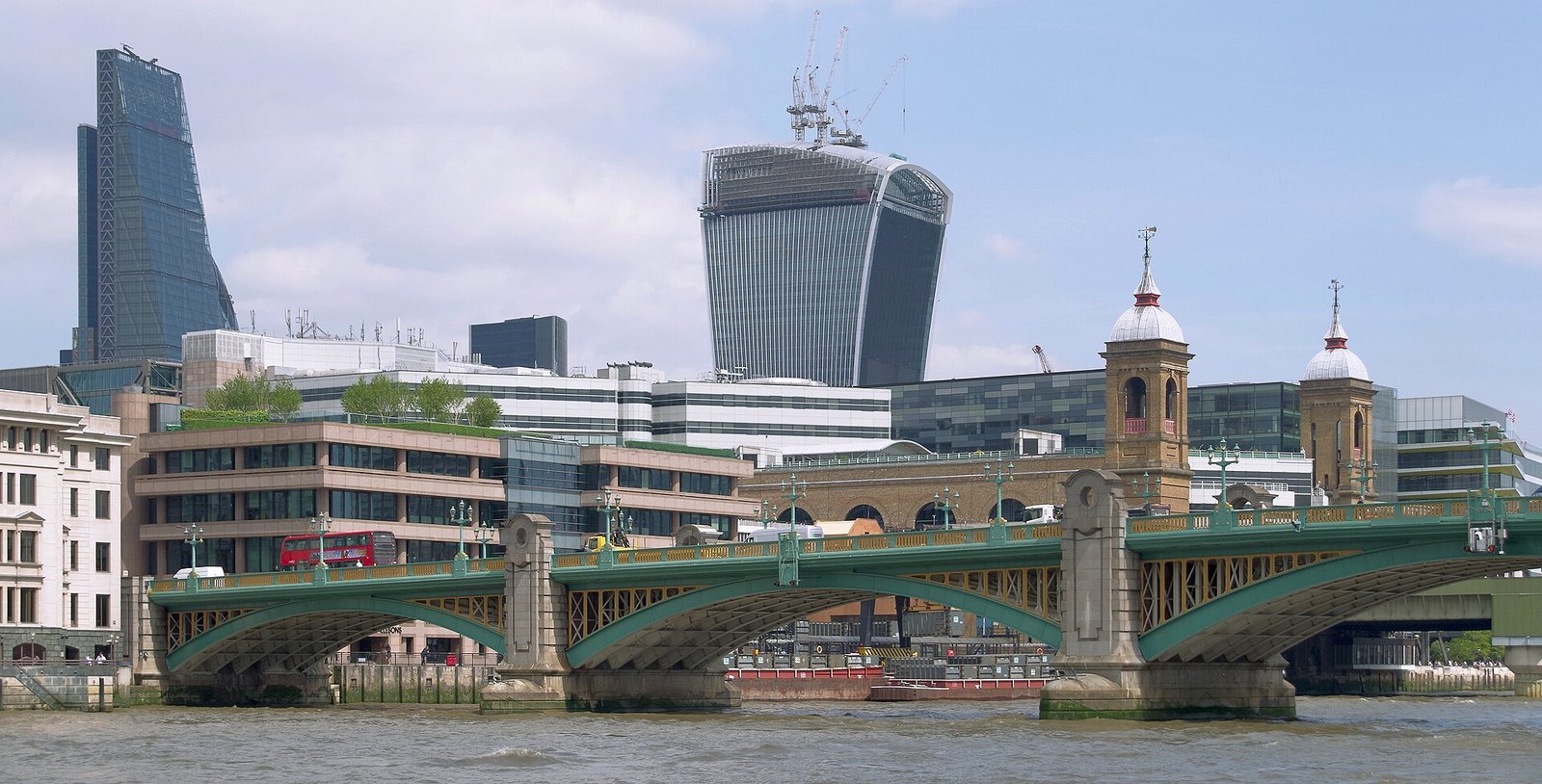
Southwark Bridge links Bankside with the City of London through five green and yellow steel arches, replacing John Rennie’s remarkable cast iron crossing in 1921.
At a glance
Key facts
Location
First opened
June 6, 1921
Crosses
Bridge type
Visit and use
Nearest postcode / ZIP code
Bridge use
Status
Open to traffic
People and construction
Architect / designer
Sir Ernest George
Engineer
Sir Basil Mott of Mott, Hay and Anderson
Builder / main contractor
Sir William Arrol & Co.
Ownership and maintenance
Owner
City Bridge Foundation (Bridge House Estates)
Maintained by
City of London Corporation
Design and dimensions
Southwark Bridge is easy to overlook among London’s famous river crossings. It does not have the towers of Tower Bridge or the crowds of the nearby Millennium Bridge, but its green and yellow arches give it a character of its own.
The bridge connects Bankside with the City of London. The crossing seen today opened in 1921, although the Southwark Bridge story began more than a century earlier with an ambitious cast iron toll bridge designed by John Rennie.
The short version
A quieter London crossing with two stories
The present Southwark Bridge is a five arch steel crossing that opened in 1921. It carries road traffic, pedestrians and cyclists across the Thames on the site of John Rennie’s earlier cast iron bridge.
Why have there been two Southwark Bridges?
The first Southwark Bridge opened in 1819. Designed by John Rennie, it was a privately financed toll bridge built to ease pressure on London Bridge and Blackfriars Bridge.
It was commonly called Queen Street Bridge and was also known as the Iron Bridge. The second name helped distinguish its cast iron arches from the stone construction associated with London Bridge.
Its central arch measured 240 feet and was described as the widest cast iron span yet built. Around 6,000 tons of cast iron were used across the structure, much of it supplied from Rotherham.
The bridge even opened at midnight. Thirty gas lamps illuminated the crossing, giving Londoners a dramatic first look at what was then an unusually bold structure.
Crossing came at a price. The original one penny toll remained until 1864, which made the bridge less attractive than nearby free crossings. The Institution of Civil Engineers history of Southwark Bridge explores the construction of both bridges in greater detail.
Why was the original Southwark Bridge replaced?
The City acquired the bridge in 1868 and removed the toll, but the structure was becoming increasingly unsuitable for modern traffic.
The roadway was narrow and its approaches were steep. One particularly memorable description called it the curse of the cart driver and the ruin of his horses.
Building a wider bridge on the same site created an awkward problem. London still needed the crossing, while electrical cables and gas pipes running across the river also had to remain in service.
Did you know?
London kept crossing while the bridge was rebuilt
Temporary bridges were erected on both sides of the permanent structure. They carried pedestrians, gas pipes and electrical cables while also supporting cranes used during demolition and construction.
How did the First World War delay Southwark Bridge?
Work on the replacement began during the early 1910s, and the old bridge was demolished in 1913. The new granite piers were largely ready by the outbreak of the First World War.
Material shortages slowed construction until work largely stopped in 1917. Once the war ended, growing traffic congestion made finishing the crossing a priority. Southwark Bridge became one of London’s first major public projects to resume after the Armistice.
King George V officially opened the bridge on June 6, 1921. He used a golden key to open the temporary barriers before crossing with Queen Mary in a horse drawn carriage. According to the City of London account of Southwark Bridge’s centenary, the first public vehicle to follow them was a taxi.
Who designed the current Southwark Bridge?
Civil engineer Sir Basil Mott developed the bridge through Mott, Hay and Anderson. Architect Sir Ernest George designed its granite piers, turrets and decorative details, while Sir William Arrol and Company served as the main contractor.
The bridge has five steel arches supported by four granite river piers. Seven steel ribs sit beneath each arch, creating the strength needed to carry the roadway without making the bridge appear excessively heavy.
The position of the piers was carefully planned to follow the same river channels as neighboring crossings. Aligning them with the piers of Blackfriars Bridge and the former London Bridge helped vessels move along the Thames without facing a confusing obstacle course.
Southwark Bridge received Grade II listed status in 1995. The official Historic England listing for Southwark Bridge recognizes both its architectural character and its place in London’s transport history.
Six important dates
Southwark Bridge timeline
1819
John Rennie’s cast iron toll bridge opens across the Thames.
1864
The one penny toll is finally removed.
1868
The bridge is acquired by the City’s bridge estate.
1913
The old bridge is demolished for its wider replacement.
1921
The present Southwark Bridge officially opens.
1995
The bridge receives Grade II listed status.
Why is Southwark Bridge green and yellow?
The distinctive colors are not a recent attempt to make the bridge stand out. They are based on its original color scheme, including a shade known as Southwark Green.
A major restoration stripped the metalwork back to its bare surface before the colors were renewed. More than 1,000 tons of abrasive material were used during the work, followed by approximately 13,000 liters of paint.
Look again after dark
The arches become part of an artwork
Southwark Bridge joined the Illuminated River project in 2019. Its evening lighting emphasizes the green arches and the rhythm of the granite piers without overwhelming the bridge’s original design.
Can you walk or cycle across Southwark Bridge?
Yes. Southwark Bridge carries road traffic, pedestrians and cyclists, and there is no toll. Separated cycle tracks run across the bridge as part of Cycleway 7, making this one of the more useful central London crossings for everyday cycling.
Pedestrian paths run along both sides of the roadway. They offer open views along the Thames while usually attracting fewer sightseers than the nearby Millennium Bridge.
Look beneath the bridge as well as across it. Old steps at the southern landing were once used by Thames watermen waiting for passengers. On the northern bank, a pedestrian tunnel contains a mural showing the frost fairs once held on the frozen river. The Illuminated River guide to Southwark Bridge explains these easily missed details.
Is Southwark Bridge worth visiting?
Southwark Bridge is worth visiting if you enjoy quieter landmarks with details that reward a closer look. Its colors, curved steelwork and granite turrets make it unlike the other bridges nearby.
The southern end is close to Tate Modern, Shakespeare’s Globe and the Thames Path. The northern end leads toward Cannon Street and the heart of the City of London.
For a longer bridge walk, cross Southwark Bridge in one direction and return using the nearby Millennium Bridge. The two crossings provide very different views of the same stretch of river.
Research
Southwark Bridge sources and further reading
Explore the engineering records, heritage listings and official accounts used to research this bridge profile.
-
The construction and engineering of Southwark Bridge
Institution of Civil Engineers -
Official heritage listing for Southwark Bridge
Historic England -
The City of London’s history of its Thames bridges
City of London Corporation -
Southwark Bridge at 100
City of London Corporation -
Ownership and history of Southwark Bridge
City Bridge Foundation -
Southwark Bridge and the Illuminated River
Illuminated River
Information checked October 10, 2026.