Bridge profile
Tower Bridge
London, England, United Kingdom
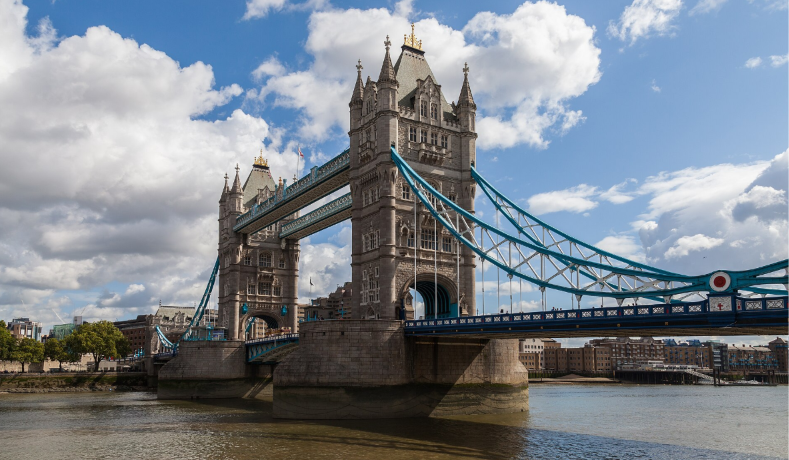
Opened in 1894, Tower Bridge combines Victorian Gothic architecture with a working bascule and suspension structure that still opens for ships on the River Thames.
At a glance
Key facts
Location
Nearest postcode or ZIP
SE1 2UP
Crosses
First opened
June 30th, 1894
Designer
Sir John Wolfe Barry and Sir Horace Jones
Bridge type
Bridge use
Main materials
Total length
244 m (800 ft)
Number of spans
3
Status
Open to traffic
Tower Bridge was built to solve a very London problem. The city needed another road crossing, but the River Thames was still a busy working highway. Any new bridge had to carry people and traffic without trapping tall ships on the wrong side.
The answer became one of the most recognisable bridges in the world. Tower Bridge combines an opening roadway, suspended side spans, steel construction and Gothic towers that look far older than the machinery hidden inside them.
The short version
A bridge designed to move
Tower Bridge is both a bascule bridge and a suspension bridge. Its central roadway opens for ships, while its suspended side spans connect the towers with the riverbanks.
Why was Tower Bridge built?
London expanded rapidly during the nineteenth century, particularly around the East End. London Bridge could no longer handle the growing pressure on the city’s roads, but building a fixed bridge farther downstream would have blocked ships from reaching the Pool of London.
More than 50 designs were considered before architect Sir Horace Jones and civil engineer Sir John Wolfe Barry developed the plan that became Tower Bridge. Construction began in 1886 and took eight years to complete.
Tower Bridge officially opened on 30 June 1894. The official Tower Bridge construction timeline follows the project from its early design stages to its first public crossings.
How does Tower Bridge open for ships?
The central roadway is divided into two moving sections called bascules. Each section rotates around an off centre pivot and is balanced by a huge counterweight.
The word bascule comes from the French word for a seesaw. That gives a good picture of how the roadway works. The weight on one side of the pivot helps balance the road on the other, reducing the power needed to raise it.
The original system used steam engines to create hydraulic pressure. In 1976, the machinery was modernised to use electricity and oil hydraulics. The original Victorian engines, boilers and accumulators remain on display in the Engine Rooms.
Did you know?
More than 6,000 lifts in one year
During its first year of operation, Tower Bridge opened 6,194 times. That works out at an average of around 17 bridge lifts every day.
Tower Bridge still opens for qualifying vessels. The official explanation of how Tower Bridge works provides a closer look at the bascules and hydraulic system.
Why does Tower Bridge look like a castle?
The towers may look medieval, but the bridge is built around a strong steel frame. Its Gothic appearance was chosen to complement the nearby Tower of London, which was already one of the city’s most important historic landmarks.
Granite and Portland stone cover much of the metal structure. The pointed roofs, turrets and decorative stonework help disguise the machinery and steelwork needed to support the bridge.
The high level walkways are more than viewing platforms. They connect the two towers and help tie the suspended sections of the bridge together. Today, visitors can cross them and look through glass floors installed above the roadway.
Tower Bridge is protected as a Grade I listed structure. The Historic England entry for Tower Bridge records its architectural and engineering importance.
Four important dates
Tower Bridge timeline
1886
Construction begins beside the River Thames.
1894
Tower Bridge officially opens to the public.
1976
The lifting system changes from steam power to electricity and oil hydraulics.
2014
Glass floors open inside the high level walkways.
Is Tower Bridge the same as London Bridge?
No. Tower Bridge and London Bridge are two separate crossings.
Tower Bridge is the Victorian landmark with twin towers and an opening roadway. London Bridge stands farther upstream and has been rebuilt several times during its much longer history.
The confusion is understandable because Tower Bridge has become one of the most familiar images of London. You can compare the two crossings through our London Bridge profile.
Can you visit Tower Bridge?
The roadway and pedestrian paths continue to carry everyday traffic across the Thames. Visitors can also enter the towers, cross the high level walkways, look through the glass floors and explore the Victorian Engine Rooms.
The bridge remains fully operational, so visitors may see the bascules rise for a passing vessel. Bridge lift times are published in advance, making it possible to plan a visit around one of the openings.
Opening times, ticket prices and lift schedules can change. Check the official Tower Bridge website before visiting.
Research
Tower Bridge sources and further reading
Explore the official histories, heritage records and specialist sources used to research this bridge profile.
-
The official history of Tower Bridge
Tower Bridge -
Timeline of the construction of Tower Bridge
Tower Bridge -
How Tower Bridge opens for ships
Tower Bridge -
Facts about Tower Bridge
Tower Bridge -
Tower Bridge heritage listing
Historic England
Information checked September 29, 2026.