Bridge profile
Albert Bridge, London
Chelsea and Battersea, London, England
Albert Bridge connects Chelsea and Battersea in a pastel sweep of iron and steel, complete with Victorian tollbooths, warning signs and a reputation for trembling under marching feet.
At a glance
Key facts
Visit and use
History
Alternative names
The Trembling Lady
People and construction
Engineer
Rowland Mason Ordish
Builder / main contractor
Andrew Handyside & Co. (ironwork)
Ownership and maintenance
Owner
Royal Borough of Kensington and Chelsea
Maintained by
Royal Borough of Kensington and Chelsea
Design and dimensions
Main materials
Total length
241 meters / 791 feet
Main span
139 meters / 456 feet
Number of spans
3
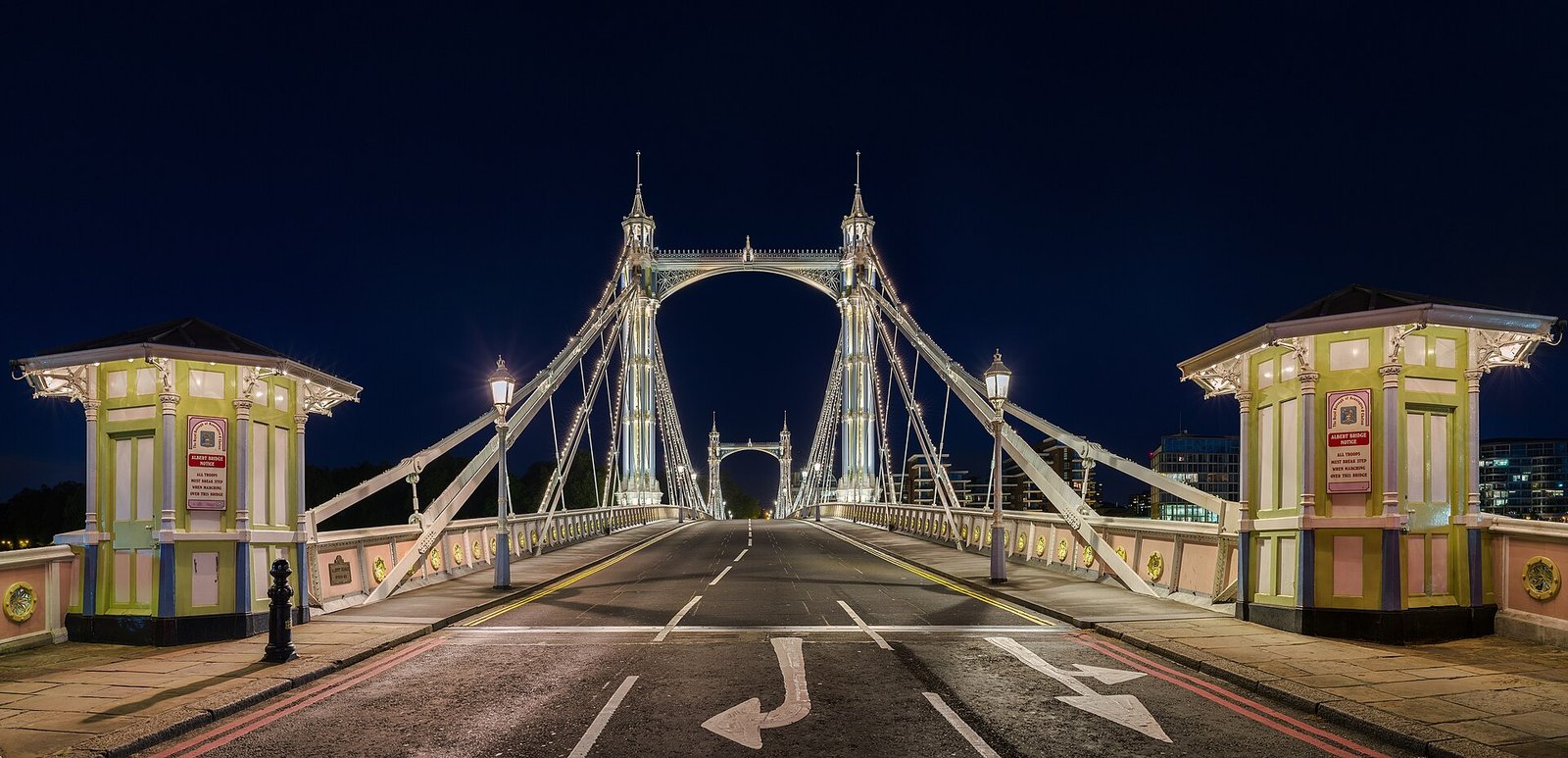
Albert Bridge looks more like an elegant piece of Victorian decoration than a busy London crossing. Its pastel towers, slender supports and rows of lights create one of the most recognizable views along the western Thames.
Beneath that graceful appearance is a bridge that has needed ingenuity, strengthening and determined public support to survive. It has trembled under marching feet, escaped demolition more than once and kept four tollbooths long after Londoners stopped paying to cross.
The short version
The bridge that refused to disappear
Albert Bridge is a three span crossing that combines suspension and cable stayed construction. It opened between Chelsea and Battersea in 1873 and remains famous for its pastel colors, surviving tollbooths and signs ordering marching troops to break step.
Why was Albert Bridge built?
During the nineteenth century, Chelsea and Battersea were growing quickly on opposite sides of the River Thames. Battersea Bridge already crossed the river nearby, but local connections were still considered inadequate.
The Albert Bridge Company was formed in 1863 to create another crossing. Parliament authorized the project in 1864, although construction was delayed while plans for Chelsea Embankment were settled.
Work finally began in 1871. The bridge was designed by engineer Rowland Mason Ordish, who specialized in ambitious iron structures and had already worked on projects including the Royal Albert Hall and Holborn Viaduct.
Albert Bridge opened to traffic on August 23, 1873. It was named after Prince Albert, the husband of Queen Victoria, who had died twelve years earlier.
Is Albert Bridge a suspension bridge or a cable stayed bridge?
It is both. Albert Bridge was designed using the Ordish Lefeuvre system, an unusual arrangement that combined features of suspension bridges with features now associated with cable stayed bridges.
Diagonal wrought iron stays extend from the towers toward the deck. These help support the roadway directly, while chains and vertical rods distribute additional weight through the structure.
The ornate towers are made from cast iron. They stand on cylindrical iron piers filled with masonry and concrete, while the roadway is supported by an iron structure and a timber deck.
The original design was innovative but also delicate. Moisture entered parts of the cable system, and corrosion appeared much sooner than expected. Sir Joseph Bazalgette strengthened the bridge between 1884 and 1887, replacing the original wire cables with steel link chains.
The Institution of Civil Engineers history of Albert Bridge explains how the different systems were combined and how later alterations helped the bridge survive.
Did you know?
Soldiers must break step
Signs on the tollbooths instruct troops to stop marching in rhythm while crossing Albert Bridge. Marching feet can create repeated forces that increase a bridge’s movement, so soldiers are told to break their synchronized step.
Why is Albert Bridge called the Trembling Lady?
Albert Bridge earned the nickname the Trembling Lady because it moved noticeably when large numbers of people crossed it.
Some movement is normal in a bridge, but repeated footsteps can become a problem when people move at the same rhythm. Each step adds another small push. If those pushes match the natural movement of the structure, the vibration can become stronger.
This is why the break step signs were placed near the bridge. Chelsea Barracks stood nearby, making organized groups of marching soldiers a regular sight in the area.
The signs remain attached to the old tollbooths today. They have become one of the bridge’s most photographed details, even though the nearby barracks have closed.
Why does Albert Bridge still have tollbooths?
Albert Bridge was originally a private toll crossing. People paid to use it, and four small octagonal booths were placed beside the roadway to collect the money.
The business was not a success. Too few people were willing to pay when other crossings were available, and the Metropolitan Board of Works acquired the bridge in 1879.
The toll was abolished, but the booths survived. They are now the only remaining tollbooths on a Thames bridge in London.
The London Museum history of Albert Bridge explores the tollbooths, changing appearance and repeated attempts to replace the bridge.
Six important dates
Albert Bridge timeline
1873
Albert Bridge opens between Chelsea and Battersea.
1879
Public ownership begins and the crossing becomes free to use.
1884 to 1887
Sir Joseph Bazalgette strengthens the bridge and replaces its original cables.
1957
A public campaign helps protect the bridge from demolition.
1972 to 1973
Two concrete piers and a supporting steel beam are added beneath the center.
2026
Repairs begin after a cracked cast iron component is discovered.
How did Albert Bridge escape demolition?
Albert Bridge spent much of the twentieth century under threat. Its narrow roadway, strict weight limits and recurring structural problems made replacement appear easier than continued repair.
A 1926 commission recommended removing it, but the economic conditions of the following years prevented the plan from progressing.
Another serious proposal appeared in 1957. Public opposition followed, with poet and conservation campaigner John Betjeman becoming one of the bridge’s most prominent defenders.
The bridge survived again. Strengthening work completed from 1972 to 1973 added two concrete piers beneath the center span and introduced another form of support. Albert Bridge had now become a mixture of cable stayed, suspension and beam bridge construction.
Albert Bridge remains one of the few historic London road bridges never to have been completely replaced. It shares that distinction with Tower Bridge.
The official Historic England listing for Albert Bridge recognizes its architectural character, unusual engineering and importance to the London riverscape.
Look again after dark
Pastel colors and thousands of lights
Albert Bridge’s pink, blue and green color scheme was introduced in 1992 to make the structure easier to see in fog. After dark, thousands of lights trace its towers, chains and deck across the Thames.
Why is Albert Bridge closed to cars?
Albert Bridge closed to motor vehicles on February 7, 2026, after a routine inspection found a crack in a cast iron component beside one of the bridge abutments.
The Royal Borough of Kensington and Chelsea is carrying out a major repair program. The work includes replacing the damaged component, renewing the timber road deck, refurbishing the tollbooths and improving the bridge lighting.
The bridge remains open to pedestrians and people with bicycles during the work, although temporary arrangements require cyclists to dismount while crossing. The council is working toward reopening the bridge to motor vehicles in 2027, but a final reopening date has not been announced.
Current access
Check before traveling
Pedestrians can currently cross Albert Bridge, while cyclists must dismount during this stage of the repair work. Check the official Albert Bridge repair updates before making a special journey.
Is Albert Bridge worth visiting?
Albert Bridge is worth visiting for its appearance and its unusual details. The pastel ironwork makes it unlike any other Thames crossing, while the tollbooths and break step signs provide clues to its long and sometimes difficult history.
The southern end leads directly toward Battersea Park. On the northern side, the bridge meets Chelsea Embankment near Cheyne Walk and Chelsea Physic Garden.
The bridge is particularly striking around sunset and after dark, when its lights reflect across the river. Current repair work may affect some views, but pedestrians can still experience the crossing itself.
Visitors following the Thames eastward can continue toward Vauxhall Bridge, where eight large bronze figures are hidden in full view along the sides of the crossing.
Research
Albert Bridge sources and further reading
Explore the engineering records, heritage listing and official updates used to research this bridge profile.
-
The construction and engineering of Albert Bridge
Institution of Civil Engineers -
Official heritage listing for Albert Bridge
Historic England -
The history of Albert Bridge and the Trembling Lady
London Museum -
Current Albert Bridge repairs and access information
Royal Borough of Kensington and Chelsea -
Albert Bridge repair work from the Battersea side
Wandsworth Council
Information checked November 9, 2026.