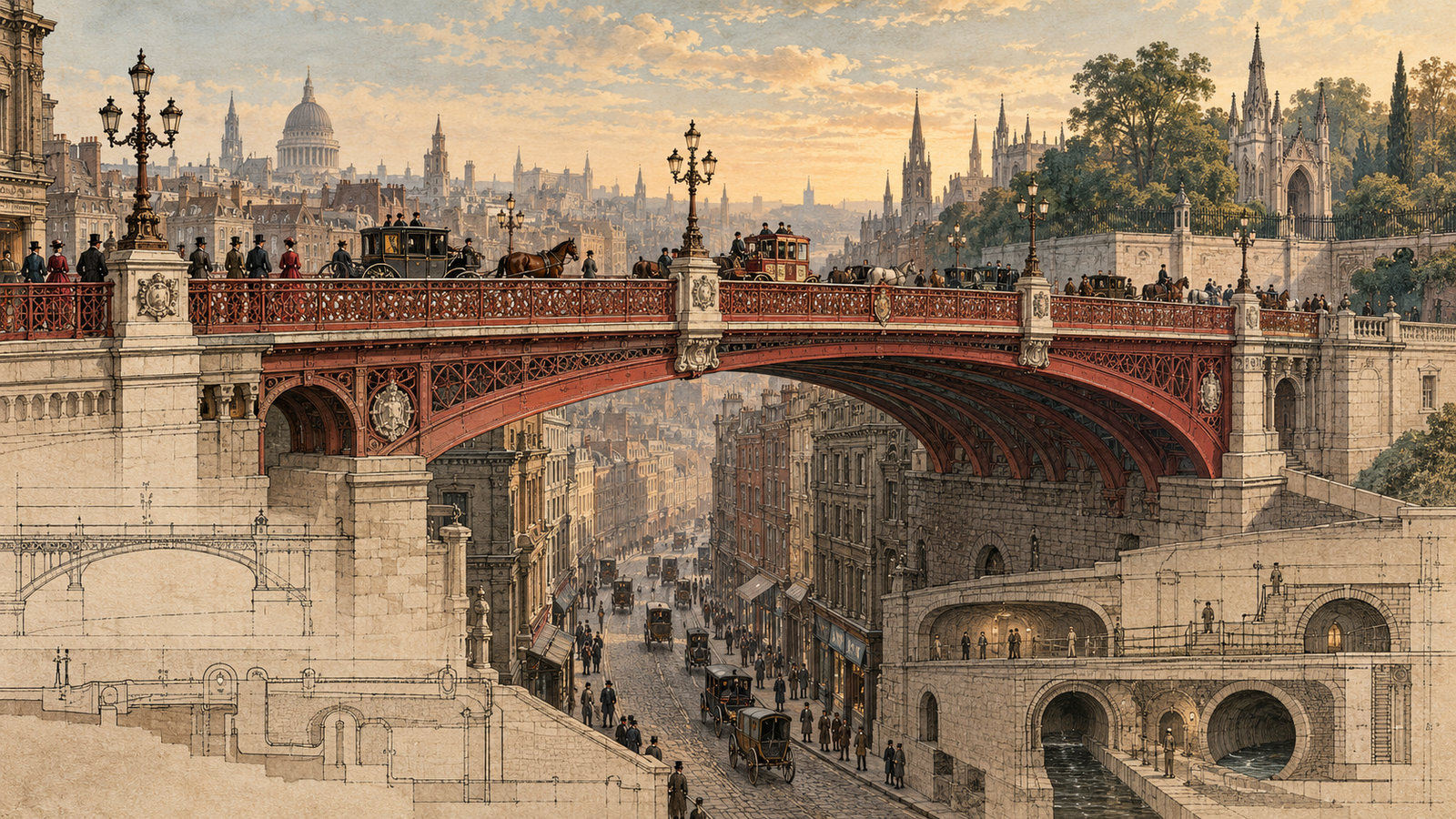
Some engineers leave behind one famous landmark. William Haywood left pieces of himself across an entire city.
He designed Holborn Viaduct, helped develop plans for intercepting London’s sewage, created one of Europe’s largest municipal cemeteries and experimented with quieter, safer surfaces for some of the busiest streets in the capital.
Londoners still travel through places shaped by his decisions every day. Yet Haywood’s name is far less familiar than that of his colleague Joseph Bazalgette.
The short version
The man who worked above and below London
William Haywood was both an architect and a civil engineer. His work stretched from decorated bridges and Gothic chapels to sewers, street surfaces, traffic studies and the hidden services beneath London’s roads.
Who was William Haywood?
William Haywood was born in Camberwell on December 8, 1821. He attended Camberwell Grammar School before training under the architect George Aitchison.
Architecture appeared to be his intended profession. Haywood began his career designing houses and later became a Fellow of the Royal Institute of British Architects.
His career changed direction in 1845 when he joined the Commissioners of Sewers for the City of London as an assistant surveyor. He became surveyor in 1846 and later served as the organization’s chief engineer.
Haywood remained involved with the City’s infrastructure for almost five decades. During that time, the position expanded far beyond anything its name might suggest.
A misleading job title
The Commissioners of Sewers did much more than sewers
The organization also dealt with streets, paving, drainage, traffic, sanitation and major public improvements. This allowed Haywood to work on almost every part of the Victorian city, from the ground beneath its roads to the structures rising above them.
What role did William Haywood play in London’s sewers?
London’s drainage problems were already severe when Haywood joined the Commissioners. Sewage entered local waterways and eventually reached the River Thames, while different authorities controlled different pieces of the system.
In 1850 and 1851, Haywood assisted engineer Frank Forster with a plan for intercepting sewage on the north side of the Thames. Intercepting sewers were designed to capture waste before it reached the river and carry it away from the most heavily populated districts.
After Forster’s death, Joseph Bazalgette became chief engineer to the Metropolitan Commission of Sewers. Haywood worked with Bazalgette on further drainage proposals in 1854.
Bazalgette rightly receives much of the credit for delivering London’s great metropolitan sewer system. Haywood did not build that network single handedly, but his knowledge of the City and his earlier planning formed part of the work that led toward it.
Bazalgette’s own account of the project recorded that Haywood assisted Frank Forster with the drainage plan for districts north of the Thames.
Giving credit carefully
Haywood worked with Bazalgette, not instead of him
Haywood was an important contributor with detailed knowledge of the City of London. Bazalgette led the much larger metropolitan project that transformed drainage across London.
How did William Haywood transform Holborn?
Haywood’s most recognizable project began with a difficult piece of geography.
Anyone traveling between Holborn and the City had to descend into the old valley of the River Fleet before climbing back out. The steep streets were tiring for pedestrians and dangerous for heavily loaded horse drawn vehicles.
The Holborn Valley Improvements replaced this awkward journey with a level route. The scheme included Holborn Circus, new streets and the enormous raised roadway now known as Holborn Viaduct.
Haywood developed the architectural design and overall improvement scheme. Civil engineer Rowland Mason Ordish contributed the structural engineering for the bridge itself.
Construction began in 1863. Queen Victoria formally opened the new route on November 6, 1869.
The completed structure was more than an ornate iron bridge over Farringdon Street. The full raised route stretched for approximately a quarter of a mile and contained multiple levels of vaults, passages, sewers and spaces for public utilities.
You can explore its structure, statues and surviving details in our Holborn Viaduct, London profile.
Hidden beneath the roadway
Haywood designed space for the city’s services
The viaduct carried more than traffic. Passages beneath the roadway accommodated pipes, telegraph lines, drainage and other services. In 1882, these hidden spaces helped Thomas Edison’s engineers install an experimental electricity network without excavating the street.
That later chapter is explored in our story about how Thomas Edison’s Holborn Viaduct power station lit London.
Why did William Haywood design a cemetery?
Victorian London’s overcrowded burial grounds were not only unpleasant. They had become a serious public health concern.
In 1853, the City purchased approximately 200 acres of land near Little Ilford, now part of Manor Park. Haywood was given the task of turning it into the City of London Cemetery.
He designed the overall layout along with its entrance lodges, gateways, Anglican chapel, Nonconformist chapel and catacombs. Landscape gardener William Davidson was responsible for much of the planting and landscape work.
The cemetery began accepting burials in 1856. Haywood later designed extensions and additional roadways as its use increased.
Historic England now recognizes the cemetery as a Grade I registered landscape. Its assessment describes Haywood’s western layout as being planned on a grand scale, with formal avenues, curving drives, chapels and the sunken Catacomb Valley.
The Historic England record for the City of London Cemetery provides a detailed account of Haywood’s surviving design.
A final personal connection
Haywood designed his own Gothic mausoleum
Haywood’s small stone mausoleum stands inside the cemetery he designed. Decorated with pointed arches, pinnacles, gargoyles and iron gates, it created a permanent link between the engineer and one of his largest surviving works.
How did Haywood change London’s roads?
Road surfaces may sound less exciting than bridges and sewers, but they affected almost everyone using Victorian London.
Iron wheels and horses placed enormous strain on busy streets. Poor surfaces created noise, dust, expensive repairs and a greater risk of horses slipping or being injured.
Haywood compared different paving materials and recorded how they performed under heavy traffic. His reports considered construction cost, maintenance, cleanliness, safety and the noise produced by iron wheels.
He helped introduce asphalt to the City’s roads in 1869. An early experiment took place in Threadneedle Street, beginning a gradual change from stone and wooden surfaces toward smoother road construction.
Research into Haywood’s experiments with Victorian road paving shows how seriously he treated a part of city life that most people walked across without noticing.
That was typical of Haywood’s work. Some of his most useful decisions disappeared beneath people’s feet.
What else did William Haywood design?
Haywood’s responsibilities were unusually broad.
He designed housing for working families in Whitechapel, including buildings erected by the Commissioners of Sewers around Stoney Lane and Artizan Street.
He studied vehicle and pedestrian movement through the City and produced an extensive report on traffic in 1869. Its subjects included congested streets, bridge approaches, foot traffic, road widths and the great streams of vehicles entering the commercial center.
He also worked on private buildings, contributed to the monument to Prince Albert at Holborn Circus and acted as a consulting engineer beyond his official City position.
Haywood presented more than 100 reports to the Commissioners of Sewers. Together they covered an extraordinary range of municipal problems, many of which still occupy city planners today.
Six important dates
William Haywood’s life and work
1821
William Haywood is born in Camberwell.
1845
He joins the City of London Commissioners of Sewers.
1853
Work begins on his design for the City of London Cemetery.
1863
Construction of the Holborn Valley Improvements begins.
1869
Holborn Viaduct opens and asphalt is introduced to City roads.
1894
Haywood dies after almost five decades of City service.
Why is William Haywood less famous than Joseph Bazalgette?
There is no single answer, but the nature of their work provides part of the explanation.
Bazalgette became associated with one enormous and easily understood achievement: the sewer network that helped rescue London from a sanitation crisis.
Haywood’s influence was spread across dozens of projects and responsibilities. A cemetery, a viaduct, road experiments, traffic reports, housing, drainage and utility passages do not fit into one simple story.
He also worked principally within the City of London, while Bazalgette’s Metropolitan Board of Works operated across a far larger area.
The two men should not be presented as rivals. They collaborated, shared information and worked within overlapping parts of an expanding city.
Haywood’s achievement was versatility. He could think like an architect when designing a chapel, like an engineer when planning drainage and like a city administrator when studying traffic or road maintenance.
What remains of William Haywood’s London?
Holborn Viaduct remains his most visible central London landmark. Its red ironwork and stone pavilions still carry traffic across the old Fleet Valley.
The City of London Cemetery preserves another side of his work. Its chapels, gates, catacombs, avenues and formal layout reveal that the same person responsible for streets and sewers could also create ceremonial architecture and landscaped space.
His reports survive in archives, providing detailed evidence of how Victorian engineers tried to make London cleaner, safer and easier to navigate.
William Haywood did not transform London through one isolated structure. He helped redesign the systems that allowed the city to function.
Every bridge has a story, but Haywood’s story does not stop at the bridge. It continues beneath the road, through the cemetery gates and along streets that millions of people still use.
Research
William Haywood sources and further reading
Explore the biographies, engineering records, archives and heritage sources used to research William Haywood’s life and work.
-
Contemporary biography of William Haywood
Dictionary of National Biography -
William Haywood’s architectural and engineering career
The Victorian Web -
Joseph Bazalgette’s account of London’s main drainage works
Institution of Civil Engineers paper hosted by University College London -
Historic assessment of the City of London Cemetery
Historic England -
William Haywood and the construction of Holborn Viaduct
London Museum -
City engineering, sewer and drainage records
The London Archives catalogue -
William Haywood’s reports on sewers, paving and City traffic
Wellcome Collection -
William Haywood and Victorian road paving experiments
Greater London Industrial Archaeology Society -
William Haywood’s mausoleum in the City of London Cemetery
Historic England
Information checked October 18, 2026.