Bridge profile
Hungerford Railway Bridge, London
Westminster and South Bank, London, England
Opened in 1864 on foundations inherited from Brunel, Hungerford Railway Bridge carries trains across the Thames into London Charing Cross station.
At a glance
Key facts
Location
Westminster and South Bank, London, England
First opened
January 11, 1864
Crosses
Bridge type
Visit and use
History
Alternative names
Hungerford Bridge; Charing Cross Bridge; Charing Cross Railway Bridge
People and construction
Architect / designer
Sir John Hawkshaw
Engineer
Sir John Hawkshaw
Builder / main contractor
Cochrane & Co.
Ownership and maintenance
Owner
Network Rail
Maintained by
Network Rail
Design and dimensions
Main materials
Total length
Approximately 1,300 feet (396 meters)
Main span
Approximately 154 feet (47 meters)
Number of spans
98
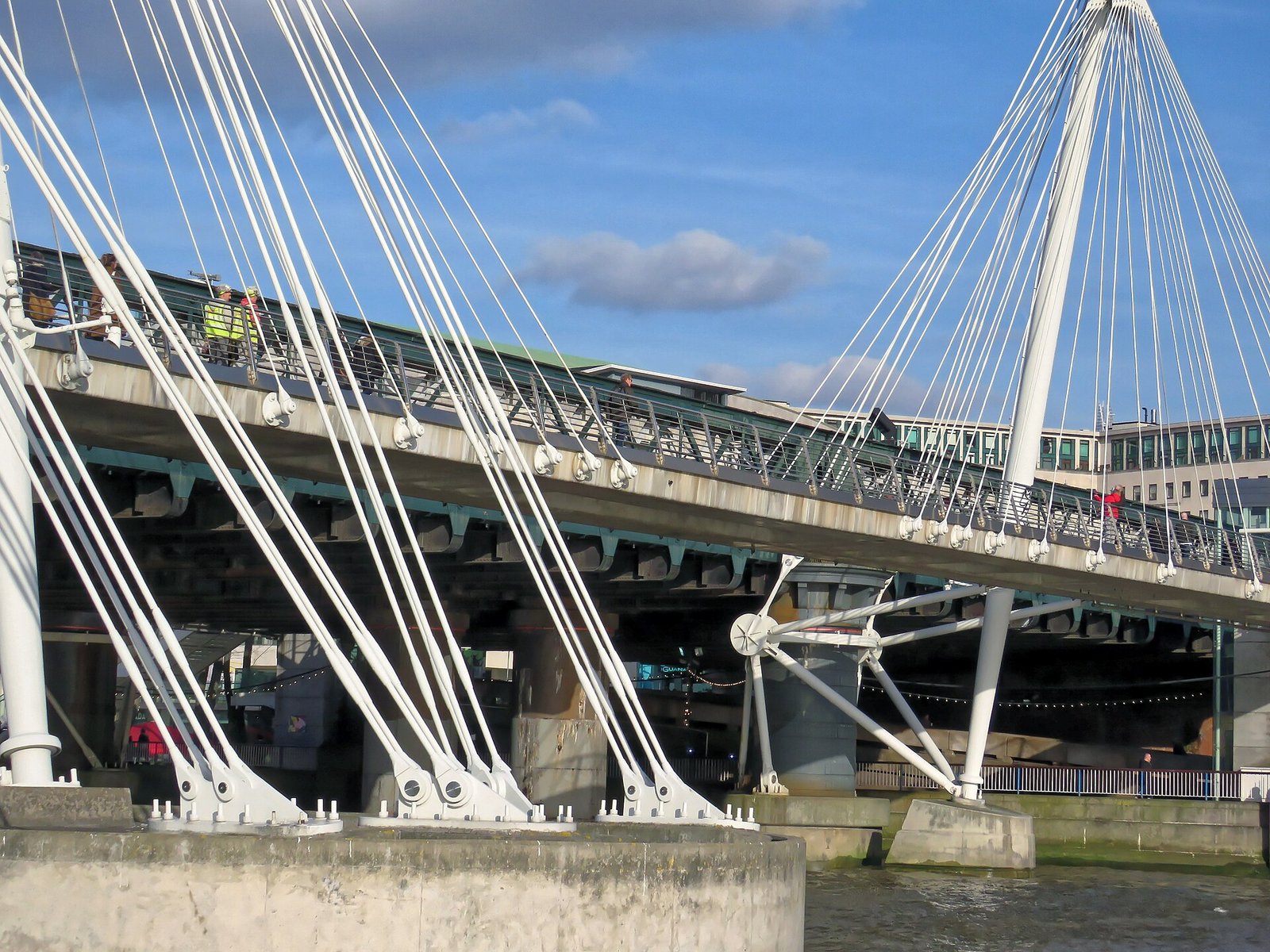
Hungerford Railway Bridge is easy to overlook. Its dark Victorian girders sit between the bright cables of the Golden Jubilee Bridges, while trains hurry across the Thames toward Charing Cross station.
Look more closely and it becomes one of London’s most interesting crossings. Parts of an earlier bridge designed by Isambard Kingdom Brunel survive beneath it, while other pieces of that lost bridge ended up more than 100 miles away in Bristol.
The short version
A Victorian railway bridge with a Brunel connection
Hungerford Railway Bridge opened in 1864 to carry trains into Charing Cross station. Sir John Hawkshaw designed its wrought iron lattice spans, but the railway reused supports from an earlier suspension bridge created by Isambard Kingdom Brunel.
Why was Hungerford Railway Bridge built?
The first bridge at this location was not built for trains. Brunel’s Hungerford Suspension Bridge opened in 1845, providing a pedestrian route between the South Bank and Hungerford Market on the north side of the Thames.
The arrival of the railway changed its future. The South Eastern Railway wanted to extend its route from London Bridge to a new central London terminus at Charing Cross. The company purchased Hungerford Market and the suspension bridge in 1859, then removed most of Brunel’s crossing to make way for the railway.
Sir John Hawkshaw designed the replacement bridge. Construction took place during the early 1860s, and the new crossing opened with Charing Cross station on January 11, 1864. The history of Charing Cross station and Hungerford Bridge explains how the railway reached the heart of London.
What happened to Brunel’s original bridge?
Brunel’s suspension bridge disappeared from the skyline, but it was not completely lost.
Two of its original supports were retained and incorporated into the railway crossing. They were altered and extended as the new structure developed, but they still connect today’s bridge with the crossing that opened in 1845.
The suspension chains had an even longer journey. They were removed, taken to Bristol and reused during the completion of Clifton Suspension Bridge. This means that pieces of the first Hungerford Bridge survive in two different cities.
Did you know?
Part of the old bridge moved to Bristol
The suspension chains from Brunel’s Hungerford Bridge were reused at Clifton Suspension Bridge. The London crossing vanished, but some of its most important components found a second life across the Avon Gorge.
How was Hungerford Railway Bridge constructed?
The bridge has nine spans formed from wrought iron lattice girders. The crisscrossed metalwork creates a rigid structure capable of carrying heavy railway traffic while keeping the individual components relatively slender.
The girders are supported by cast iron piers in the river and brick abutments at the banks. Historic England records the crossing as two railway bridges joined by lateral trusses rather than one completely uniform structure.
The first section opened in 1864 with four railway tracks and pedestrian paths. It was widened in 1886 as the railway needed more capacity, creating the side by side arrangement that Network Rail now records as Bridges 7 and 7A.
You can compare its lattice construction with the plate girders of nearby Cannon Street Railway Bridge and the enclosed railway deck of Blackfriars Railway Bridge.
Could pedestrians once cross the railway bridge?
Yes. The original railway crossing included pedestrian paths beside the tracks. These were narrow routes attached directly to the railway structure rather than the spacious crossings seen today.
Pedestrians initially paid a toll to use them. The toll was abolished in 1878, but railway expansion gradually took space away from people on foot. One path was converted for railway use during the nineteenth century, leaving a single narrow walkway on the downstream side.
That remaining path became increasingly unsuitable for the number of people moving between Charing Cross and the South Bank. It was eventually replaced by the much wider Golden Jubilee Bridges, which opened in 2002.
Six important dates
Hungerford Bridge timeline
1845
Brunel’s suspension footbridge opens across the Thames.
1859
The South Eastern Railway purchases the original bridge.
1864
Hawkshaw’s railway bridge opens with Charing Cross station.
1886
The railway bridge is widened to provide additional capacity.
2002
The Golden Jubilee pedestrian bridges open beside it.
2025
A major restoration of the Victorian metalwork begins.
Are Hungerford Bridge and the Golden Jubilee Bridges the same?
No. The names are often used together because the three crossings sit immediately beside one another, but they perform different jobs.
Hungerford Railway Bridge is the central Victorian structure carrying trains into Charing Cross. The two Golden Jubilee Bridges are modern pedestrian crossings positioned on either side of it.
The pedestrian bridges share the river crossing and make use of the older bridge’s supports, but they have their own decks, cables and outward leaning pylons. Our Golden Jubilee Bridges profile explores those two footbridges in more detail.
Can you walk across Hungerford Railway Bridge?
You cannot walk on the railway bridge itself. Public pedestrian access is provided by the Golden Jubilee Bridges on either side.
Walking across either footbridge provides one of the clearest close views of Hungerford Railway Bridge. From there, you can see its lattice girders, passing trains and the older supports rising from the Thames.
The crossing also provides views toward the London Eye, the Palace of Westminster and the City of London. It connects the South Bank with Victoria Embankment and Charing Cross, making it both a useful everyday route and an excellent place to watch London moving around the river.
Why is Hungerford Railway Bridge being restored?
Network Rail began a major refurbishment program in January 2025. The Victorian wrought iron has been exposed to river weather for more than 160 years, so regular protection is essential if the bridge is to continue carrying trains safely.
The work includes cleaning and painting the bridge, testing the pins that join its structural members and replacing protective end caps. Network Rail says the original metalwork will be retained and refurbished rather than replaced.
Materials and waste are being moved by barge where possible. This reduces the number of construction vehicles traveling through central London while work continues above the river.
Trains are expected to continue using the crossing through most of the project, although some weekend closures may be required. Network Rail currently expects the Hungerford Railway Bridge refurbishment to be completed by the end of winter 2028.
Research
Hungerford Railway Bridge sources and further reading
Explore the railway histories, heritage records and official project information used to research this bridge profile.
-
The history of Charing Cross station and Hungerford Bridge
Network Rail -
Hungerford Railway Bridge refurbishment
Network Rail -
Restoring the original Victorian metalwork
Network Rail Media Centre -
Historic record of Hungerford Railway Bridge
Historic England -
Hungerford Bridge and the River Thames crossings
Port of London Authority -
Construction and dimensions of Charing Cross Bridge
Southern Railway Email Group
Information checked October 18, 2026.