Bridge profile
Cannon Street Railway Bridge, London
City of London and Southwark, London, England
Opened in 1866 and later widened to ten tracks, Cannon Street Railway Bridge carries trains over the Thames into the heart of the City of London.
At a glance
Key facts
Location
First opened
September 1, 1866
Crosses
Bridge type
Visit and use
History
Alternative names
Alexandra Bridge, Cannon Street Bridge
People and construction
Architect / designer
Sir John Hawkshaw and Sir John Wolfe Barry
Engineer
Francis Brady (1886 to 1893 widening)
Ownership and maintenance
Owner
Network Rail
Maintained by
Network Rail
Design and dimensions
Some bridges demand attention. Cannon Street Railway Bridge simply gets on with the job.
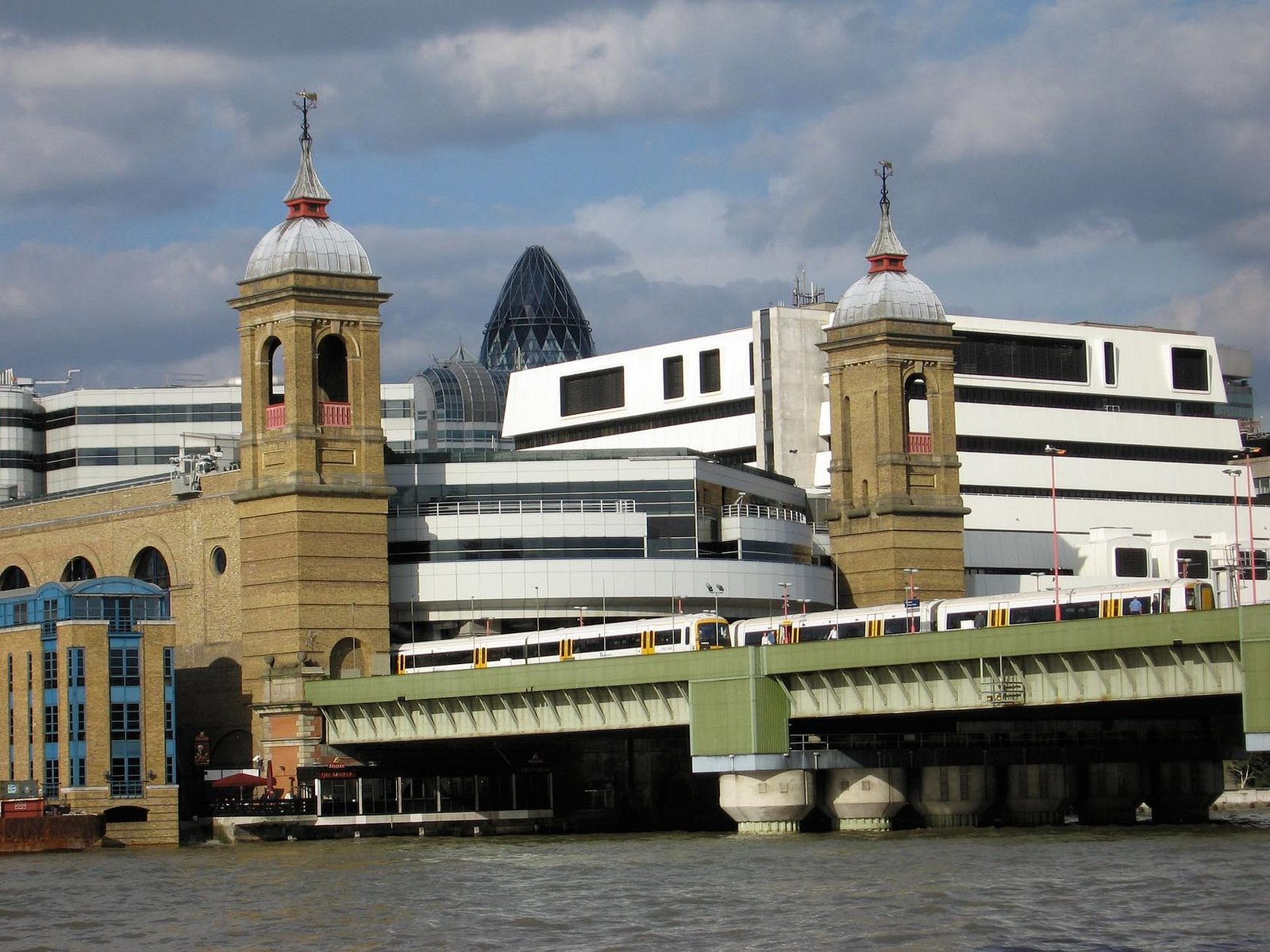
Its broad green structure carries trains across the River Thames and directly into Cannon Street station. Look beyond its practical appearance, however, and you find a bridge with vanished toll footpaths, Victorian cast iron piers and a brief spell as the widest railway bridge in the world.
The short version
A railway bridge built for the City
Cannon Street Railway Bridge opened in 1866 to carry the South Eastern Railway across the Thames and into a new terminal in the City of London. It originally carried five tracks and two footpaths before being widened to ten tracks during the late nineteenth century.
Why was Cannon Street Railway Bridge built?
The South Eastern Railway already carried passengers into London Bridge station, but it wanted a terminal closer to the commercial center of the City of London.
Parliament authorized the bridge, station and connecting railway in 1861. Construction began in 1863 under the direction of Sir John Hawkshaw, working with Sir John Wolfe Barry.
The bridge crossed the Thames between Southwark and the City, allowing trains to continue directly into the new Cannon Street station. The bridge and station opened together on September 1, 1866.
The Network Rail history of Cannon Street station follows the development of the crossing and the terminal it was built to serve.
Why was it originally called Alexandra Bridge?
The official name was Alexandra Bridge, chosen in honor of Princess Alexandra of Denmark. She had married Albert Edward, Prince of Wales, in 1863 and later became queen when he succeeded to the throne as Edward VII.
The royal name never became the one Londoners used most often. The bridge was closely associated with Cannon Street station, so Cannon Street Bridge and Cannon Street Railway Bridge became the familiar names.
Despite how it sounds, Cannon Street was not named after artillery. Its name developed from an old term connected with the candle makers who once worked in the area.
How was Cannon Street Railway Bridge constructed?
The bridge crosses the Thames in five spans. Its railway deck is supported by plate girders resting on rows of large cast iron cylinders sunk into the riverbed.
The original bridge had four river piers, with each pier formed from four cylinders. These hollow cylinders were filled with concrete below the riverbed and brickwork above it, producing heavy foundations capable of supporting passing trains.
The two shore spans measure approximately 38 meters, or 126 feet, while each of the three central spans measures approximately 41 meters, or 136 feet.
The Institution of Civil Engineers history of Cannon Street Railway Bridge explains its foundations, girders and later strengthening work in greater detail.
Did you know?
It became the widest railway bridge in the world
When the widening work was completed in 1893, the bridge measured approximately 120 feet across. Network Rail records that this made it the widest railway bridge in the world at the time.
Why was Cannon Street Railway Bridge widened?
Rail traffic into Cannon Street grew quickly. The original five tracks could no longer handle the number of trains approaching the station, so a major widening program began in 1886.
Engineer Francis Brady expanded the bridge on its upstream side. Two additional cast iron cylinders were added to each river pier, increasing the number of cylinders in every pier from four to six.
The work allowed the railway to double the number of tracks from five to ten. It also increased the width of the bridge from approximately 66 feet to 120 feet.
The widening was completed in 1893. Although the bridge became far more useful for trains, the work brought an end to its remaining pedestrian routes.
Could people once walk across Cannon Street Railway Bridge?
Yes. The original bridge included two footpaths alongside the railway tracks.
One path was reserved for railway employees. The other eventually opened to the public as a toll route across the Thames. Historic England records public pedestrian use between 1872 and 1877, when users paid a halfpenny to cross.
The toll was abolished in 1877, but the footpaths did not survive the later widening. They were removed as the railway expanded across the available deck space.
The Historic England record for Cannon Street Railway Bridge preserves this easily missed part of its history.
Five important dates
Cannon Street Railway Bridge timeline
1863
Construction begins on the bridge and railway into Cannon Street.
1866
The bridge and Cannon Street station open to railway traffic.
1893
The widened bridge opens with space for ten railway tracks.
1981
British Rail completes major work on the modern railway deck.
2019
The bridge joins the Illuminated River artwork.
How much of the Victorian bridge survives?
Cannon Street Railway Bridge has been strengthened and reconstructed several times. Work between 1910 and 1913 added girders so the bridge could carry increasingly heavy trains.
A much larger renovation took place between 1979 and the early 1980s. The railway deck was replaced, while gaps inside the older iron cylinders were filled with grout. Reinforced concrete collars were also added around the tops of the cylinders.
Many of the original decorative details disappeared during this modernization, leaving the bridge with the simple industrial appearance seen today. However, the Victorian cast iron piers remain an important part of the crossing.
What are the two brick towers beside the bridge?
Two large brick towers stand at the northern end of the bridge beside Cannon Street station. They formed part of the original Victorian station complex rather than serving as ordinary bridge towers.
The towers once concealed water tanks used to operate the station’s hydraulic lifts. Their shaped roofs and gilded weather vanes create a more decorative entrance than the practical railway bridge in front of them.
Much of the original Cannon Street station was demolished during twentieth century redevelopment, but the two riverside towers survived and remain among its most recognizable historic features.
Can you walk across Cannon Street Railway Bridge today?
No. The bridge is open to trains but has no public pedestrian or cycling route.
It can be viewed clearly from the Thames Path on both sides of the river. Southwark Bridge provides a useful view from the west, while the riverside paths near London Bridge provide views from the east.
Passengers can also cross the bridge by train when traveling to or from Cannon Street station. The low railway deck means the river and neighboring bridges can appear only briefly through the carriage windows.
For another railway crossing with a very different relationship to the public, explore our Blackfriars Railway Bridge, London profile. Its station platforms extend directly across the Thames.
Why does Cannon Street Railway Bridge light up at night?
In 2019, Cannon Street Railway Bridge became one of the first crossings included in Illuminated River, an artwork connecting several bridges through coordinated lighting.
Artist Leo Villareal created a sequence of subtle moving colors inspired by the movement of trains across the bridge. Energy efficient LED lighting replaced the older system and was designed to reduce unnecessary light spilling onto the river.
The Illuminated River guide to Cannon Street Railway Bridge explains the lighting design and the history that inspired it.
Research
Cannon Street Railway Bridge sources and further reading
Explore the railway histories, engineering records and heritage sources used to research this bridge profile.
-
History of Cannon Street station and railway bridge
Network Rail -
Construction and engineering of Cannon Street Railway Bridge
Institution of Civil Engineers -
Historic record of Cannon Street Railway Bridge
Historic England -
Cannon Street Railway Bridge and the Thames crossings
Port of London Authority -
History and lighting of Cannon Street Railway Bridge
Illuminated River -
The 2019 lighting of Cannon Street Railway Bridge
Network Rail Media Centre
Information checked October 18, 2026.