Bridge profile
Vauxhall Bridge, london
Vauxhall and Pimlico, London, England
Vauxhall Bridge crosses the Thames between Pimlico and Vauxhall, hiding eight monumental bronze figures beneath its busy road and protected cycle route.
At a glance
Key facts
Location
First opened
May 26, 1906
Crosses
Bridge type
Visit and use
Nearest postcode / ZIP code
Bridge use
Status
Open to traffic
People and construction
Engineer
Sir Alexander Binnie and Sir Maurice Fitzmaurice
Builder / main contractor
Messrs. Pethick Bros. for the piers and foundations; Charles Wall for the superstructure
Ownership and maintenance
Owner
Transport for London
Maintained by
Transport for London
Design and dimensions
Vauxhall Bridge is easy to cross without noticing its greatest feature. Cars, buses, bicycles and pedestrians travel between Pimlico and Vauxhall while eight monumental bronze figures watch the Thames from the piers below.
The present bridge opened in 1906, but the history of crossing the river here may reach back thousands of years. Between the modern traffic, hidden sculpture and possible Bronze Age remains, Vauxhall Bridge has far more to reveal than its practical appearance suggests.
The short version
A working bridge with a hidden art gallery
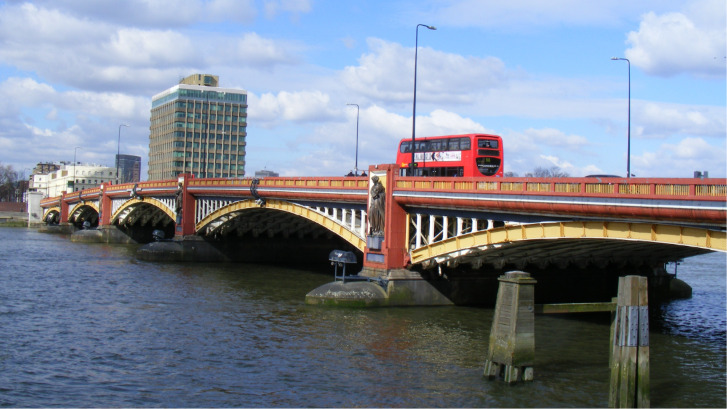
Vauxhall Bridge is a five span steel arch bridge connecting Vauxhall with Pimlico. It opened in 1906, became the first bridge to carry trams across the Thames and hides eight enormous bronze figures representing the work of local government.
Why was Vauxhall Bridge built?
The present Vauxhall Bridge replaced an earlier crossing completed in 1816. That bridge was originally known as Regent’s Bridge before taking the Vauxhall name.
The first bridge had nine cast iron arches supported by masonry piers. It was intended to encourage development south of the Thames and provide access to the popular Vauxhall Pleasure Gardens.
Crossing was not originally free. The Vauxhall Bridge Company charged tolls in the hope of earning money from visitors traveling to the gardens and the growing neighborhoods around them.
The tolls were abolished in 1879 when the bridge passed into public ownership. By then, however, the structure was already struggling with damage caused by the river.
Changes to the flow of the Thames had allowed water to scour material from around its foundations. Repairs became increasingly expensive, while growing traffic placed more pressure on a bridge built for an earlier London.
The London County Council decided in 1894 that replacement was the better option. Demolition of the old bridge began in 1898 and a temporary wooden crossing was erected while plans for its successor continued.
Why did the new Vauxhall Bridge take so long to build?
The replacement project did not progress smoothly. Although the old bridge was demolished in 1898, construction of the present crossing did not begin until 1904.
Early plans favored a heavier bridge with concrete and granite arches. Concerns about the soft London clay beneath the river encouraged a change to a lighter steel superstructure.
Sir Alexander Binnie began the design while serving as chief engineer of the London County Council. His successor, Sir Maurice Fitzmaurice, continued and developed the work.
The finished bridge used five steel arches supported by concrete piers and abutments faced with granite. Messrs. Pethick Bros. constructed the piers and foundations, while Charles Wall was responsible for the superstructure.
Vauxhall Bridge finally opened on May 26, 1906. The Prince of Wales, who later became King George V, conducted the opening ceremony.
Four important dates
Vauxhall Bridge timeline
1816
The first Vauxhall Bridge opens across the Thames.
1879
The bridge enters public ownership and its tolls are removed.
1906
The present steel arch bridge officially opens.
2015
A protected two way cycle track opens across the bridge.
What are the statues on Vauxhall Bridge?
Vauxhall Bridge has eight bronze female figures positioned against its river piers. They represent areas of responsibility associated with the London County Council.
The figures are easy to miss because they face the river and sit below the level of the road. Someone can cross the bridge every day without getting a clear look at them.
Frederick Pomeroy created the four figures facing upstream. Alfred Drury produced the four on the downstream side.
Agriculture
The figure carries a shepherd’s crook and a sheaf of corn.
Architecture
The figure holds a model of St Paul’s Cathedral.
Engineering
The figure holds a detailed steam engine and a mallet.
Pottery
The figure carries a large vase.
Government
One of Alfred Drury’s four figures facing downstream.
Education
A celebration of public education and civic responsibility.
Fine Art
The arts take their place alongside practical public services.
Science
This figure is also described in some records as Astronomy.
The Historic England listing for Vauxhall Bridge considers the sculptures one of the principal reasons for the bridge’s Grade II* status.
Did you know?
You cannot properly see the bridge’s greatest feature from the bridge
The eight bronze figures are positioned on the river piers below road level. The best views are found from the Thames Path, the river or a neighboring bridge rather than from the roadway above them.
How was Vauxhall Bridge constructed?
Vauxhall Bridge has five steel arch spans. Its central span measures 45.4 meters, while the neighboring spans become gradually shorter toward the riverbanks.
Each arch is formed from thirteen steel ribs. These support the road deck above while transferring its weight toward the piers and abutments.
The piers and abutments are made from concrete and faced with granite. Beneath the surface, large masses of Portland cement concrete form the foundations.
The bridge measures 231.6 meters from end to end according to its official heritage listing. Its broad deck was designed around a central pair of tram tracks, with space for road traffic and pedestrians on either side.
Historic England records the bridge’s colorful decorative scheme as burgundy and orange with blue and white trim. This helps pick out the ribs, panels and smaller details beneath the roadway.
Did trams cross Vauxhall Bridge?
Yes. The present Vauxhall Bridge was the first bridge to carry trams across the River Thames.
Tram tracks ran through the center of the roadway when the bridge opened. This was not a small addition made later. The width and strength required for tram traffic formed part of its design.
The opening ceremony itself demonstrated the new connection. Guests traveled across the bridge by tram before continuing to another London County Council event.
London’s last conventional tram services ended in 1952, but the bridge retained its role as a major transport route. It now carries the A202, bus services, ordinary road traffic, pedestrians and a protected cycle track.
Was there a bridge at Vauxhall during the Bronze Age?
There may have been a wooden crossing near this location thousands of years before the modern bridge.
In 1998, archaeological work in the Thames uncovered remains of an oak structure dating from around 1500 BC. The discovery suggests that people were using a constructed route into the river during the Bronze Age.
It is not certain that the structure crossed the entire Thames. It may instead have formed a walkway leading toward an island that was later submerged.
Before the modern bridge
A possible crossing from around 1500 BC
The oak remains discovered near Vauxhall may represent one of the earliest constructed routes into the Thames. Archaeologists remain cautious about whether it crossed the whole river or connected the bank with a lost island.
Can you walk or cycle across Vauxhall Bridge?
Vauxhall Bridge has pedestrian paths and can be crossed for free at any time the bridge is open.
Cyclists have a protected two way track across the bridge. The separated route opened in 2015 as part of the cycling connection between Oval and Pimlico.
The route was designed to remove cyclists from the busiest parts of the Vauxhall road system and provide a protected crossing of the Thames. The official announcement for the Vauxhall protected cycle route records its opening and original design.
Pedestrians can follow the Thames Path downstream toward Lambeth Bridge, the next road crossing to the east.
Is Vauxhall Bridge currently open?
Yes. Vauxhall Bridge remains open to ordinary road traffic, buses, pedestrians and cyclists.
Transport for London introduced a temporary 18 tonne weight restriction on July 1, 2026, after an inspection identified deterioration in parts of the structure. Buses and emergency vehicles are exempt from the restriction.
Transport for London has stated that the bridge remains safe for people using it. The restriction is intended to prevent further damage while longer term work is developed.
Restrictions and construction arrangements can change. Check the latest Transport for London information about Vauxhall Bridge when planning a journey involving a heavy vehicle.
Research
Vauxhall Bridge sources and further reading
Explore the official heritage records, archive photographs and transport sources used to research this bridge profile.
-
Official heritage listing for Vauxhall Bridge
Historic England -
Historic photograph of a Vauxhall Bridge steel arch being positioned
Historic England Archive -
Albert Embankment conservation area and Vauxhall Bridge sculptures
London Borough of Lambeth -
Alfred Drury and his Vauxhall Bridge sculptures
Royal Society of Sculptors -
Opening of the protected cycle route across Vauxhall Bridge
London City Hall -
Current Vauxhall Bridge weight restriction
Transport for London
Information checked October 16, 2026.