Bridge profile
Lambeth Bridge, London
Lambeth and Westminster, London, England
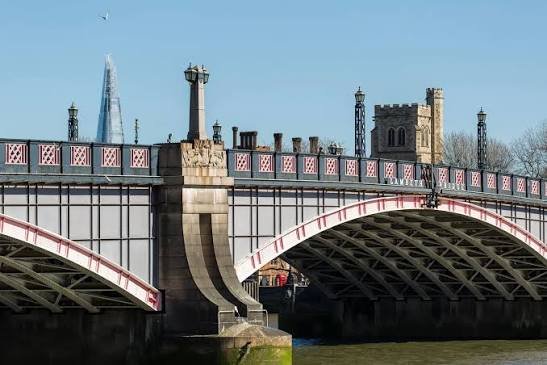
Lambeth Bridge crosses the Thames in five red steel arches, linking Lambeth with Westminster beside the Houses of Parliament and Lambeth Palace.
At a glance
Key facts
Location
First opened
July 19, 1932
Crosses
Bridge type
Visit and use
Nearest postcode / ZIP code
Bridge use
Status
Open to traffic
People and construction
Architect / designer
Sir Reginald Blomfield and George Topham Forrest
Engineer
Sir George Humphreys
Builder / main contractor
Dorman Long & Co. Ltd.
Ownership and maintenance
Owner
Transport for London
Maintained by
Transport for London
Design and dimensions
Lambeth Bridge connects two very different sides of central London. Lambeth Palace stands close to its southern landing, while the northern approach leads toward Westminster and the Houses of Parliament.
The red bridge seen today opened in 1932, but people had been crossing the Thames here for centuries. Its story includes a horse ferry, a rusting Victorian suspension bridge, a parliamentary argument and four stone decorations that are constantly mistaken for pineapples.
The short version
A red bridge beside Parliament
Lambeth Bridge is a five span steel arch crossing that opened in 1932. It replaced a badly corroded Victorian suspension bridge and is known for its red paintwork, granite piers and pineapple shaped stone pinecones.
Why was there a horse ferry at Lambeth?
Long before the first bridge appeared, this part of the Thames was an important landing place. Records of people crossing here stretch back to the thirteenth century.
A horse ferry eventually carried passengers, animals and carriages between Lambeth and Millbank. It was one of the few local ferries capable of transporting an entire horse drawn carriage across the river.
The Archbishop of Canterbury controlled the service from nearby Lambeth Palace. The ferry stopped operating after Westminster Bridge opened in 1750, but its name survives on the northern approach through Horseferry Road.
A name hiding in plain sight
Horseferry Road remembers the old crossing
The road leading away from Lambeth Bridge is a reminder of the ferry that carried horses and carriages across the Thames before a permanent bridge existed here.
What happened to the first Lambeth Bridge?
The first Lambeth Bridge opened in November 1862. Designed by Peter W. Barlow, it was an iron suspension bridge with three long spans and steep approaches.
It opened as a toll bridge, but the charges were abolished in 1879 after the Metropolitan Board of Works took responsibility for it. By then, serious corrosion had already begun affecting the iron structure.
Repairs were carried out in 1887, but the bridge continued to deteriorate. Its steep approaches discouraged horse drawn traffic, and it gradually became more useful to pedestrians than vehicles.
The bridge closed to vehicle traffic in 1910. Plans for a replacement were delayed by the First World War, leaving London with an increasingly outdated crossing for many more years. The London Museum history of Lambeth Bridge follows the site from the horse ferry to the present structure.
Why did Parliament debate the replacement bridge?
The London County Council received permission to build a replacement in 1924, but the final design differed from the version originally presented to Parliament.
The first proposal included elliptical arches faced with granite. When detailed work began, engineers decided that the design would be too heavy and less suitable for modern traffic and river navigation.
A lighter design using visible steel arches was produced instead. The alteration was important enough to be debated in the House of Lords in 1928 before construction could proceed.
The surviving parliamentary debate about rebuilding Lambeth Bridge provides an unusual glimpse of a bridge design being questioned before work began.
Who designed the current Lambeth Bridge?
Construction started in 1929. Sir George Humphreys served as the engineer, working with consulting architects Sir Reginald Blomfield and George Topham Forrest.
Dorman Long and Company fabricated and erected the bridge. The firm was one of the leading bridge builders of its era and also worked on the Tyne Bridge and Sydney Harbour Bridge.
A temporary footbridge allowed people to continue crossing during construction. King George V and Queen Mary officially opened the completed bridge on July 19, 1932.
Lambeth Bridge received Grade II listed status in 2008. The Historic England listing for Lambeth Bridge records the bridge, its approaches, lamp standards, walls and distinctive obelisks.
What is Lambeth Bridge made from?
The bridge has five shallow steel arches supported by reinforced concrete piers and abutments faced with polished Cornish granite.
Each arch contains nine steel ribs beneath the roadway. These ribs spread the weight of the bridge while allowing the visible arches to remain relatively shallow and graceful.
The central span measures 50.3 meters, while the complete bridge is approximately 236.5 meters long. Cast iron balustrades and carefully designed lamp standards add decoration without hiding the steel structure.
Six important dates
Lambeth Bridge timeline
1862
The first iron suspension bridge opens as a toll crossing.
1879
The bridge toll is abolished.
1910
The corroded bridge closes to vehicle traffic.
1932
The present steel arch bridge officially opens.
2008
Lambeth Bridge receives Grade II listed status.
2021
The bridge joins the Illuminated River artwork.
Why is Lambeth Bridge painted red?
Lambeth Bridge is painted predominantly red because its northern landing sits close to the Houses of Parliament. The color represents the red leather benches used in the House of Lords.
The choice creates a visual partner for nearby Westminster Bridge, which is painted green to match the benches in the House of Commons.
The connection between the two bridges turns parliamentary tradition into part of London’s riverside landscape. You do not need to understand politics to tell which chamber each bridge represents.
Red and green
Two bridges, two houses of Parliament
Lambeth Bridge represents the red benches of the House of Lords, while Westminster Bridge represents the green benches of the House of Commons.
Are those decorations pineapples or pinecones?
Four stone decorations stand on top of the obelisks at the bridge approaches. They are widely described as pineapples, but the official Historic England listing identifies them as pinecones.
Pinecones have long been used as symbols of hospitality. Their shape, however, has encouraged a more colorful local explanation involving the nearby burial place of seventeenth century gardener and plant collector John Tradescant.
Tradescant is often connected with the introduction or early cultivation of pineapples in Britain. This has led to the claim that the bridge decorations honor him.
The story is appealing, but the evidence is weak. The London Museum investigation of the Lambeth Bridge decorations also concludes that the official pinecone explanation is more convincing.
Settle the argument
Officially pinecones, visually very pineapple
Historic England calls the decorations pinecones. Most people seeing them from the pavement will understand why the pineapple story refuses to disappear.
Can you walk or cycle across Lambeth Bridge?
Yes. Lambeth Bridge carries road traffic, pedestrians and cyclists between Lambeth and Westminster.
Footways run along both sides of the bridge, providing views toward the Palace of Westminster, Lambeth Palace and the riverside buildings around Millbank. There is no charge to cross.
In 1965, Lambeth Bridge became the first London crossing to have a pedestrian route tunneled beneath it along the embankment. This allowed people following the riverside to continue beneath the bridge without crossing the road above.
Is Lambeth Bridge worth visiting?
Lambeth Bridge is worth visiting for its river views, political color scheme and unusual decorations. It also tends to feel calmer than Westminster Bridge, despite being only a short walk away.
The southern landing is close to Lambeth Palace and the Garden Museum. On the Westminster side, the bridge reaches Victoria Tower Gardens beside the Palace of Westminster.
Visit during daylight to see the red steelwork and carved details, then return after sunset if you want to see the bridge’s lighting. Lambeth Bridge joined the Illuminated River project in 2021, extending the red color across its nighttime appearance.
Research
Lambeth Bridge sources and further reading
Explore the museum accounts, heritage records and historical documents used to research this bridge profile.
-
Official heritage listing for Lambeth Bridge
Historic England -
The horse ferry, two bridges and pineapple mystery
London Museum -
The 1928 parliamentary debate about Lambeth Bridge
UK Parliament -
Lambeth Bridge and other Thames crossings
Port of London Authority -
Ownership and highway responsibility for London bridges
Transport for London -
Lambeth Bridge and the Illuminated River
Illuminated River
Information checked October 10, 2026.