Bridge profile
Millennium Bridge, London
London, England, United Kingdom
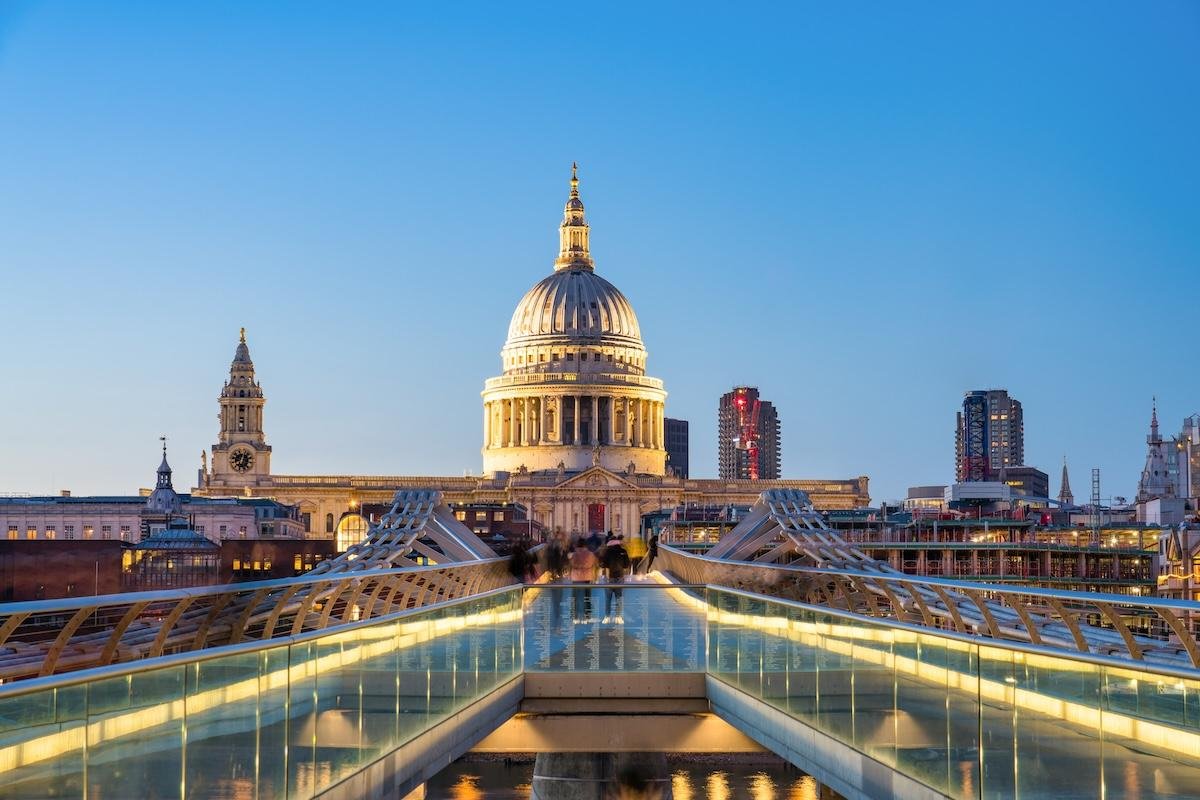
Opened in 2000 and quickly nicknamed the Wobbly Bridge, London’s Millennium Bridge is a pedestrian suspension bridge connecting St Paul’s Cathedral with Tate Modern.
At a glance
Key facts
Location
First opened
June 10, 2000
Crosses
Bridge type
Visit and use
People and construction
Architect / designer
Foster + Partners, Arup and Sir Anthony Caro
Design and dimensions
Millennium Bridge was supposed to arrive as a sleek symbol of a new century. Instead, its first crowds gave London a surprise. The bridge began moving from side to side, earned the nickname the Wobbly Bridge and closed only days after opening.
That difficult beginning became part of its appeal. The problem was studied, the bridge was repaired and the crossing returned stronger. Today, its slim silver deck creates one of London’s most memorable walks, with St Paul’s Cathedral at one end and Tate Modern at the other.
The short version
The bridge that found its feet
Millennium Bridge is a shallow suspension bridge built for pedestrians. It opened on June 10, 2000, closed after unexpected movement under large crowds and reopened on February 22, 2002 after engineers installed equipment that controls the motion.
Why was Millennium Bridge built?
For more than a century, no new pedestrian bridge had been built across this part of the River Thames. The opening of Tate Modern at the former Bankside Power Station created an opportunity to connect the South Bank directly with St Paul’s Cathedral and the historic City of London.
A competition for the new crossing was launched in 1996 by the Millennium Bridge Trust, working with the Financial Times, the Royal Institute of British Architects and Southwark Council. The winning proposal brought together Foster + Partners, engineers Arup and sculptor Sir Anthony Caro.
The team wanted something much quieter than a bridge with tall towers. Their winning idea became known as the blade of light, a thin silver line intended to sit low across the water without interrupting protected views of St Paul’s Cathedral. The Foster + Partners Millennium Bridge project explains how architecture, engineering and sculpture shaped the final design.
How was Millennium Bridge designed?
Millennium Bridge is a shallow suspension bridge. Instead of carrying its main cables high above the walkway, the design places eight cables along the sides of the deck. Steel arms reach inward from those cables to support the pedestrian surface.
Two Y shaped supports stand in the river. The cables rise no more than about 2.3 meters above the deck, leaving people with wide views along the Thames rather than enclosing them behind a tall structure.
The bridge is approximately 325 meters long and its walkway is about 4 meters wide. Its main structure is steel, while the deck is made from aluminum. City Bridge Foundation’s 25 facts about Millennium Bridge provides a useful tour through its design, opening and unusual history.
Did you know?
Around 90,000 people crossed on opening day
The enormous crowd helped reveal a type of sideways movement that had not been properly understood when the bridge was designed. The opening became both a public celebration and an unexpected full scale experiment.
Why is Millennium Bridge called the Wobbly Bridge?
Millennium Bridge opened to the public on Saturday, June 10, 2000. As thousands of people crossed, parts of the deck began swaying noticeably from side to side. Access was restricted the following day and the bridge closed on Monday evening while the movement was investigated.
The problem became known as synchronous lateral excitation. In plain language, a small sideways movement caused pedestrians to adjust their steps for balance. Enough people made similar adjustments at the same time, adding more energy to the movement and making the bridge sway further.
This did not mean the bridge was about to collapse. It meant that the interaction between the flexible structure and a dense moving crowd had produced a level of motion that was uncomfortable and unsuitable for public use. The nickname Wobbly Bridge arrived almost immediately and has remained long after the wobble disappeared.
How was the Millennium Bridge wobble fixed?
Engineers studied the movement and developed a system of dampers beneath the deck. Dampers absorb and control motion in a similar way to shock absorbers in a vehicle. They allowed the appearance of the bridge to remain almost unchanged while dealing with the forces created by pedestrians.
The crossing remained closed for around 18 months while the solution was designed, installed and tested. It reopened on February 22, 2002 and the repair proved successful. Research from the project also influenced how engineers around the world assess movement on pedestrian bridges.
Foster + Partners’ facts about the design and repair of Millennium Bridge offer more detail about the ideas behind the crossing and the response to its movement.
Four important dates
Millennium Bridge timeline
1996
A competition is launched to find a design for the new Thames crossing.
2000
The bridge opens on June 10 and closes after unexpected sideways movement.
2002
Millennium Bridge reopens on February 22 after dampers are installed.
2023
The deck receives important maintenance and a thorough clean.
Does Millennium Bridge still wobble?
No. The damping system controls the movement that caused the original problem, and the bridge has carried pedestrians successfully since reopening in 2002.
Like every busy bridge, it still requires inspection and maintenance. In 2023, the crossing closed temporarily while contractors replaced the membrane separating its aluminum deck from the steel structure below. The work also included a deep clean before the bridge reopened in November.
Planned maintenance and temporary closures can change, so visitors can check the official London bridge works and closures page before making a special journey.
A curious London rule
Why was straw hanging beneath the bridge?
During the 2023 maintenance work, a bundle of straw was suspended beneath Millennium Bridge. This followed a traditional Thames rule requiring straw to warn vessels when work reduces the available space below a bridge.
Was Millennium Bridge in Harry Potter?
Yes. Millennium Bridge appears in the sixth Harry Potter film, where it is attacked and destroyed by Death Eaters. The fictional disaster gave the bridge one of its most recognizable screen appearances.
The real bridge has also appeared in Guardians of the Galaxy and Run Fatboy Run. Its straight view toward St Paul’s Cathedral and its low, uncluttered design make it an easy London location to recognize on screen.
Its history includes other unusual public moments. In 2007, 600 people bounced across the bridge on space hoppers for 60 seconds, setting a world record. Both the movie appearances and the space hopper event are recorded in City Bridge Foundation’s official anniversary history.
Can you walk across Millennium Bridge?
Yes. Millennium Bridge is a public pedestrian crossing and no ticket is required. The walk places Tate Modern and Shakespeare’s Globe near the southern end, with St Paul’s Cathedral and the streets of the City of London to the north.
The bridge is particularly popular with photographers because the dome of St Paul’s lines up with the walkway when viewed from the south. The low cables also leave broad views toward other Thames crossings and landmarks.
Visitors can continue east beside the river toward London Bridge and then onward to Tower Bridge. This makes Millennium Bridge an easy starting point for a walk connecting three very different London bridges.
Research
Millennium Bridge sources and further reading
Explore the official histories, design records and maintenance updates used to research this bridge profile.
-
Millennium Bridge history and 25th anniversary facts
City Bridge Foundation -
Millennium Bridge design and project overview
Foster + Partners -
Ten facts about Millennium Bridge
Foster + Partners -
City of London guide to Millennium Bridge
City of London Corporation -
Millennium Bridge maintenance and reopening in 2023
City Bridge Foundation -
Current bridge works and closure information
City Bridge Foundation
Information checked October 1, 2026.