Bridge profile
Chelsea Bridge, London
Chelsea and Battersea, London, England, United Kingdom
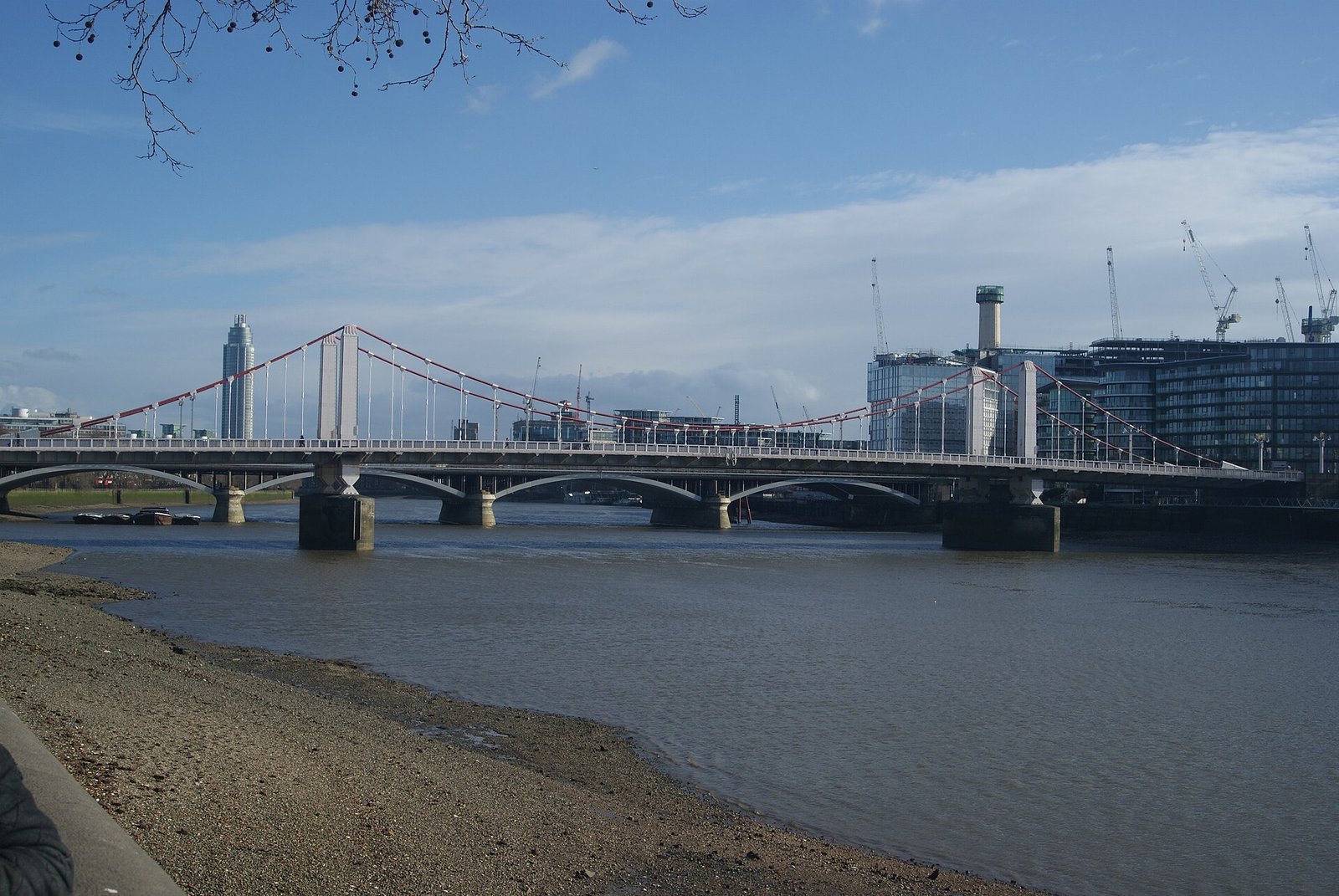
Opened in 1937, Chelsea Bridge crosses the Thames between Chelsea and Battersea in a graceful sweep of white steel, red trim and golden galleons.
At a glance
Key facts
Visit and use
Nearest postcode / ZIP code
Bridge use
Status
Open to traffic
People and construction
Architect / designer
George Topham Forrest
Engineer
Sir Thomas Peirson Frank, London County Council Engineers, Rendel, Palmer and Tritton
Builder / main contractor
Holloway Brothers (London) Ltd.
Ownership and maintenance
Owner
Royal Borough of Kensington and Chelsea
Maintained by
Royal Borough of Kensington and Chelsea
Design and dimensions
Main materials
Total length
212.7 meters / 698 feet
Main span
107.3 meters / 352 feet
Number of spans
3
Chelsea Bridge crosses the Thames in a clean sweep of white steel, red trim and slender suspension cables. It connects the northern riverbank with Battersea, landing beside Battersea Park and a short walk from Battersea Power Station.
The bridge looks quietly elegant, but its history is anything but ordinary. Two different bridges have occupied this crossing, an unpopular toll once charged visitors heading to a public park, and construction work uncovered one of the finest pieces of Iron Age art ever found in Britain.
The short version
An elegant bridge with an unusual structure
Chelsea Bridge is a three span suspension bridge opened in 1937. Its cables are connected to strong girders within the bridge, allowing the structure to resist much of its own pulling force instead of relying entirely on enormous anchorages buried beside the river.
Why was Chelsea Bridge built?
The first bridge at this location was built to improve access to the newly created Battersea Park. Work began during the 1850s, and the crossing opened in March 1858.
Londoners commonly called it Victoria Bridge, although the name was never formally established. Reaching the new public park came with an irritating catch: people were charged a toll to cross.
The arrangement attracted understandable criticism. London had been given a new park, but many visitors had to pay simply to reach its entrance. The Metropolitan Board of Works later acquired the bridge, and the tolls disappeared in 1879.
What happened to the original Chelsea Bridge?
The first bridge was admired for its appearance, but doubts about its strength appeared early. It required strengthening during the 1860s and again around 1880, when the name Chelsea Bridge came into wider use.
By the 1920s, the narrow Victorian crossing could no longer comfortably handle London’s growing motor traffic. Plans for a replacement were delayed by financial pressure, but the old bridge was eventually demolished during the 1930s.
Construction of the bridge standing today took place between 1934 and 1937. London County Council engineers led by Sir Thomas Peirson Frank developed the design, with Rendel, Palmer and Tritton serving as consultants. George Topham Forrest advised on its appearance, while Holloway Brothers carried out the construction.
Did you know?
A Canadian prime minister opened the bridge
Canadian Prime Minister William Lyon Mackenzie King opened Chelsea Bridge on May 6, 1937. Douglas fir from British Columbia had been used during construction, giving Canada an unexpected connection to the new London crossing.
How does Chelsea Bridge support itself?
Chelsea Bridge is described as a self anchoring suspension bridge. The idea sounds more complicated than it needs to.
Most traditional suspension bridges secure their main cables inside huge anchorages built into the ground. The cables pull against those anchorages as the weight of the roadway hangs beneath them.
The ground beside Chelsea Bridge was not ideal for that approach. Instead, the engineers connected the cables to strong stiffening girders running through the bridge. Much of the pulling force is therefore contained within the structure rather than transferred into enormous blocks beside the river.
The design helped create the bridge’s slim appearance while supporting a broad roadway. Its early use of high tensile steel was also important. The material appeared in the suspension cables, stiffening girders and deck before Britain had introduced its first formal standard for this type of steel.
Historic England’s record of Chelsea Bridge explains why its design represented a significant step forward in British bridge construction.
How large is Chelsea Bridge?
Chelsea Bridge measures 212.7 meters from end to end and is 25 meters wide. Its central span stretches 107.3 meters across the main navigation channel, with a 52.4 meter side span at each end.
Steel forms the bridge’s cables, towers, girders and deck. Its foundations and piers use steel and reinforced concrete, while granite facing protects and decorates the sections visible above the water.
Boats travel through the central opening, which provides approximately 6.6 meters of clearance above mean high water springs.
The bridge in numbers
Chelsea Bridge dimensions
212.7 meters
Total bridge length
107.3 meters
Central span
25 meters
Overall width
3 spans
One central and two side spans
Why are there golden ships on Chelsea Bridge?
The bridge’s decoration is restrained until you look closely. Tall lamp standards rise from the approaches, each crowned by a golden galleon.
Heraldic shields represent the former London County Council and the areas surrounding the bridge. Doves carrying olive branches appear among the metalwork, while the white, red and blue gray color scheme gives the crossing a brighter character than its steel construction might suggest.
Look closer
Not every treasure is easy to spot
The golden galleons are visible above the traffic, but some of the bridge’s smaller shields, birds and symbols are easier to appreciate while crossing on foot.
What was found beneath Chelsea Bridge?
Work on the first bridge produced a discovery far older than the crossing itself.
In 1857, workers recovered an elaborately decorated bronze shield covering from the Thames. The object, now known as the Battersea Shield, was made between approximately 350 and 50 BCE.
Its surviving bronze surface carries flowing patterns and 27 red glass studs. It would originally have covered a wooden shield, but the wood disappeared during the centuries spent in or near the river.
The object shows no clear signs of battle damage. Its delicate decoration has led researchers to suggest that it may have been a ceremonial possession deliberately placed in the Thames as an offering.
The mystery of the Battersea Shield remains open, but its discovery transformed nineteenth century bridge construction into an unexpected journey back to Iron Age Britain.
Five important dates
Chelsea Bridge timeline
1857
Workers recover the Battersea Shield from the Thames.
1858
The first bridge opens beside Battersea Park.
1879
Tolls are removed from the crossing.
1937
The current Chelsea Bridge opens.
2008
The bridge receives Grade II protection.
Can you walk or cycle across Chelsea Bridge?
Yes. Chelsea Bridge remains open to road traffic, pedestrians and cyclists. Broad footways run along both sides, giving views toward Battersea Power Station, Battersea Park and the neighboring Thames crossings.
The bridge forms part of Cycleway 8 and has designated cycling space, although the arrangement differs between directions. Anyone planning a longer journey can follow TfL’s Cycleway 8 route through central London.
Battersea Park begins at the southern end of the bridge. Continue upstream and the white steelwork soon gives way to the pastel towers of Albert Bridge. Head downstream and trains cross the Thames on Grosvenor Railway Bridge before reaching Victoria.
Research
Chelsea Bridge sources and further reading
Explore the heritage records, official transport information and archaeological research used to create this bridge profile.
-
Chelsea Bridge heritage listing
Historic England -
Chelsea Bridge and the Thames Conservation Area
Royal Borough of Kensington and Chelsea -
The Battersea Shield found in the Thames
London Museum -
Navigation beneath Chelsea Bridge
Port of London Authority -
Cycleway 8 through central London
Transport for London
Information checked November 17, 2026.