Bridge profile
Fan Bridge, London
Merchant Square, Paddington Basin, London, England
Paddington’s Fan Bridge turns an everyday footbridge into a spectacle as five steel sections rise above the canal like a giant Japanese hand fan.
At a glance
Key facts
Location
First opened
September 2014
Crosses
Bridge type
Visit and use
History
Alternative names
Merchant Square Footbridge; Merchant Square Bridge; Merchant Square Fan Lift Bridge
People and construction
Architect / designer
Knight Architects
Engineer
AKT II; Eadon Consulting
Builder / main contractor
Mace Ltd
Ownership and maintenance
Owner
European Land & Property Ltd
Maintained by
Merchant Square Estates
Design and dimensions
Most footbridges either stay still or rise as one solid piece. Fan Bridge does neither. At Paddington Basin, its walkway separates into five steel sections that lift to different heights, creating the shape of a huge hand fan.
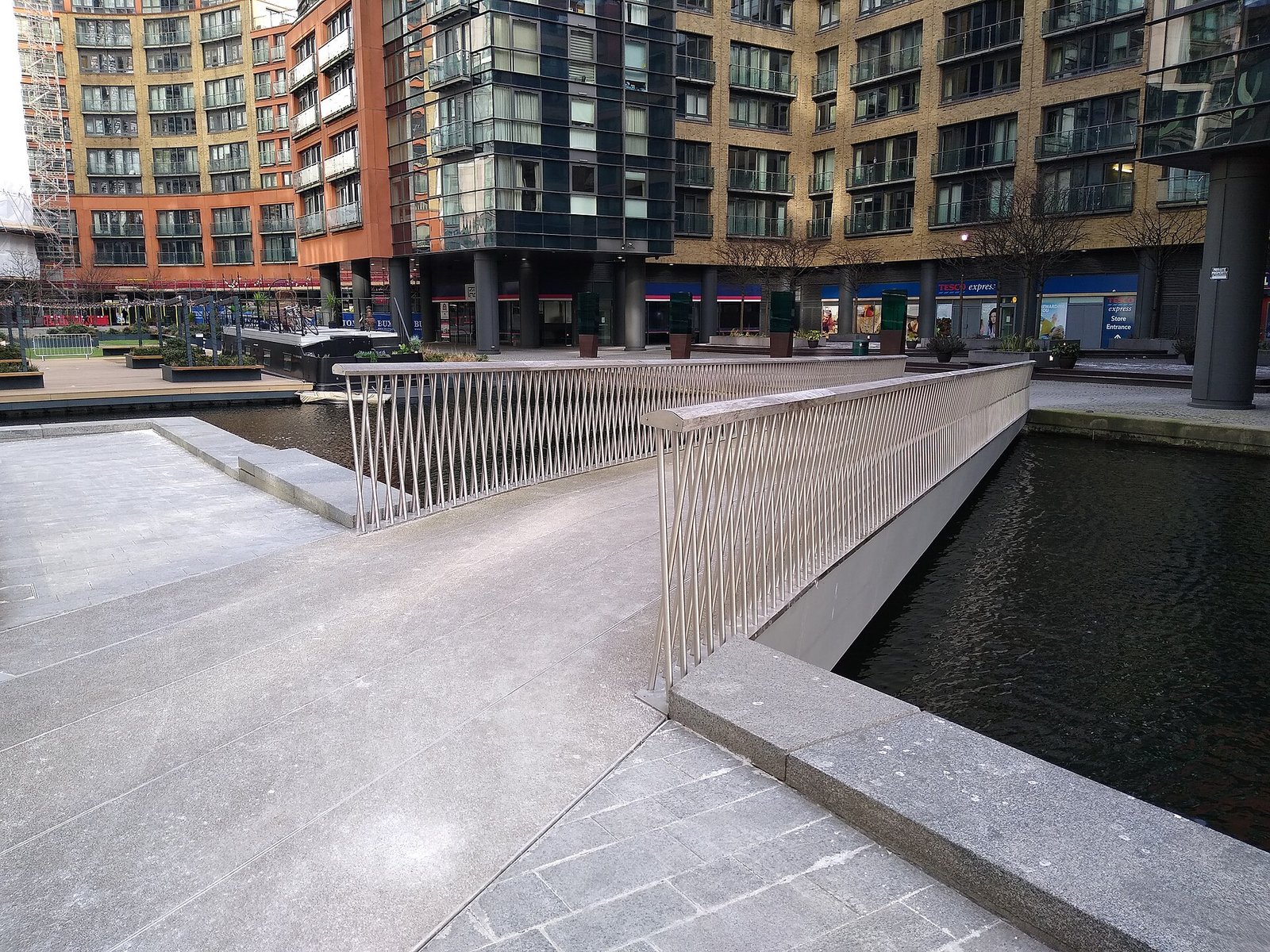
When the bridge is lowered, the trick is surprisingly well hidden. The five sections fit together to form a wide pedestrian crossing, with little indication that the entire walkway can rise above the canal.
The short version
A footbridge that opens like a fan
Fan Bridge is a movable pedestrian bridge at Merchant Square in Paddington Basin. Five steel sections rise using hydraulic cylinders, opening at different angles to create the appearance of a traditional Japanese hand fan.
Why was Fan Bridge built at Paddington Basin?
Fan Bridge was created as part of the redevelopment of Merchant Square, a collection of homes, offices, restaurants and public spaces beside Paddington Basin.
A pedestrian crossing was needed to connect the areas on opposite sides of the water. However, the entrance to the end of the basin also had to remain available for boats, which meant the new crossing needed to open.
The project was not intended to produce an ordinary lifting bridge. The client wanted a structure that would improve the walking route while becoming a recognizable part of Merchant Square.
Knight Architects and structural engineer AKT II won a limited design competition in 2012. Their solution turned the necessary opening movement into a public performance. The Knight Architects account of Merchant Square Footbridge explains how the project was designed to give the development a stronger identity.
How does Fan Bridge open?
The bridge deck is divided lengthwise into five separate fabricated steel beams. These long sections are often described as fingers or blades.
Each section is hinged at the northern side of the basin and has its own hydraulic cylinder. When the bridge opens, the cylinders raise the five sections at different speeds and to different angles.
The sections move together but do not remain level with one another. One rises steeply while the others stop progressively lower, producing the bridge’s distinctive fan shape.
When the bridge closes, the five sections return to a nearly level position and join to form one continuous walking surface approximately three meters wide.
Did you know?
It is almost five bridges in one
Each of the five steel sections has its own hydraulic cylinder and moves at a carefully controlled speed. The separate sections must finish their movement together to create the completed fan.
Why does Fan Bridge resemble a Japanese hand fan?
The fan shape is produced by raising each section through a different distance. The sections nearest one side of the bridge rise much higher than those beside them.
The hydraulic cylinders look similar from the outside, but their movements are individually limited. This allows each section to stop at the correct angle while keeping the overall movement coordinated.
The sections are also positioned along slightly different pivot lines. This prevents them from colliding as they separate and helps create the expanding shape visible from around the basin.
The mechanical design account from Eadon Consulting provides a closer look at the hydraulic equipment and the carefully controlled movement of the five sections.
What do the counterweights do?
Large shaped counterweights sit behind the five bridge sections. These balance part of the weight of the steel beams, reducing the force required from the hydraulic system.
The counterweights are functional, but they were also designed as part of the surrounding public space. As the bridge rises, their sculpted forms rotate toward the ground and become part of the visual performance.
When the bridge is lowered, the counterweights remain visible beside the walkway as a series of curved steel forms. They provide one of the clearest clues that this is not an ordinary footbridge.
Each moving section weighs approximately six to seven metric tons. The counterweights help make it possible to lift these sections using a comparatively compact hydraulic system.
How much room does Fan Bridge create for boats?
The bridge spans approximately 20 meters across the head of Paddington Basin. When raised, it creates a navigable opening approximately 2.5 meters high and 5.5 meters wide around the middle of the channel.
The five sections are supported mainly from the northern side of the basin. When lowered, their ends meet the opposite bank and form a stable pedestrian deck.
The bridge can also close under gravity. This was an important safety feature because it allows the sections to return to the walking position even if hydraulic power is unavailable.
The Structural Steel Design Awards record for Fan Bridge explains the counterweights, hydraulic cylinders and unusually precise steel fabrication.
Four important dates
Fan Bridge timeline
2012
Knight Architects and AKT II win the design competition for the new crossing.
2014
The five steel sections are fabricated, transported by canal and installed at Merchant Square.
September 2014
Fan Bridge officially opens to pedestrians.
2015
The bridge receives a Structural Steel Design Award and recognition from the Institution of Structural Engineers.
Who designed and built Fan Bridge?
Knight Architects developed the architectural design, working with AKT II on the bridge’s structural engineering.
Eadon Consulting designed the mechanical operating equipment and prepared the hydraulic and electrical specifications. Studio Fractal designed the lighting, including low energy LED lights incorporated into the handrails.
Mace served as the main contractor, while SH Structures fabricated the steel bridge sections. The five sections had to be manufactured with considerable precision so they would form a smooth walking surface when lowered without striking one another during operation.
The project went on to receive several design and engineering awards. The Institution of Structural Engineers praised Fan Bridge for combining an efficient structure with an elegant and entertaining lifting movement.
An appropriate arrival
The bridge traveled to Paddington by canal
Road access around the construction site was limited, so the five completed steel sections were carried to a wharf, loaded onto a barge and towed along the canal before being lifted into position.
What materials were used to build Fan Bridge?
The five moving sections are fabricated steel box girders. Their depth changes along the bridge, allowing the structure to appear comparatively slender while remaining strong enough to carry pedestrians.
Stainless steel rods form the transparent balustrades along the sides. Timber handrails provide a warmer surface for pedestrians, while LED lighting concealed beneath them illuminates the walkway after dark.
The walking surface has a durable epoxy and aggregate finish designed to provide grip. Beneath the northern end, the hydraulic cylinders and rotational bearings sit inside a concrete substructure protected from the canal water.
What did Fan Bridge replace?
Fan Bridge replaced another unusual movable crossing called the Helix Bridge.
The earlier glass and steel bridge retracted using a rotating movement that made it appear to corkscrew across the canal. It later stopped operating and was removed in 2013.
The replacement continued Paddington Basin’s tradition of treating bridges as moving public art. The Inland Waterways Association history of Britain’s canal bridges describes the former Helix Bridge and the two unusual moving bridges that remain at Paddington.
Are Fan Bridge and Rolling Bridge the same bridge?
No. Fan Bridge and Rolling Bridge are two separate pedestrian crossings at Paddington Basin.
Fan Bridge divides into five long sections that rise at different angles. Rolling Bridge is smaller and curls its eight hinged sections backward until the two ends meet.
The bridges are only a short walk apart, making it possible to see both during the same visit. Explore the smaller curling structure through our Rolling Bridge, London profile.
Can you walk across Fan Bridge?
Yes. Fan Bridge is an everyday pedestrian crossing when its five sections are lowered.
It connects the public spaces around Merchant Square and provides a convenient walking route across the head of Paddington Basin. There is no admission charge or toll to cross it.
Pedestrians cannot use the bridge during an opening. The surrounding waterside paths provide several places from which the lifting movement can be watched.
When can you watch Fan Bridge open?
The Paddington Partnership currently lists demonstrations at noon on Wednesdays and Fridays and at 2 p.m. on Saturdays.
Opening times may change because of maintenance, weather or operational requirements. Check the latest local visitor information for Fan Bridge shortly before making a special journey.
Before making a special journey
Confirm the demonstration time
Fan Bridge remains worth seeing when closed, but its full character only becomes visible during an opening. Check the local timetable before traveling specifically to watch it move.
Research
Fan Bridge sources and further reading
Explore the architectural records, engineering accounts and local visitor information used to research this bridge profile.
-
Design story of Merchant Square Footbridge
Knight Architects -
Mechanical and hydraulic design of Fan Bridge
Eadon Consulting -
Steel design, fabrication and installation
SteelConstruction.info -
Merchant Square Footbridge structural award
Institution of Structural Engineers -
Fan Bridge visitor information and demonstration times
The Paddington Partnership -
History of Britain’s canal and river bridges
Inland Waterways Association
Information checked October 16, 2026.