Bridge profile
Rolling Bridge, London
Paddington Basin, London, England
Paddington’s Rolling Bridge transforms from a steel and timber footbridge into an octagonal sculpture using eight hinged sections and quiet hydraulic power.
At a glance
Key facts
Location
First opened
September 2004
Crosses
Bridge type
Visit and use
History
Alternative names
Paddington Rolling Bridge; Curling Bridge
People and construction
Architect / designer
Heatherwick Studio
Engineer
SKM Anthony Hunts and Packman Lucas
Builder / main contractor
Littlehampton Welding Ltd
Ownership and maintenance
Owner
European Land & Property Ltd
Maintained by
Merchant Square Estates
Design and dimensions
Most movable bridges lift, swing or slide out of the way. Paddington’s Rolling Bridge does something far stranger. It curls itself into a compact octagon beside the water.
When extended, it looks like a small steel and timber footbridge crossing an inlet at Paddington Basin. Its real character appears when eight hinged sections rise together, gradually transforming the walkway into a freestanding sculpture.
The short version
A footbridge that curls into a sculpture
The Rolling Bridge is a movable pedestrian bridge completed in 2004. Hydraulic cylinders lift its eight connected sections until the two ends meet, leaving the canal inlet clear for boats.
Why was the Rolling Bridge built?
The Rolling Bridge forms part of the pedestrian route around Paddington Basin, an arm of the Grand Union Canal that was redeveloped with offices, homes and public spaces.
A small inlet interrupted the route beside the water. People needed a convenient way to cross it, but boats also needed to enter and leave the inlet.
A fixed bridge would have blocked the waterway. A conventional lifting or swinging bridge could have solved the practical problem, but the development team wanted something that would also give Paddington Basin a memorable identity.
Heatherwick Studio was appointed in 2002. Instead of treating the opening movement as something to hide, the designers made that movement the most important part of the bridge.
The Heatherwick Studio account of the Rolling Bridge explains how the design developed from the idea of a structure that would transform rather than appear broken when opened.
How does the Rolling Bridge work?
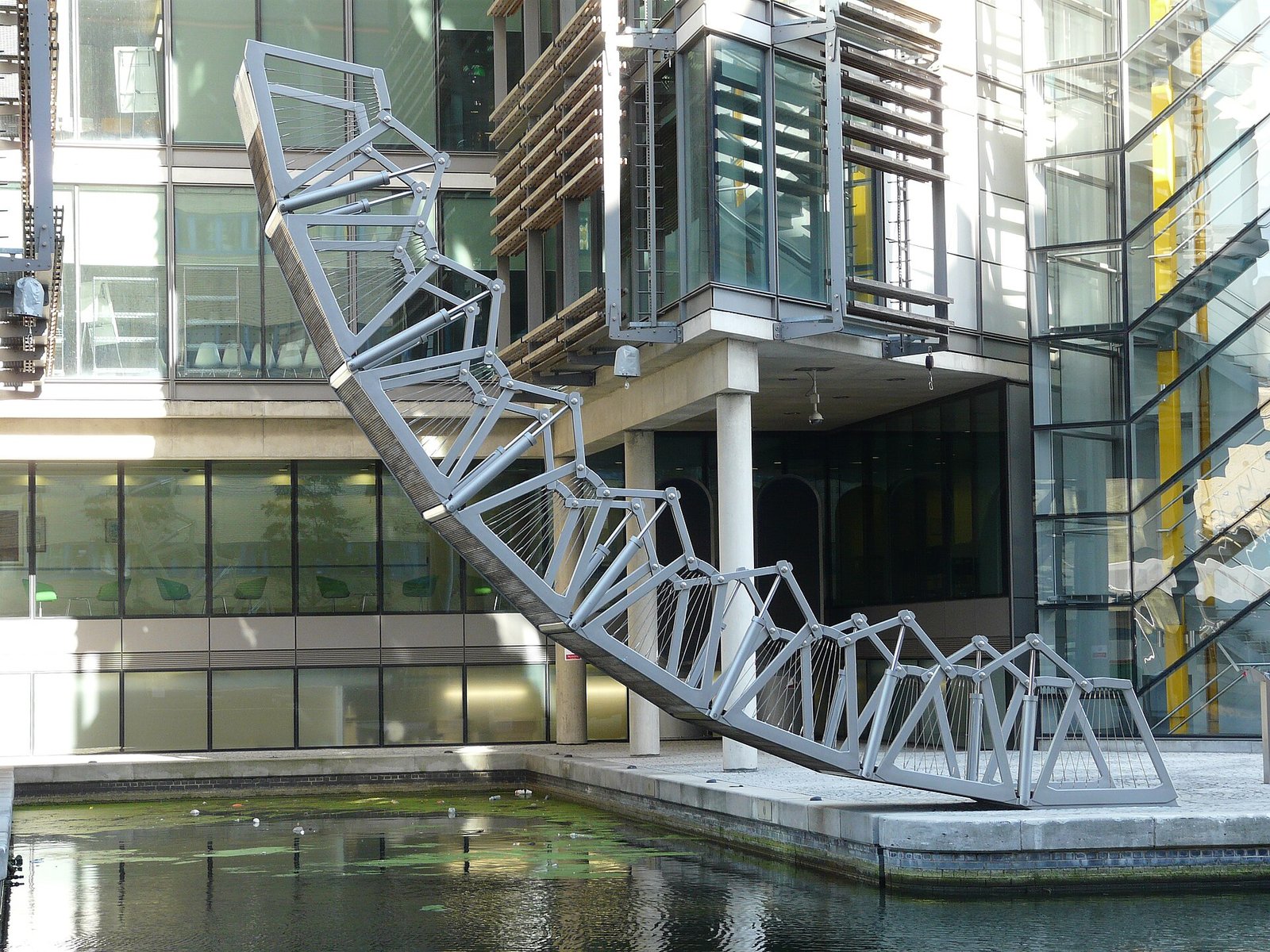
The bridge is divided into eight triangular steel sections connected by hinges at walkway level.
Hydraulic cylinders are concealed inside vertical posts along the sides of the bridge. When the system is activated, the cylinders pull parts of the handrails together and lift the connected walkway sections.
All eight sections move as part of the same controlled action. The bridge rises from the unsupported end and curls backward toward the bank until its two ends meet.
When fully curled, the bridge forms an eight sided shape. This compact position leaves the canal inlet open and turns the entire walkway into a sculptural object beside the water.
The transformation takes approximately three minutes. The mechanism can also be stopped during the movement, allowing the bridge to hold different curved shapes between its flat and fully curled positions.
Did you know?
Its movement was inspired by Jurassic Park
Heatherwick Studio took early inspiration from the fluid, curling tails of the animatronic dinosaurs created for Jurassic Park. That idea helped the designers imagine a bridge that would coil smoothly rather than lift as one rigid section.
Does the Rolling Bridge really roll?
The name is memorable, but the bridge does not roll along the ground like a wheel.
It curls back on itself through a series of hinged movements. The final shape is an octagon rather than a true circle, which is why the structure is sometimes described as a curling bridge.
The Rolling Bridge name refers to the visual impression created by the complete movement. From the side, the structure appears to roll itself into a ball.
When flat, its operation is difficult to guess. The bridge resembles a simple modern footbridge until the sections begin to rise.
How is the bridge supported when people cross it?
When fully extended, the structure behaves like a small steel truss. The handrails are not merely protective barriers. They form an important part of the bridge’s supporting structure.
The linked handrail sections act as the upper part of the truss, helping the bridge carry pedestrian loads across the inlet.
As the bridge starts curling, the structural forces change. The extended bridge becomes a cantilever supported from one bank, and the hydraulic system becomes part of the moving structure.
Some sections experience changes in the direction of their structural forces as they move over the top of the curl. Engineers therefore had to examine the bridge in many different positions rather than calculating only its flat and fully curled forms.
The Structural Steel Design Awards account of the Rolling Bridge provides a more technical explanation of these changing forces.
Four important dates
Rolling Bridge timeline
2002
Heatherwick Studio is appointed to design the bridge.
August 2004
The completed structure is installed at Paddington Basin.
September 2004
The Rolling Bridge officially opens.
2005
The bridge receives a Structural Steel Design Award.
Who designed and built the Rolling Bridge?
Heatherwick Studio created the architectural concept, with Thomas Heatherwick closely associated with the bridge’s unusual idea.
Structural engineering was developed with SKM Anthony Hunts and Packman Lucas. Specialists including Primary Fluid Power, Solent Fluid Power and DJW Consulting contributed to the hydraulic system.
Littlehampton Welding constructed the bridge at its workshop on the Sussex coast. The complete structure was then transported to London by water, traveling along the Grand Union Canal before being lifted into position at Paddington Basin.
Building the bridge in a workshop allowed the steel sections, hinges and hydraulic components to be assembled with unusually fine tolerances. When the bridge is fully curled, the separate frame members sit extremely close together.
The fabricator’s account of building the Rolling Bridge shows how the completed structure was brought to Paddington by canal.
Built beside the sea
The bridge arrived in London by canal
The entire structure was fabricated by Littlehampton Welding on the Sussex coast. It was transported to London and floated along the Grand Union Canal before being lifted over the Paddington Basin inlet.
What materials were used for the Rolling Bridge?
The main structure is made from rectangular steel sections, with hardwood timber forming the pedestrian deck.
Steel pins and bearings connect the eight moving sections. Hydraulic cylinders inside the bridge control the curling action, while additional equipment is housed within a nearby building.
The combination of gray steel and dark timber keeps the extended bridge visually simple. That simplicity makes its transformation more surprising because little about the flat walkway reveals the movement it can perform.
Is the Rolling Bridge the only bridge of its kind?
Guinness World Records recognizes the Rolling Bridge as the world’s first curling bridge and describes it as the only example of its kind.
Other bridges fold, retract or roll through different mechanical systems, but Paddington’s bridge is unusual because its complete walkway curls into a closed geometric shape.
The Guinness World Records entry for the first curling bridge records its eight moving sections and hydraulic operation.
Can you walk across the Rolling Bridge?
The Rolling Bridge was designed as a pedestrian crossing and can be walked across when it is extended over the inlet.
It provides a short connection around Paddington Basin rather than crossing the full width of the Grand Union Canal. Because the inlet is small, visitors can pass nearby without realizing that the ordinary looking walkway can curl into a sculpture.
There is no toll or admission charge. The bridge sits within the publicly accessible waterside area around Merchant Square.
A short walk around the basin also leads to the nearby Fan Bridge, a larger movable footbridge that opens through five rising sections.
Can you watch the Rolling Bridge move?
The bridge has historically been demonstrated on selected days each week, most commonly around lunchtime.
However, published visitor information currently conflicts. Visit London advertises demonstrations on Wednesdays and Fridays at midday, while the Paddington Partnership’s local visitor page states that the bridge is currently out of action.
Do not make a special journey solely to watch the bridge move without checking directly with Merchant Square shortly before visiting. Even when the mechanism is unavailable, the bridge and surrounding Paddington Basin area can still be viewed.
Check the latest local visitor information for the Rolling Bridge before planning a visit around a demonstration.
Before making a special journey
Check whether the bridge is operating
Historic timetables are still repeated across visitor websites, but the rolling mechanism has experienced periods out of service. Confirm the current position with Merchant Square if seeing the bridge move is the main reason for your visit.
Research
Rolling Bridge sources and further reading
Explore the design accounts, construction records and visitor information used to research this bridge profile.
-
Design story of the Rolling Bridge
Heatherwick Studio -
Structural design and hydraulic movement
New Steel Construction -
Fabrication and canal delivery of the Rolling Bridge
Littlehampton Welding -
World’s first curling bridge record
Guinness World Records -
Rolling Bridge entry in Contemporary Westminster
Westminster City Council -
Current visitor information for the Rolling Bridge
The Paddington Partnership
Information checked October 16, 2026.