Bridge profile
Golden Jubilee Bridges, London
Charing Cross and South Bank, London, England
The Golden Jubilee Bridges carry pedestrians between Charing Cross and the South Bank on two cable stayed walkways filled with remarkable views of central London.
At a glance
Key facts
Location
First opened
May 13, 2002 (upstream bridge); September 20, 2002 (downstream bridge)
Crosses
Bridge type
Visit and use
History
Alternative names
Hungerford Footbridges
People and construction
Architect / designer
Lifschutz Davidson Sandilands
Engineer
WSP Group and Gifford
Builder / main contractor
Costain and Norwest Holst
Ownership and maintenance
Owner
Westminster City Council
Maintained by
Westminster City Council
Design and dimensions
The Golden Jubilee Bridges create one of London’s most unusual river crossings. Two modern pedestrian bridges sit on either side of the much older Hungerford Railway Bridge, placing walkers beside passing trains while opening wide views along the Thames.
Their white pylons and fans of slender cables look light beside the dark Victorian railway structure. Together, the three structures appear to form one enormous bridge, but the Golden Jubilee Bridges are a separate matched pair with their own design, history and purpose.
The short version
Two footbridges built around a working railway
The Golden Jubilee Bridges are twin cable stayed pedestrian bridges completed in 2002. They flank the Victorian Hungerford Railway Bridge and connect the South Bank with Charing Cross and Victoria Embankment.
Why are there two Golden Jubilee Bridges?
The Golden Jubilee Bridges are not two unrelated crossings. They were designed together as a matched pair, with one pedestrian bridge on each side of Hungerford Railway Bridge.
This arrangement separated pedestrians from the railway while allowing the existing rail crossing to remain in operation. It also created two different walking experiences across the same part of the Thames.
The upstream bridge faces toward the London Eye, the Houses of Parliament and Westminster. The downstream bridge provides views toward Waterloo Bridge and the eastern London skyline.
Placing the walkways away from the sides of the railway bridge reduced some of the noise and vibration experienced by pedestrians. It also created a visible gap between the modern bridges and the heavy Victorian structure.
What crossed the Thames here before the Golden Jubilee Bridges?
The history of the crossing began long before the modern pedestrian bridges appeared.
In 1845, Isambard Kingdom Brunel opened a suspension footbridge between Hungerford Market and the South Bank. It was built to bring more customers toward the market near the site now occupied by Charing Cross Station.
The crossing was not originally free. More than 80,000 people reportedly paid a halfpenny toll to use the bridge on its first day.
Brunel’s footbridge was purchased by the South Eastern Railway Company in 1859. The company wanted to extend its railway across the Thames into a new central London terminus.
The suspension bridge was dismantled and replaced by the Hungerford Railway Bridge, designed by Sir John Hawkshaw and completed in 1864. Parts of Brunel’s bridge did not go to waste. Its suspension chains were reused during the completion of the Clifton Suspension Bridge in Bristol.
The Network Rail history of Charing Cross Station and Hungerford Bridge explains how the railway transformed this part of the river.
Six important dates
Golden Jubilee Bridges timeline
1845
Brunel’s suspension footbridge opens as a toll crossing.
1864
Hungerford Railway Bridge replaces the suspension bridge.
1996
A competition is launched for two new pedestrian bridges.
2002
Both Golden Jubilee Bridges open to pedestrians.
2003
Princess Alexandra conducts the ceremonial opening.
2021
The bridges join the Illuminated River artwork.
Why were the Golden Jubilee Bridges built?
Pedestrians continued to cross beside the railway after the Victorian bridge opened. The railway company was originally required to provide paths on both sides of the tracks.
One path was later removed when additional railway capacity was needed. The remaining walkway became narrow, poorly maintained and uncomfortable after dark.
By the 1990s, the crossing was no longer suitable for the number of people moving between Charing Cross, Waterloo and the South Bank. A design competition for two replacement footbridges was launched in 1996.
Lifschutz Davidson Sandilands won the competition with engineers from WSP Group. Gifford later completed the detailed structural design, while Costain and Norwest Holst carried out the principal construction work.
The architects’ account of the Hungerford Footbridges project explains how the bridges were designed around the railway, surrounding landmarks and protected views across London.
How do the Golden Jubilee Bridges work?
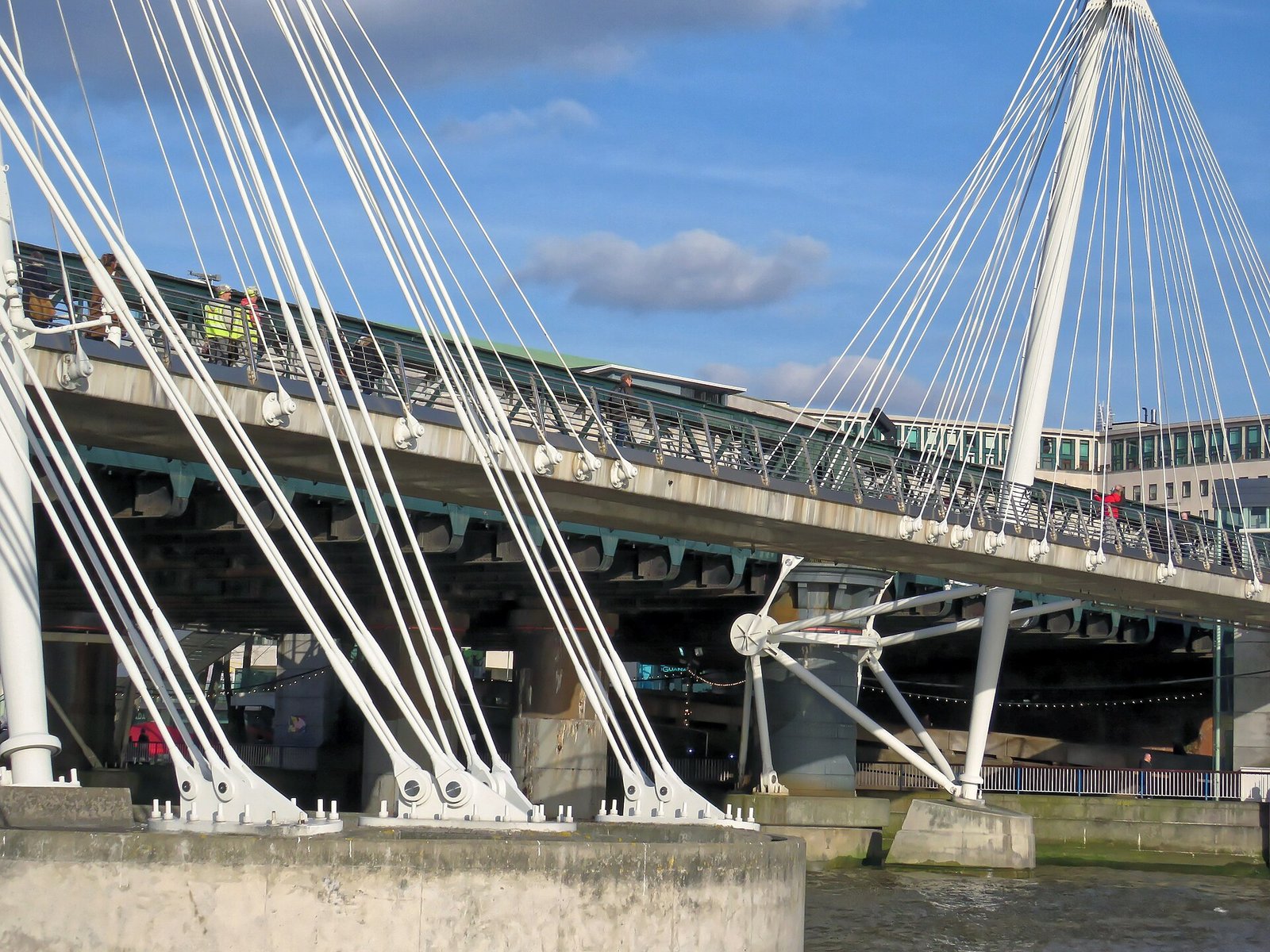
Each Golden Jubilee Bridge is a cable stayed structure. The pedestrian deck is supported by cables connected to a series of tall steel pylons.
The pylons lean away from the railway bridge. Cables running toward the deck help carry its weight, while cables extending in the opposite direction hold the pylons in balance.
This creates the bridges’ most recognizable feature. The repeated pylons and cables form a changing pattern as people walk across, sometimes appearing orderly and sometimes overlapping in a dense web.
Each bridge is approximately 315 meters long and divided into seven spans. Reinforced concrete beams form the pedestrian deck, while high tensile steel is used for the pylons and cable system.
The bridges are around 4.7 meters wide, providing considerably more space than the walkway they replaced. The decks sit several meters away from the railway tracks, allowing pedestrians to see the water between the structures.
Did you know?
The railway kept running during construction
The new pedestrian bridges had to be built beside one of London’s busiest railway approaches. Construction was carefully arranged so trains could continue traveling into and out of Charing Cross Station.
Why were the bridges so difficult to build?
The project occupied one of the most complicated bridge sites in London.
Engineers had to work around the existing railway, boat traffic on the Thames and Underground tunnels running beneath the river. The Bakerloo and Northern lines pass close to the foundations at the northern end of the crossing.
There was also concern that unexploded bombs from the Second World War could remain within the riverbed. Some foundation work was completed by hand to reduce the risk of disturbing anything buried near the Underground tunnels.
The design was altered so that a major northern support could be positioned on Victoria Embankment instead of within the river. Large concrete components were transported along the Thames by barge before being placed into position.
The pedestrian decks were assembled and gradually pushed across the river in sections. This construction method reduced the amount of work that had to take place directly above the water and limited disruption to river traffic.
A specialist paper on the structural design and construction of the Golden Jubilee Footbridges examines this launching process in greater technical detail.
A crowded underground site
Railways above and Underground trains below
The bridges were constructed beside an operating railway while Underground trains passed through tunnels beneath the river. Engineers also had to consider river traffic, historic structures and the possibility of unexploded wartime bombs.
Why are they called the Golden Jubilee Bridges?
The footbridges were completed during 2002, the year of Queen Elizabeth II’s Golden Jubilee. The name commemorates the fiftieth anniversary of her accession to the throne.
The upstream bridge opened in May 2002 and the downstream bridge followed in September. Princess Alexandra conducted a ceremonial opening on July 2, 2003.
The bridges are also known as the Hungerford Footbridges because they sit beside Hungerford Railway Bridge. Golden Jubilee Bridges is their official and more distinctive name.
How busy are the Golden Jubilee Bridges?
The bridges create a direct pedestrian route between Charing Cross and the South Bank. They are useful for commuters moving between railway stations, but they also carry large numbers of visitors heading toward theaters, galleries and riverside attractions.
An estimate published in 2014 suggested that around 8.4 million pedestrians were using the bridges each year. At that time, they were described as the most heavily used pedestrian crossings over the Thames.
Their popularity is helped by their location. The northern end reaches Victoria Embankment beside Charing Cross and Embankment stations. The southern end arrives close to the Royal Festival Hall, Southbank Centre and London Eye.
Can you walk across the Golden Jubilee Bridges?
Yes. Both bridges are public pedestrian crossings and there is no charge to use them.
Steps provide access at the ends of the bridges, with lifts available for step free access. Lift availability can change during maintenance, so visitors who require step free access should check current local travel information before arriving.
The two bridges provide different views. The upstream crossing is the stronger choice for views toward Westminster and the London Eye. The downstream crossing looks toward Waterloo Bridge and the eastern side of central London.
A riverside walk can continue west toward Westminster Bridge or east toward Waterloo Bridge. Using one of those crossings for the return journey creates an easy central London bridge loop.
Why do the Golden Jubilee Bridges light up at night?
The Golden Jubilee Bridges became part of the Illuminated River artwork in 2021.
Light emphasizes the bridges’ leaning pylons and cable patterns after dark. The illumination also makes the pedestrian decks feel visually connected with the other central London bridges included in the project.
The Illuminated River guide to the Golden Jubilee Footbridges provides more information about their lighting, design and history.
Research
Golden Jubilee Bridges sources and further reading
Explore the architectural accounts, railway history and specialist engineering sources used to research this bridge profile.
-
Design and history of the Hungerford Footbridges
Lifschutz Davidson Sandilands -
Golden Jubilee Footbridges history and illumination
Illuminated River -
History of Charing Cross Station and Hungerford Bridge
Network Rail -
Hungerford Bridge and Golden Jubilee Bridges
Port of London Authority -
Structural engineering of the Golden Jubilee Footbridges
Structural Engineering International -
Golden Jubilee Footbridges maintenance program
Westminster City Council
Information checked October 16, 2026.