Bridge profile
Waterloo Bridge, London
location: Westminster and Lambeth, London, England, United Kingdom
Completed during World War II and officially opened in 1945, Waterloo Bridge combines pale Portland stone, sweeping London views and the remarkable story of its wartime workforce.
At a glance
Key facts
Location
First opened
December 10, 1945
Crosses
Bridge type
Visit and use
Nearest postcode / ZIP code
Bridge use
Status
Open to traffic
History
Alternative names
The Ladies’ Bridge
People and construction
Architect / designer
Sir Giles Gilbert Scott, with engineers Rendel, Palmer and Tritton
Design and dimensions
Main materials
Total length
370 meters / 1,230 feet
Number of spans
5
Waterloo Bridge may have the finest view from any road crossing in London. From the middle, the skyline opens in both directions, with the Palace of Westminster to the west and St Paul’s Cathedral and the City to the east.
The bridge beneath your feet has an equally memorable story. Built through World War II, it is closely associated with the women who joined its wartime workforce. Its pale stone arches also replaced a celebrated crossing by one of Britain’s greatest bridge engineers.
The short version
London’s wartime bridge
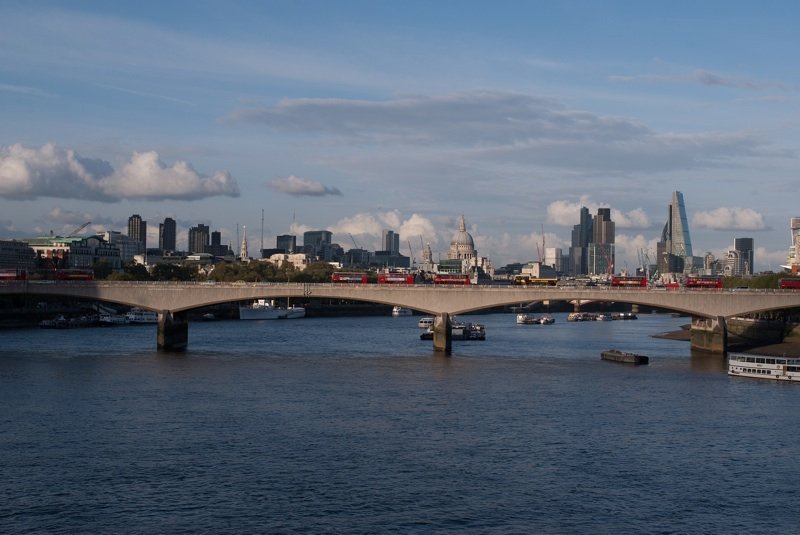
Waterloo Bridge is a five-span reinforced concrete crossing faced with pale Portland stone. Designed by Sir Giles Gilbert Scott, it opened partly in 1942 and was completed in 1945 after construction continued through bombing, labor shortages and wartime restrictions.
When was Waterloo Bridge built?
The present Waterloo Bridge was built between 1937 and 1945. Two lanes opened to traffic in 1942, allowing Londoners to use part of the crossing while work continued. The completed bridge received its official opening ceremony on December 10, 1945.
That date can make the answer look simpler than it is. Construction began before World War II, continued during the Blitz and remained unfinished when traffic first crossed. The bridge therefore belongs to both prewar London and the city that emerged from the conflict.
The official Historic England listing for Waterloo Bridge records its construction history, designers, materials and Grade II* status.
Did you know?
London used it before it was finished
Two lanes of the new Waterloo Bridge opened in 1942, three years before its official completion. The partial opening kept an important route across the Thames working during the war.
Was Waterloo Bridge built by women?
Women unquestionably worked on the Waterloo Bridge project during World War II. Historic England records that the workforce included women carrying out both skilled and unskilled labor, while surviving photographic evidence shows female acetylene welders dismantling the temporary bridge beside the new crossing in 1944.
This history explains the affectionate nickname the Ladies’ Bridge. For decades, the story survived largely through memories and Thames tour guides because the women received little formal recognition when the bridge opened.
The evidence deserves careful wording. It confirms that women helped build and complete the bridge project, but it does not give us a reliable total for the female workforce or prove that women alone built most of the structure. The Historic England account of the women who worked on Waterloo Bridge explains how their contribution was added to the official heritage record in 2015.
The honest answer
A real story with missing names
Women’s wartime work on Waterloo Bridge is documented, but many individual names and roles have been lost. The nickname remains a useful reminder of both their contribution and how easily working lives can disappear from the record.
What happened to the first Waterloo Bridge?
The present bridge is the second permanent crossing at this location. The first was designed by Scottish engineer John Rennie and opened on June 18, 1817.
The project was originally known as Strand Bridge because its northern approach met the Strand. Before the opening, it was renamed Waterloo Bridge to commemorate the British and allied victory over Napoleon at the Battle of Waterloo in 1815.
Rennie’s bridge had nine granite arches and was admired for its orderly, monumental appearance. It was also a toll bridge until 1877. By the early twentieth century, however, one of its piers had settled into the riverbed and a visible dip had developed near the Strand end.
A temporary steel bridge opened beside it while politicians, engineers and preservation campaigners argued over what should happen next. Demolition of Rennie’s crossing began in 1934, clearing the way for the bridge London uses today. The London Museum history of Waterloo Bridge follows both crossings and the long wait for a replacement.
Who designed the current Waterloo Bridge?
Architect Sir Giles Gilbert Scott designed the appearance of the current bridge. His other famous London work includes Battersea Power Station and the familiar red telephone box.
The engineering was developed by Rendel, Palmer and Tritton, and Peter Lind and Company carried out the main construction work. Together, they produced a broad, restrained bridge that feels lighter than its concrete structure might suggest.
Waterloo Bridge is approximately 370 meters, or 1,230 feet, long and 24 meters, or 80 feet, wide. Its generous deck carries the A301 road, sidewalks and segregated cycle lanes between the Strand and the South Bank.
What type of bridge is Waterloo Bridge?
Waterloo Bridge is a five-span reinforced concrete arch bridge. Four hollow piers support five shallow spans, with three central spans of approximately 75 meters and two outer spans of approximately 72 meters.
The technical description sounds heavier than the result looks. The arches are low and smooth, the supports narrow toward the water, and the pale facing keeps the whole structure visually calm.
Portland stone covers the arch edges, walls and parapets. Granite from the first Waterloo Bridge was reused on the piers, giving the replacement a physical connection to Rennie’s demolished crossing.
Four important dates
Waterloo Bridge timeline
1811
Construction begins on John Rennie’s first bridge at the site.
1817
The first Waterloo Bridge opens after being renamed for the famous battle.
1937
Work begins on the present bridge designed by Giles Gilbert Scott.
1945
The completed bridge receives its official opening ceremony.
Why is Waterloo Bridge famous in art and music?
Artists were interested in Waterloo Bridge long before the current structure existed. John Constable painted the opening of Rennie’s bridge, filling the Thames with boats, flags and spectators.
Claude Monet later studied the bridge from the Savoy Hotel. Between 1900 and 1904, he produced 41 paintings of Waterloo Bridge, returning to the same view as fog, smoke, sunlight and river traffic changed its appearance. The National Gallery of Art’s Waterloo Bridge at dusk shows the old bridge dissolving into blue and green light.
The crossing also gave its name to Waterloo Sunset, released by The Kinks in 1967. Ray Davies turned the river view into one of London’s best-known songs, adding another layer to a place already rich in visual history.
Can you walk or cycle across Waterloo Bridge?
Yes. Waterloo Bridge is free to cross and has sidewalks on both sides. It also carries segregated cycle lanes, making it a useful central London route as well as a sightseeing stop.
The crossing links Waterloo Road and the South Bank with Lancaster Place, the Strand and Aldwych. Waterloo station is a short walk south, while Covent Garden and Somerset House are close to the northern end.
Transport for London identifies segregated cycle lanes over Waterloo Bridge as an alternative central London route across the Thames.
What can you see from Waterloo Bridge?
Looking west gives you the London Eye, the Palace of Westminster and the curve of the South Bank. The Golden Jubilee Bridges sit in the foreground, with Westminster Bridge farther along the river.
Looking east brings St Paul’s Cathedral, the City skyline and the towers of Canary Wharf into view. Follow the South Bank in that direction and you can reach Millennium Bridge, then continue toward Tower Bridge.
The bridge is especially rewarding near sunset, but the view is impressive in almost any weather. Fog and gray skies are not necessarily bad news here. They are part of the atmosphere that fascinated Monet more than a century ago.
Research
Waterloo Bridge sources and further reading
Explore the museum histories, heritage records, transport information and art collections used to research this bridge profile.
-
The history and cultural life of Waterloo Bridge
London Museum -
Waterloo Bridge official heritage listing
Historic England -
Recognizing the women who worked on Waterloo Bridge
Historic England -
The original and replacement Waterloo bridges
Survey of London -
Central London bridge cycling information
Transport for London -
Claude Monet’s Waterloo Bridge, London, at Dusk
National Gallery of Art -
Waterloo Bridge visitor information and location
Visit London
Information checked October 3, 2026.