At a glance
Key facts
Visit and use
History
Alternative names
Galton Valley Bridge
People and construction
Engineer
Thomas Telford
Builder / main contractor
Horseley Iron Works
Ownership and maintenance
Owner
Canal & River Trust
Maintained by
Canal & River Trust
Design and dimensions
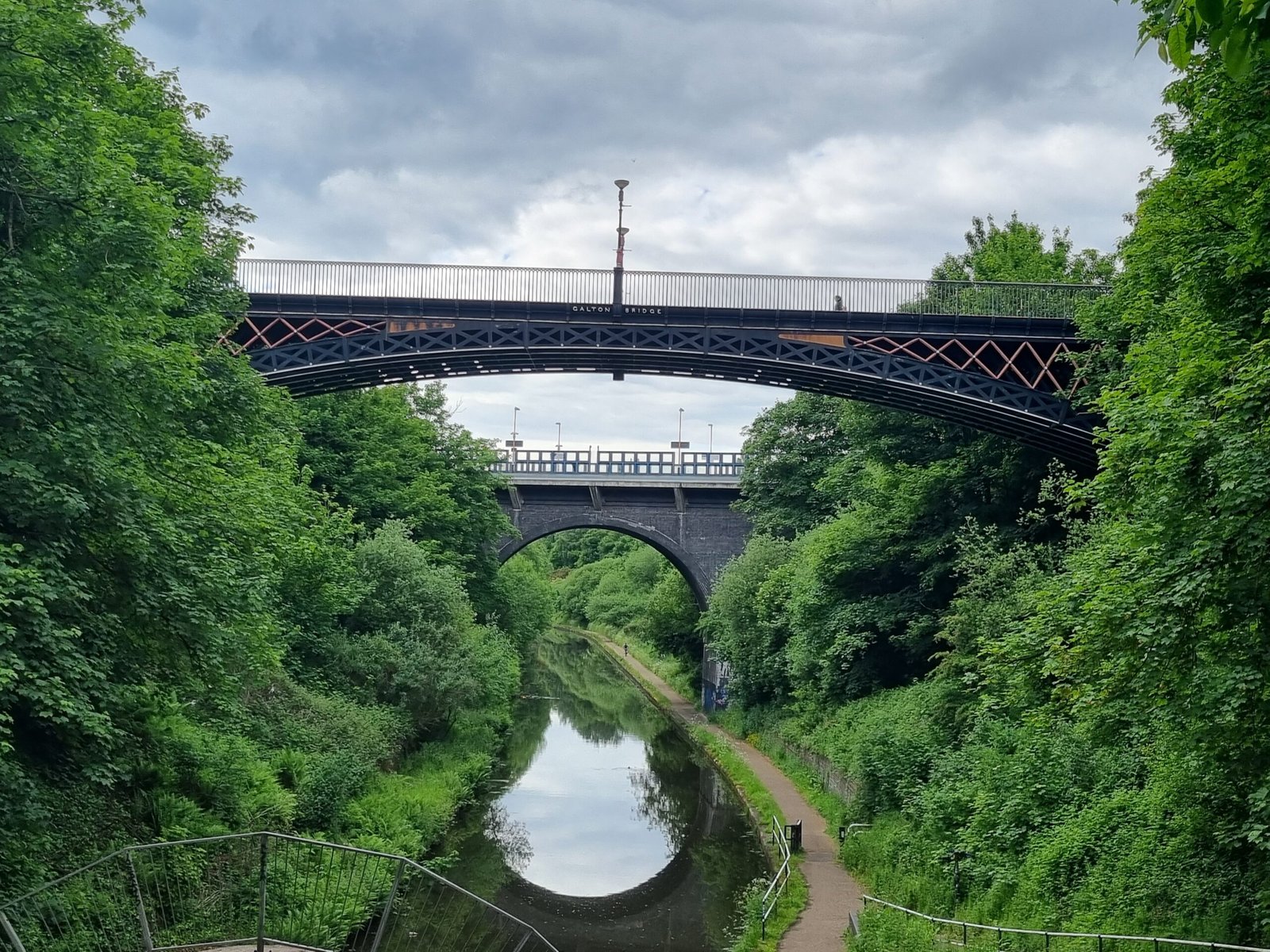
Galton Bridge does not simply cross a canal. It soars above one.
Thomas Telford designed the bridge as part of his ambitious reconstruction of the canal route between Birmingham and Wolverhampton. Its shallow cast iron arch spans the deep Smethwick cutting, carrying pedestrians approximately 21 meters above the water.
When the bridge opened in 1829, its scale was remarkable. It remains one of the most impressive survivors from the transformation of Britain’s canal network during the early nineteenth century.
The short version
A giant iron arch above a canal cutting
Galton Bridge was built in 1829 to carry Roebuck Lane across Thomas Telford’s New Main Line. Its cast iron arch spans approximately 46 meters and stands around 21 meters above the canal. The former road bridge is now used by pedestrians.
Why was Galton Bridge built?
By the beginning of the nineteenth century, the canals around Birmingham and the Black Country were struggling with congestion. The older route engineered by James Brindley followed the landscape closely, producing loops, locks and slow sections that made journeys longer.
Thomas Telford was asked to improve the network. His answer was the Birmingham Canal Navigations New Main Line, a straighter route built through deep cuttings and across large embankments.
According to the Canal & River Trust’s history of the New Main Line, Telford’s route reduced the canal distance between Birmingham and Wolverhampton by around one third. It also used fewer locks and ran approximately six meters below parts of Brindley’s earlier canal.
At Smethwick, the new channel cut deeply through the landscape. Roebuck Lane still needed to cross the valley, so Telford designed an iron bridge capable of clearing the entire cutting in one enormous arch.
How does Galton Bridge span the cutting?
The main arch is formed from cast iron ribs pierced with a repeating lattice pattern. Further lattice bracing fills the spaces between the arch and the bridge deck.
The ironwork rests on large brick abutments with sandstone details. At deck level, cast iron railings lead toward stone end piers decorated with Gothic panels.
The bridge’s name is cast into the ironwork above the center of the arch. The words “Horseley Iron Works 1829” also appear on the structure, recording the West Midlands company that supplied its ironwork.
Look closely
The bridge carries its own signature
Galton Bridge does not hide its origins. Its name appears across the center of the ironwork, while the Horseley Iron Works name and the year 1829 were cast into the structure.
Was Galton Bridge once the highest iron bridge in the world?
The bridge is widely described as a world record structure, although historical sources do not always use identical wording.
Sandwell’s conservation area appraisal describes it as the largest single span iron bridge in the world when it was constructed. Other heritage accounts call it the highest single span arch bridge of its time.
What can be measured is impressive enough. The main arch spans approximately 45.7 meters, while the bridge stands around 21 meters above the canal.
The Smethwick Summit and Galton Valley conservation appraisal calls the bridge one of Telford’s engineering masterpieces and highlights its importance to nineteenth century engineering.
Galton Bridge by the numbers
A bridge built on a dramatic scale
1829
The year Galton Bridge was completed.
45.7 meters
The approximate span of its main cast iron arch.
21 meters
Its approximate height above the canal.
Grade I
The bridge’s national heritage classification.
Why is it called Galton Bridge?
The bridge was named after Samuel Tertius Galton, a member of the Birmingham Canal Navigations committee.
Galton came from a prominent Birmingham family and was associated with the Lunar Society, the influential circle of manufacturers, scientists and thinkers that helped shape the Midlands during the Industrial Revolution.
The name is sometimes mistaken for a reference to Francis Galton, the later Victorian scientist. Samuel Tertius Galton was his grandfather.
Why is a railway span attached to Galton Bridge?
The original Galton Bridge was built in 1829 to cross the canal cutting. The railway had not yet been constructed, so Thomas Telford’s cast iron arch spans only the Birmingham Canal Navigations New Main Line.
During the later nineteenth century, the route was extended southwest across the neighboring railway. A separate rounded brick arch was attached to the original bridge, with stone details, iron railings and lamps continuing the route.
Historic England includes both connected sections within the same Grade I listing for Galton Bridge. They remain distinct structures from different periods: Telford’s cast iron canal bridge from 1829 and the later brick railway span.
Two periods, one listing
The railway arch came later
The famous Galton Bridge is the single cast iron arch over the canal. The adjoining brick railway arch was added later and is included within the same protected listing because the two sections are physically connected.
Does traffic still use Galton Bridge?
No. Galton Bridge was originally a road bridge carrying Roebuck Lane, but it is now restricted to pedestrians.
This change has helped protect the historic ironwork from modern vehicle weights and traffic levels. The bridge can still be crossed on foot, giving visitors a close view of its railings, stone piers and surviving lamps.
Location check
Galton Bridge is not in Birmingham
The bridge crosses the Birmingham Canal Navigations and sits near a railway station bearing its name, but its location is Smethwick in the Metropolitan Borough of Sandwell. Birmingham begins farther east.
Can you visit Galton Bridge?
Yes. Galton Bridge is open to pedestrians and can be viewed from the bridge deck or from the canal towpath below.
The lower viewpoint provides the clearest impression of the arch’s scale. From the towpath, the bridge appears to stretch across the entire cutting with little more than its slender iron latticework between the two sides.
The nearest practical postcode is B66 1HU. Smethwick Galton Bridge railway station is nearby, making this one of the easier major historic bridges in the West Midlands to reach by public transportation.
The canal and railway remain active transport routes. Visitors should follow local signs and check current access information before making a special journey.
Research
Galton Bridge sources and further reading
Explore the official heritage records, canal histories and local research used to investigate Galton Bridge.
-
Official Grade I listing for Galton Bridge
Historic England -
History of Thomas Telford’s New Main Line
Canal & River Trust -
Galton Bridge in the Sandwell Historic Environment Record
Historic England Heritage Gateway and Sandwell Historic Environment Record -
Smethwick Summit and Galton Valley conservation appraisal
Sandwell Council -
Galton Bridge transport heritage record
National Transport Trust -
Archive record covering Galton Bridge and Horseley Iron Works
Dudley Archives
Information checked November 17, 2026.