Bridge profile
Serpentine Bridge, London
Hyde Park and Kensington Gardens, London, England
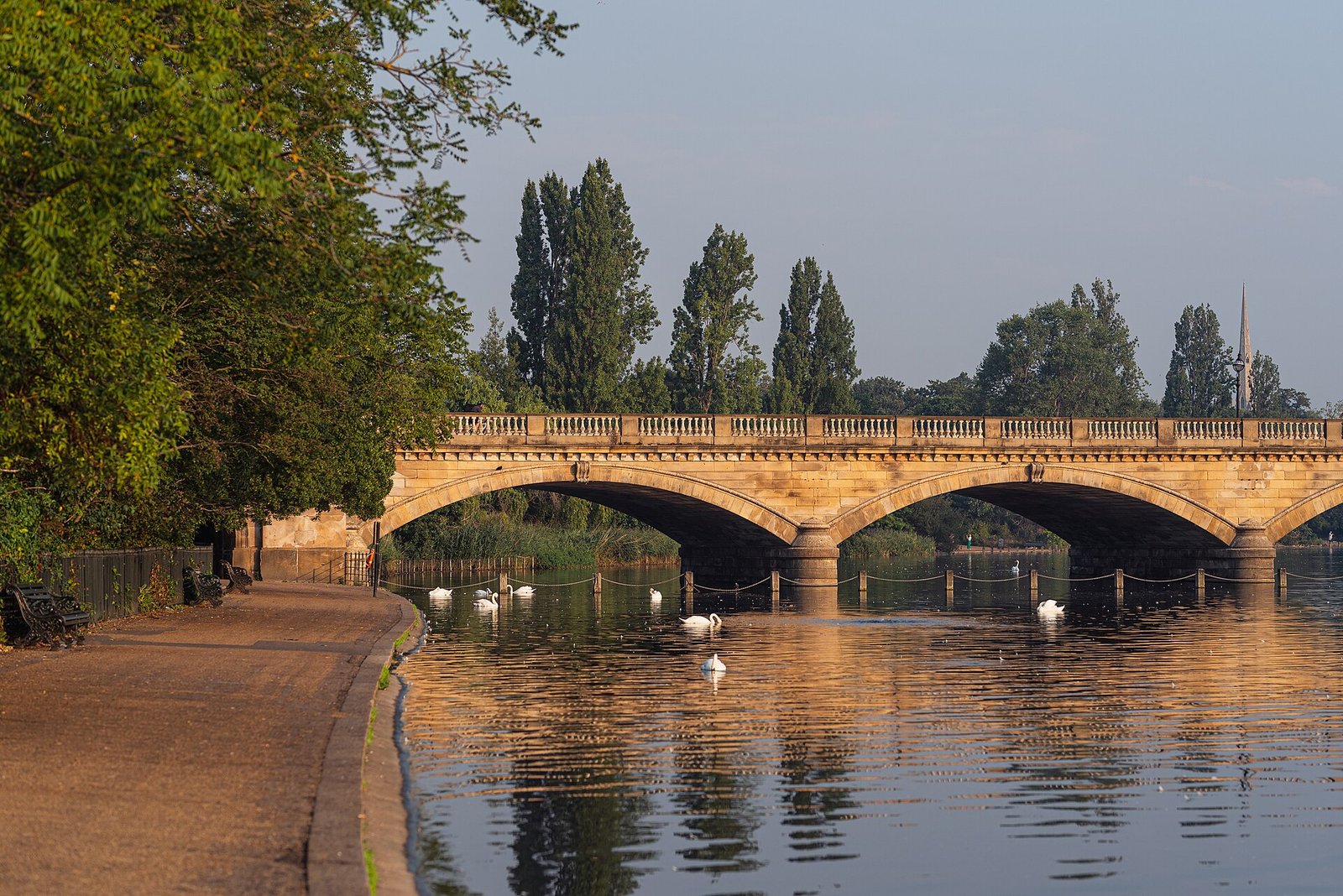
Serpentine Bridge has carried Londoners between Hyde Park and Kensington Gardens since 1826, crossing the water on five elegant Bath stone arches.
At a glance
Key facts
Visit and use
Nearest postcode / ZIP code
Bridge use
Status
Open to traffic
People and construction
Engineer
George Rennie and Sir John Rennie
Builder / main contractor
Jolliffe and Banks
Ownership and maintenance
Owner
The Crown
Maintained by
The Royal Parks
Design and dimensions
Serpentine Bridge does more than carry a road across a lake.
Its five pale stone arches mark the point where Hyde Park meets Kensington Gardens and where the Serpentine becomes Long Water. Cars, cyclists and pedestrians pass over the bridge, while walkers can slip through separate openings underneath it.
The crossing has occupied this important position since 1826, making it one of the most visible surviving works of the Rennie engineering family in London.
The short version
One bridge between two famous parks
Serpentine Bridge is a five arch Bath stone crossing built in the 1820s by George and John Rennie. It carries West Carriage Drive between Hyde Park and Kensington Gardens while separating the Serpentine from Long Water.
Where is Serpentine Bridge?
Serpentine Bridge crosses the connected lake system at the boundary between Hyde Park and Kensington Gardens.
Hyde Park lies to the east of the bridge, while Kensington Gardens lies to the west. West Carriage Drive runs across the top and forms the modern dividing line between the two Royal Parks.
The bridge is close to the Italian Gardens, the Peter Pan statue, the Serpentine Gallery and the Diana, Princess of Wales Memorial Fountain.
Are the Serpentine and Long Water the same lake?
They are two named sections of the same connected body of water.
Long Water runs through Kensington Gardens on the western side of the bridge. Once the water passes beneath Serpentine Bridge into Hyde Park, it becomes the Serpentine.
The distinction is historical rather than physical. Before the present bridge was built, a small cascade separated the two sections.
George Rennie brought the water to the same level in 1828, creating the continuous lake visitors see today.
The bridge in numbers
A carefully composed stone crossing
1826
Year completed
5
Segmental water arches
2
Pedestrian openings
1970
Year Grade II listed
Why was Serpentine Bridge built?
A crossing had existed near this point before the present bridge, but the Royal Parks were being reshaped during the early nineteenth century.
The new bridge formed part of a wider road circuit around Hyde Park and provided a more formal connection across the water. Construction began around 1825 and the bridge was completed in 1826, although associated work on the lake continued until 1828.
The crossing was commissioned by the Office of Woods and Forests, the government body responsible for managing Crown lands and royal parks.
The Royal Parks management plan for Hyde Park records the Rennie brothers, the construction period and the contractors responsible for the bridge.
Who designed Serpentine Bridge?
Serpentine Bridge was designed by civil engineers George Rennie and Sir John Rennie.
They were the sons of John Rennie, one of Britain’s most important bridge and canal engineers. After their father died in 1821, the brothers continued several projects connected with his practice.
Sir John Rennie also supervised the completion of New London Bridge, the nineteenth century crossing that was later dismantled and reconstructed in Arizona. You can follow that unusual journey in our London Bridge, Arizona profile.
Jolliffe and Banks constructed Serpentine Bridge. The company worked on several major Rennie projects, including London Bridge, Waterloo Bridge and Southwark Bridge.
How was Serpentine Bridge designed?
The bridge is built from Bath stone, a warm colored limestone used for many important British buildings.
Five shallow segmental arches carry the road across the water. Their low curves allow the bridge to sit comfortably in the park landscape without resembling a heavy urban viaduct.
Semicircular cutwaters project from the piers and help direct water around the structure. Above the arches, rusticated stonework, decorative keystones, a projecting cornice and a balustraded parapet give the bridge its formal appearance.
The Historic England record for Serpentine Bridge describes these architectural details and confirms its Grade II status.
Easy to miss
You can walk underneath the bridge
Alongside its five water arches, Serpentine Bridge contains two semicircular openings for pedestrians. These allow park visitors to continue beside the lake without crossing the road above.
Why does a busy road cross the bridge?
West Carriage Drive did not always operate as the major road seen today.
The route was extended south across Serpentine Bridge during preparations for the International Exhibition of 1862. The change was controversial because it placed a substantial road between Hyde Park and Kensington Gardens.
The road connection was intended to be temporary, but it quickly became a useful London route and remained in place after the exhibition ended.
That decision transformed Serpentine Bridge from a picturesque park crossing into a working piece of the city’s road network.
Who can use Serpentine Bridge today?
Serpentine Bridge carries cars, pedestrians and cyclists.
Pedestrians can cross using the pavements beside the road or pass through the dedicated openings below. A marked cycle route also crosses the bridge, although the cycling space around the bridge is not physically protected from vehicles.
Despite the traffic, the bridge remains one of the best viewpoints across both sections of the lake.
What happened to Serpentine Bridge during its recent restoration?
A vehicle collision damaged part of the historic stone parapet, requiring specialist repairs.
The Royal Parks commissioned a restoration using carefully matched stone and traditional conservation methods. Replacement sections were produced away from the bridge before being installed, while further work was completed beneath the arches.
The restoration was completed in 2026 and preserved the bridge’s historic appearance.
The official Serpentine Bridge restoration contract notice records the repair project and its connection with the earlier vehicle impact damage.
Is Serpentine Bridge a listed structure?
Serpentine Bridge has been Grade II listed since January 14, 1970.
Its protected features include the five segmental arches, two pedestrian openings, cutwaters, decorative stonework, cornice and balustraded parapet.
The listing recognizes the bridge as both an important work by the Rennie family and a significant part of the historic Royal Parks landscape.
Can you visit Serpentine Bridge?
Yes. The bridge is part of the public road and path network through Hyde Park and Kensington Gardens.
No ticket is required. The nearest practical postcode is W2 2UH.
The clearest views are available from the paths beside the Serpentine and Long Water. Walking underneath also provides a closer look at the stone arches and the separate pedestrian openings.
For a very different bridge across a royal park lake, explore our Blue Bridge in St James’s Park profile.
Research
Serpentine Bridge sources and further reading
Explore the official heritage records, park histories and restoration documents used to research this bridge profile.
-
Official heritage listing for Serpentine Bridge
Historic England -
Hyde Park management plan and bridge history
The Royal Parks -
Kensington Gardens historic landscape record
Historic England -
Hyde Park historic landscape record
Historic England -
Historic photograph of Serpentine Bridge
Historic England Archive -
Serpentine Bridge restoration works
The Royal Parks and Find a Tender
Information checked November 16, 2026.