Bridge profile
Macclesfield Bridge, London
Regent’s Park, London, England
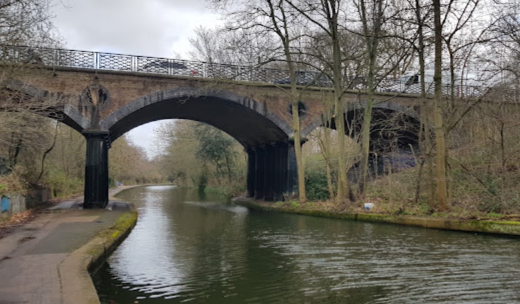
Macclesfield Bridge crosses Regent’s Canal on cast iron columns that survived the 1874 explosion which gave it the nickname Blow Up Bridge.
At a glance
Key facts
Visit and use
History
Alternative names
Blow Up Bridge, North Gate Bridge
People and construction
Engineer
James Morgan
Ownership and maintenance
Owner
The Crown
Maintained by
The Royal Parks
Design and dimensions
Macclesfield Bridge looks far too composed for a structure that was once blown apart.
Today, cars and pedestrians cross quietly into Regent’s Park while boats pass along Regent’s Canal below. Its brick arches, decorative railings and cast iron columns feel like a peaceful part of the park landscape.
That calm appearance hides one of the most dramatic bridge stories in London. In 1874, a barge carrying around five tons of gunpowder exploded directly underneath it.
The short version
The London bridge that survived an explosion
Macclesfield Bridge was destroyed by a gunpowder barge explosion in 1874. It was reconstructed in 1876 using surviving cast iron columns from the original bridge, giving London an unusual mixture of Regency engineering and Victorian rebuilding.
What is Macclesfield Bridge?
Macclesfield Bridge is a road and pedestrian bridge crossing Regent’s Canal at the northwestern edge of Regent’s Park.
It carries the road between Avenue Road, Prince Albert Road and the Outer Circle, forming one of the northern entrances into the park.
The original bridge was constructed in 1815 and 1816 during the development of Regent’s Canal. The canal was an important commercial route, carrying fuel, building materials, food and industrial cargo through London.
The bridge was designed by James Morgan, engineer to the Regent’s Canal Company and an assistant to architect John Nash.
Why is Macclesfield Bridge called the Blow Up Bridge?
Shortly before 5 a.m. on October 2, 1874, a group of cargo boats was being pulled westward along Regent’s Canal by a steam tug.
One of those boats was the Tilbury. Its mixed cargo included sugar, coffee, nuts, petroleum and approximately five tons of gunpowder intended for industrial blasting.
As the boat passed beneath Macclesfield Bridge, its cargo caught fire and exploded.
The blast destroyed the Tilbury, demolished the bridge and sent debris across the surrounding area. Four people aboard the boat, three men and one boy, were killed.
A contemporary Illustrated London News account of the Regent’s Canal explosion describes the cargo, the destruction and the search for those aboard.
October 2, 1874
The explosion in numbers
5 tons
Approximate gunpowder cargo
4
People aboard who were killed
1816
Original bridge completed
1876
Replacement bridge completed
What caused the Macclesfield Bridge explosion?
The precise cause was never conclusively established.
The Tilbury was carrying petroleum alongside gunpowder and ordinary cargo. Contemporary reports suggested that fire was noticed shortly before the explosion, but they could not determine exactly how it began.
Later retellings sometimes blame a match or an oil lamp. These explanations are possible, but the surviving evidence does not prove either one.
What is certain is that storing petroleum and gunpowder together created an exceptionally dangerous cargo.
Did the explosion change the law?
The disaster exposed the risks of transporting explosives through populated areas using ordinary commercial boats.
It was not the only reason regulations changed, but the accident became a powerful example of why the manufacture, storage and transportation of explosives required tighter control.
Parliament passed the Explosives Act 1875 the following year. The legislation introduced wider rules covering the manufacture, storage, sale and carriage of gunpowder and other explosive substances.
How was Macclesfield Bridge rebuilt?
The canal returned to use within days, but replacing the bridge took considerably longer.
A reconstructed Macclesfield Bridge opened in 1876. The replacement followed the character of the earlier bridge and reused cast iron columns that had survived the explosion.
This means part of the bridge visible today dates from the original construction in 1815 and 1816, while much of the brick structure belongs to the Victorian reconstruction.
Look closely
The rope marks are facing the wrong way
Before powered boats became common, horses pulled canal boats using long tow ropes. Those ropes cut grooves into the bridge columns. Some surviving columns were installed in reverse during reconstruction, leaving the historical rope marks on unexpected sides.
The Canal & River Trust history of unusual bridge names explains how the reused columns and their tow rope grooves became part of the Blow Up Bridge story.
What type of bridge is Macclesfield Bridge?
Macclesfield Bridge is an arch bridge with three shallow segmental brick arches.
The arches are supported by two rows of five cast iron columns. These columns were produced by the Coalbrookdale Company, a famous Shropshire ironworks closely connected with the development of cast iron construction.
The columns resemble the Greek Doric order, giving the underside of the bridge the appearance of a small classical structure rather than an ordinary canal crossing.
Above them, the flat road deck is edged with stone coping and cast iron lattice railings. Decorative lamp standards stand at the ends of the bridge.
The Historic England listing for Macclesfield Bridge records its brick arches, Coalbrookdale columns, railings and surviving historic fabric.
Who designed Macclesfield Bridge?
James Morgan designed the original bridge while serving as engineer to the Regent’s Canal Company.
Morgan also worked with John Nash, whose wider plans transformed Regent’s Park and surrounding parts of London during the early nineteenth century.
The bridge was originally known as North Gate Bridge. It was renamed in honor of the Earl of Macclesfield, who became chairman of the Regent’s Canal Company and helped it through a serious financial crisis.
What happened at London Zoo during the explosion?
The blast was powerful enough to alarm people across nearby districts and damage buildings around the canal.
It also caused considerable panic at London Zoo.
A contemporary report described giraffes, elephants, antelopes and a rhinoceros becoming highly agitated. Damage to an aviary allowed around a dozen small birds to escape.
The larger animals remained safely inside, but London had briefly experienced the alarming combination of a destroyed bridge, burning wreckage and frightened zoo animals before most residents had eaten breakfast.
Is Macclesfield Bridge a listed structure?
Macclesfield Bridge has been protected as a Grade II listed structure since February 5, 1970.
The listing recognizes both its architectural design and its unusual history. It also includes the north gate associated with the bridge.
Its surviving Coalbrookdale columns are particularly important because they connect the bridge visible today with the first years of Regent’s Canal.
Can you cross Macclesfield Bridge?
Yes. Macclesfield Bridge remains a working public road and pedestrian crossing into Regent’s Park.
The bridge can be crossed at street level, while the canal towpath provides the best view of its arches and cast iron columns from below.
The nearest practical postcode is NW8 7PU. No ticket is required to see or cross the bridge.
Visitors interested in nearby crossings can continue exploring our collection of Central London bridges.
Research
Macclesfield Bridge sources and further reading
Explore the heritage records, contemporary reports and canal histories used to research this bridge profile.
-
Official heritage listing for Macclesfield Bridge
Historic England -
The story behind the Blow Up Bridge name
Canal & River Trust -
Historic photograph of the 1874 explosion aftermath
Historic England Archive -
Contemporary report of the Regent’s Canal explosion
Illustrated London News via The Victorian Web -
Historic view of Macclesfield Bridge before the explosion
London Museum -
The Regent’s Park and Primrose Hill management plan
Westminster City Council and The Royal Parks
Information checked November 16, 2026.