Bridge profile
Bridge of Aspiration, London
Covent Garden, London, England
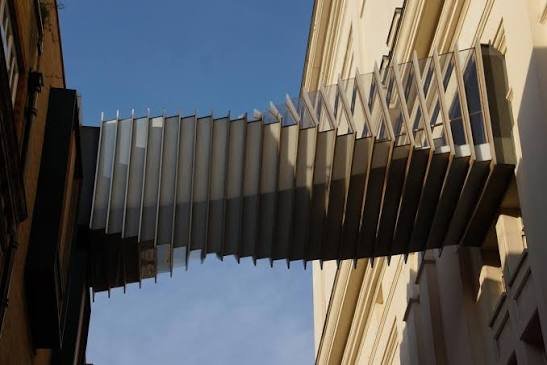
Twisting above Floral Street, the Bridge of Aspiration gives Royal Ballet School students a private route into the Royal Opera House.
At a glance
Key facts
Visit and use
History
Alternative names
Floral Street Bridge
People and construction
Architect / designer
WilkinsonEyre
Engineer
Flint & Neill Partnership
Builder / main contractor
Benson Limited, with GIG Fassadenbau GmbH as bridge subcontractor
Design and dimensions
The Bridge of Aspiration looks as though somebody pressed pause halfway through a dance.
Its glazed body twists above Floral Street in Covent Garden, connecting the Royal Ballet School with the Royal Opera House. The bridge provides students with a private route from their classrooms and rehearsal spaces toward one of the world’s best known performance venues.
The twist may look playful, but it was created to solve a stubborn architectural problem. The two buildings face each other at different angles and their landing points do not line up neatly.
The short version
A bridge that dances without moving
The Bridge of Aspiration is a fixed pedestrian bridge. Its 23 square frames gradually rotate through 90 degrees, creating the appearance of a bridge performing a quarter turn above the street.
What is the Bridge of Aspiration?
The Bridge of Aspiration is an enclosed pedestrian bridge spanning Floral Street in Covent Garden. It links the Upper School of the Royal Ballet School with the neighboring Royal Opera House.
The crossing allows dancers to move between the school and the performance building without returning to street level. The route is particularly symbolic for students training for professional careers.
The bridge is not a public walkway. Visitors can see it clearly from Floral Street, but access is normally restricted to the school and opera house.
The Royal Ballet School’s account of the Bridge of Aspiration describes it as a direct connection between the school and the Grade I listed Royal Opera House.
Why does the Bridge of Aspiration twist?
The twisting shape is partly inspired by the movement and grace of ballet, but it is not decoration added to an ordinary bridge.
The landing points inside the two buildings are positioned at different levels and on a skewed alignment. A conventional rectangular corridor would have met the buildings at awkward angles.
WilkinsonEyre solved the problem by arranging 23 square portals along the crossing. Each frame rotates by approximately four degrees compared with the one before it. Together, they complete a quarter turn across the bridge.
An aluminum spine beam supports the frames and the walkway. The result disguises the awkward alignment so successfully that the bridge appears to be choosing its twisting route rather than being forced into it.
The official WilkinsonEyre project history explains how the bridge’s unusual geometry grew directly from the position of the two buildings.
The bridge in numbers
One short crossing with plenty going on
23
Square portal frames
90°
Total rotation
9.5 m
Approximate span
2003
Year completed
How was the Bridge of Aspiration built?
Although its outer form appears complicated, the main spanning structure is relatively simple. It is supported by a lightweight aluminum box beam running between the buildings.
The bridge envelope combines aluminum, glass and timber. Some of the glazing is opaque, giving the dancers privacy while allowing daylight into the crossing. From the street, people moving inside can appear as passing shadows.
Fabrication required far more precision than the bridge’s modest size might suggest. The structural beam, glass sections and composite portal frames were manufactured in Austria before being transported to an assembly site in West London.
The completed bridge was then taken into Covent Garden and lifted into position. Installation above the busy street reportedly took less than two hours.
That is a considerable amount of international planning for a bridge short enough to cross in a few seconds.
Who designed the Bridge of Aspiration?
The bridge was designed by architectural practice WilkinsonEyre, with structural engineering by Flint & Neill Partnership.
The Royal Ballet School commissioned the crossing as part of the development of its Upper School building at 46 Floral Street. Benson Limited served as the general contractor, while GIG Fassadenbau GmbH worked on the specialist bridge structure.
Queen Elizabeth II attended the official opening of the Upper School on March 27, 2003 and crossed the completed bridge during the visit.
The bridge received several awards after completion, including a RIBA Award, a Civic Trust Award and a special award from the British Construction Industry Awards. In 2024 it received an Architecture Today Test of Time Award, recognizing that its design remained useful and distinctive more than two decades after completion.
The Architecture Today review of the Bridge of Aspiration includes reflections on its design, construction and continued use.
Why is it called the Bridge of Aspiration?
The name reflects the journey made by the students who cross it.
On one side is the school where young dancers train. On the other is the Royal Opera House, where many hope eventually to perform professionally.
The bridge therefore connects more than two buildings. It represents the route from student to performer, even if the real journey takes considerably longer than 9.5 meters.
A private London bridge
Can the public cross the Bridge of Aspiration?
Normally, no. The bridge is an internal connection used by the Royal Ballet School and Royal Opera House. It can be viewed from Floral Street, where its twisting shape is visible between the surrounding buildings.
How is the Bridge of Aspiration illuminated?
Lighting specialists Speirs Major designed a subtle system that follows the rotating frames without turning the bridge into a glowing advertisement above the street.
The design uses 57 custom LED luminaires integrated into the corners of the aluminum frames. When switched off, the fittings are barely noticeable. When illuminated, they trace selected parts of the twist and create a soft glow inside the crossing.
The lighting was deliberately kept understated. The aim was to reveal the movement of the structure while respecting the historic Covent Garden surroundings.
The Speirs Major lighting study explains how the LEDs, glazing and moving silhouettes were brought together.
Is the Bridge of Aspiration a listed structure?
The Royal Opera House is a Grade I listed building, but the Bridge of Aspiration is not included as part of that listing.
Historic England records that the high level bridge was added in 2003 to connect the opera house with the Royal Ballet School studios on Floral Street.
The bridge still had to respond sensitively to its historic surroundings. Its light structure and glazed surfaces allow it to stand out without attempting to imitate the older buildings around it.
You can read the official context in the Historic England record for the Royal Opera House.
Where can you see the Bridge of Aspiration?
The bridge crosses Floral Street in Covent Garden, close to the rear of the Royal Opera House. The nearest practical postcode is WC2E 9DA.
Because the surrounding street is narrow, it is easy to walk underneath without noticing what is above. Look upward between the buildings near the Royal Ballet School entrance and the rotating frames become unmistakable.
The best public views are from street level. Access inside the bridge is normally restricted, although occasional official tours and events may offer a closer look. Availability should always be checked directly with the Royal Ballet and Opera or the Royal Ballet School.
Does the Bridge of Aspiration move?
No. Despite its appearance, the twist is fixed into the bridge’s structure.
This makes it very different from Paddington’s Rolling Bridge, which curls into a compact shape, or the nearby Fan Bridge, whose sections rise above the canal.
The Bridge of Aspiration creates the impression of movement without needing machinery. Its carefully rotated frames perform the dance while the walkway remains still.
Research
Bridge of Aspiration sources and further reading
Explore the architectural records, official histories and specialist sources used to research this bridge profile.
-
Bridge of Aspiration project history
WilkinsonEyre -
The Bridge of Aspiration
The Royal Ballet School -
Bridge of Aspiration Test of Time review
Architecture Today -
Lighting the Bridge of Aspiration
Speirs Major -
Royal Opera House heritage record
Historic England
Information checked November 16, 2026.