Bridge profile
Blue Bridge, St James’s Park, London
St James’s Park, Westminster, London, England
Blue Bridge crosses the lake in St James’s Park, offering famous views of Buckingham Palace and a surprising story of concrete, crowds and change.
At a glance
Key facts
Location
St James’s Park, Westminster, London, England
First opened
1957
Crosses
St James’s Park LakeLakes
Bridge type
Visit and use
History
Alternative names
St James’s Park Footbridge, St James’s Park Bridge
People and construction
Architect / designer
Eric Bedford
Engineer
Francis Walley, Structural Engineering Branch of the Ministry of Works
Builder / main contractor
Higgs and Hill Ltd.
Ownership and maintenance
Owner
The Crown
Maintained by
The Royal Parks
Design and dimensions
Main materials
Total length
42 meters / 138 feet
Main span
21 meters / 69 feet
Number of spans
3
The Blue Bridge may not dominate the London skyline, but it occupies one of the capital’s finest viewing positions. From its low concrete deck, Buckingham Palace appears at one end of the lake while Horse Guards, Big Ben and the London Eye gather at the other.
Built in 1957, this is the third bridge to cross the lake in St James’s Park. Its restrained concrete structure may look simple, but its history includes a burning pagoda, an anonymous donation and a team working through the night to complete one continuous concrete pour.
The short version
London’s quietest grandstand
Blue Bridge is a pedestrian bridge across St James’s Park Lake. Its practical purpose is to shorten the walk across the park, but its famous views have turned it into something closer to a viewing platform in the heart of ceremonial London.
What is the Blue Bridge in St James’s Park?
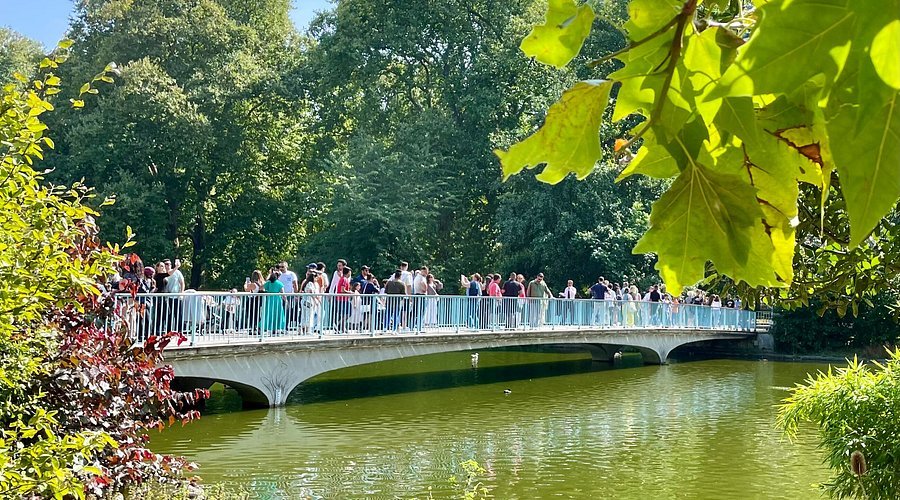
Blue Bridge crosses the narrow center of St James’s Park Lake, connecting the paths between The Mall and Birdcage Walk. It is exclusively for pedestrians and forms one of the busiest walking routes through the park.
The bridge measures approximately 42 meters from end to end. It has three spans, with a central span of about 21 meters crossing the widest part of the water.
Its gentle curve can make it look like a shallow arch bridge. Structurally, however, it is a slender beam bridge made from prestressed concrete. Hidden steel helps keep the concrete compressed, allowing the deck to remain comparatively thin without requiring a bulky structure beneath it.
Why is it called the Blue Bridge?
The name comes from the pale blue railings running along both sides of the crossing. The concrete itself was designed to appear light and unobtrusive, allowing the bridge to sit quietly within the surrounding park landscape.
That restrained appearance is part of its appeal. The bridge does not compete with Buckingham Palace or the historic buildings around Whitehall. Instead, it provides a clear place from which to see them.
The Royal Parks guide to the lake and Blue Bridge highlights the views toward Buckingham Palace, Horse Guards Parade, Big Ben and the London Eye.
What bridges stood here before Blue Bridge?
The current crossing is the third bridge built at this part of the lake.
The first was designed by John Nash and built in 1814. It was an ornamental wooden bridge with a tall pagoda at its center. The pagoda caught fire during celebrations, and the surviving bridge lasted only until 1825.
An iron suspension bridge followed in 1857. It remained in place for a century and became a familiar part of the park, but by the 1950s it required expensive repairs and additional support when large crowds were expected.
The Royal Parks eventually replaced it with the concrete bridge visitors cross today.
Four important dates
Three bridges and a new chapter
1814
John Nash’s ornamental wooden bridge is built across the lake.
1857
An iron suspension bridge replaces the earlier crossing.
1957
The present prestressed concrete bridge opens to pedestrians.
2026
Final plans for a new memorial bridge receive approval.
How was the current Blue Bridge built?
The old suspension bridge needed substantial repairs, but an anonymous donor had left £23,000 specifically for a replacement. The terms of the donation meant that the money could not simply be spent repairing the existing crossing.
Temporary dams were built on either side of the construction area and around 200,000 gallons of water were pumped away. A temporary scaffold bridge allowed people to continue crossing the lake while the new structure took shape.
During the night of June 6 and 7, 1957, a team of around 30 workers poured the concrete into its wooden framework. The work had to be completed continuously to prevent weak seams from forming between separate batches.
Did you know?
One bridge, one uninterrupted night
The construction team worked through the night under arc lights so the concrete could be poured in one continuous operation. The workers were reportedly given the previous day off to prepare for the task.
The bridge was designed by architect Eric Bedford, who later became best known for his work on the Post Office Tower, now called the BT Tower. Structural engineer Francis Walley helped turn the elegant architectural shape into an unusually slender concrete crossing.
Why are the views from Blue Bridge so famous?
The bridge stands near the center of the lake, with the water and surrounding trees creating long framed views in both directions.
Look west and Buckingham Palace appears beyond the lake and the Victoria Memorial. Look east and the skyline includes Horse Guards, the towers around Whitehall, Big Ben and the London Eye.
The bridge is therefore more than a shortcut. Visitors regularly stop in the middle to take photographs, watch the park’s waterfowl or simply work out how many London landmarks can fit into a single view.
For another nearby crossing with a completely different appearance and purpose, explore our Westminster Bridge, London profile.
Is Blue Bridge going to be replaced?
Yes. The approved plans for the Queen Elizabeth II Memorial include removing the current bridge and constructing a new crossing in its place.
The proposed replacement will have a stainless steel structure and cast glass balustrades inspired by Queen Mary’s Fringe Tiara, which Queen Elizabeth II wore on her wedding day. The wider memorial will also include statues, gardens and redesigned approaches through St James’s Park.
The current bridge remains an active pedestrian crossing while preparations continue. Historic England has recorded a Certificate of Immunity from listing for the structure, running from January 2025 until January 2030.
Further details can be found in the final recommendations for the Queen Elizabeth II Memorial.
Can you visit Blue Bridge?
Blue Bridge is free to cross and forms part of the public walking routes through St James’s Park. The nearest practical access point is within the SW1A 2BJ postcode area.
The bridge is intended for pedestrians and does not have a dedicated cycling lane. Visitors often pause on the bridge, so it can become crowded during ceremonies, major events and the busiest sightseeing periods.
Park access times and temporary restrictions can change during ceremonial events. Check the official St James’s Park visitor information before making a special journey.
Research
Blue Bridge sources and further reading
Explore the official park records, engineering histories and current planning documents used to research this bridge profile.
-
The lake and the Blue Bridge
The Royal Parks -
St James’s Park and Green Park management plan
The Royal Parks -
Historic England record for St James’s Park Footbridge
Historic England -
The construction of the Blue Bridge
The Royal Parks Guild -
Francis Walley’s engineering career and government work
The Institution of Structural Engineers -
Structural history of St James’s Park Footbridge
The Happy Pontist -
Final recommendations for the Queen Elizabeth II Memorial
UK Government
Information checked November 9, 2026.