Bridge profile
Blackfriars Railway Bridge, London
Blackfriars, Central London, England
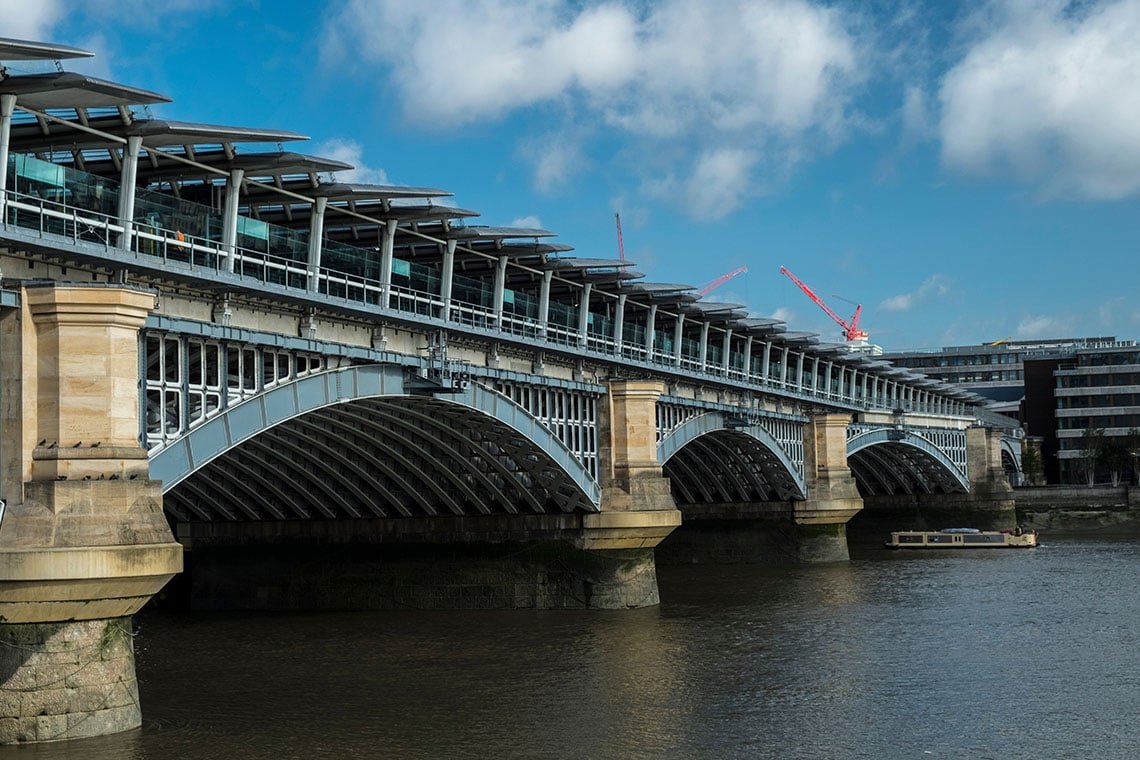
Blackfriars Railway Bridge carries trains and an entire station across the Thames, combining five Victorian iron arches with a modern roof covered by 4,400 solar panels.
At a glance
Key facts
Location
First opened
May 10, 1886
Crosses
Bridge type
Visit and use
History
Alternative names
St Paul’s Railway Bridge
People and construction
Architect / designer
William Mills, John Wolfe Barry and Henry Marc Brunel
Engineer
Edward Cruttwell
Builder / main contractor
Lucas and Aird
Ownership and maintenance
Owner
Network Rail
Maintained by
Network Rail
Design and dimensions
Main materials
Total length
Approximately 933 ft (284 m)
Main span
Approximately 185 ft (56.4 m)
Number of spans
5
Blackfriars Railway Bridge can be surprisingly easy to overlook. Much of the Victorian crossing is hidden beneath Blackfriars Station, a long glass roof and thousands of solar panels. Trains appear to glide through a building stretched directly across the River Thames.
Beneath that modern station are five wrought-iron arches dating from 1886. Beside them stand rows of bright red columns from an even older railway bridge, creating one of the most unusual groups of structures on the London riverfront.
The short version
A Victorian bridge carrying a twenty-first-century station
Blackfriars Railway Bridge opened in 1886 as St Paul’s Railway Bridge. It now carries Blackfriars Station across the Thames beneath a roof containing 4,400 solar panels.
Which Blackfriars Railway Bridge is still standing?
There have been two Blackfriars railway bridges, and parts of both can still be seen.
The first opened in 1864 for the London, Chatham and Dover Railway. Designed by Joseph Cubitt, it carried four tracks across five wrought-iron lattice-girder spans. Its most recognizable remains are the red columns standing in the Thames immediately upstream of the current railway bridge.
The operational bridge is the second crossing. It was constructed downstream of the first bridge and opened on May 10, 1886. It was originally called St Paul’s Railway Bridge because it served the new St Paul’s Station on the north bank.
St Paul’s Station was renamed Blackfriars in 1937, and the bridge gradually became known as Blackfriars Railway Bridge.
Why was a second railway bridge built at Blackfriars?
Rail travel into the City of London grew rapidly after the first bridge opened. The original four-track crossing could no longer provide enough capacity for the expanding railway and its increasingly busy collection of nearby stations.
Authority to construct another bridge was obtained in 1881. The new crossing was built beside the original rather than replacing it, allowing the railway to add more tracks while continuing to operate across the river.
The bridge was designed to match the span arrangement of its neighbors. Keeping the piers aligned reduced additional obstruction in the Thames and helped preserve workable navigation channels for river traffic.
Who designed Blackfriars Railway Bridge?
The engineering team included William Mills of the London, Chatham and Dover Railway, John Wolfe Barry and Henry Marc Brunel. Brunel was the younger son of Isambard Kingdom Brunel, while Wolfe Barry later became closely associated with the construction of Tower Bridge.
Edward Cruttwell served as resident engineer, overseeing construction beside a working railway and one of London’s busiest waterways. Lucas and Aird carried out the building work.
The completed bridge used five riveted wrought-iron arches with cast-iron spandrels. These rested on stone-faced brick piers positioned to correspond with the earlier railway bridge and the neighboring road crossing.
Did you know?
The bridge began with a different name
The 1886 crossing was originally St Paul’s Railway Bridge. It adopted the Blackfriars identity after St Paul’s Station was renamed Blackfriars in 1937.
What are the red columns beside Blackfriars Railway Bridge?
The red columns belong to the first railway bridge of 1864. They are not unfinished parts of the current crossing and they do not support the modern station.
The older bridge gradually became unsuitable for heavier modern trains. Its tracks were taken out of use and the iron superstructure was removed in 1985, but the river piers and parts of its abutments survived.
The southern abutment is protected as a Grade II listed structure. It retains restored cast-iron decoration carrying the insignia of the London, Chatham and Dover Railway. The Historic England listing for the former railway bridge abutment records its surviving stonework and railway emblems.
Six important dates
Blackfriars Railway Bridge timeline
1864
The first Blackfriars railway bridge opens.
1886
The present bridge opens as St Paul’s Railway Bridge.
1937
St Paul’s Station is renamed Blackfriars.
1985
The superstructure of the older railway bridge is removed.
2012
The rebuilt river-spanning station becomes fully operational.
2014
The completed solar roof is formally launched.
How did Blackfriars Station come to span the Thames?
Blackfriars Station was extensively rebuilt between 2009 and 2012 as part of the Thameslink upgrade. The railway bridge was strengthened and partially reconstructed to support longer platforms, a wider station and a new roof stretching across the river.
The project created station entrances on both banks of the Thames. The original entrance serves the City of London on the north side, while the newer Bankside entrance provides direct access to the South Bank, Tate Modern and Shakespeare’s Globe.
Blackfriars is the only London railway station with platforms spanning the Thames and entrances on opposite sides of the river. Much of the station therefore sits directly above flowing water rather than ordinary ground.
Solar-powered crossing
More than 4,400 panels above the Thames
The station roof contains approximately 6,000 square meters of photovoltaic panels. Network Rail says the installation can generate about 900,000 kilowatt-hours each year and provide up to half of the station’s energy.
Why is Blackfriars known as the solar bridge?
The roof added during the station reconstruction contains 4,400 photovoltaic panels. Network Rail describes it as the world’s largest solar bridge, with a generating capacity of approximately 1.1 megawatts.
The panels were designed to provide up to half of the station’s energy requirements. They also transformed the appearance of the crossing. From most riverside viewpoints, the long dark roof is now more immediately visible than the Victorian iron arches supporting it.
The Network Rail account of the Blackfriars solar bridge explains the scale and expected energy production of the installation.
Can you walk across Blackfriars Railway Bridge?
Blackfriars Railway Bridge is not an unrestricted public footbridge. Its pedestrian space forms part of Blackfriars Station rather than an open path beside the railway tracks.
People using Blackfriars Station or connecting with the Underground can travel between its north-bank and south-bank entrances. Access is controlled through the station, so visitors wanting a straightforward riverside crossing should use the neighboring Blackfriars road bridge.
The station is listed as step-free, with lifts connecting its entrances and platforms. Lift availability can change, so anyone relying on step-free access should check the current Blackfriars Station accessibility information before traveling.
Where can you see Blackfriars Railway Bridge?
One of the clearest views is from the pedestrian path on Blackfriars Bridge. From there, the modern station roof, Victorian arches and red columns of the earlier railway bridge can be seen together.
The Thames Path passes beneath the southern end of the railway crossing. This provides a closer look at the bridge structure and the Bankside station entrance. Continuing east along the river leads toward the Millennium Bridge.
River services and sightseeing boats provide the best view of the complete five-span structure. From water level, it becomes much easier to separate the current bridge from the remains of its predecessor.
Is Blackfriars Railway Bridge the same as Blackfriars Bridge?
No. They are neighboring but separate crossings.
Blackfriars Bridge is the red, white and gold road bridge carrying vehicles, pedestrians and cyclists. Blackfriars Railway Bridge stands immediately downstream and carries railway tracks, station platforms and the solar-panel roof.
The surviving red columns between them belong to the demolished 1864 railway bridge, meaning three generations of Blackfriars crossings can be seen within a very small stretch of the Thames.
Research
Blackfriars Railway Bridge sources and further reading
Explore the railway records, heritage information and official sources used to research this bridge profile.
-
Blackfriars and the world’s largest solar bridge
Network Rail -
The reconstruction of Blackfriars Station
Network Rail -
History of the Blackfriars railway bridges
National Transport Trust -
Southern abutment of the former railway bridge
Historic England -
Blackfriars Station information and accessibility
National Rail -
Ten facts about the rebuilt Blackfriars Station
Govia Thameslink Railway -
Mariner’s guide to Blackfriars Railway Bridge
Port of London Authority
Information checked October 18, 2026.